
💊 Non Addictive Anxiety Medication Options That Work

You may be staring at an unfinished email, avoiding a presentation, or lying awake while your mind runs through every possible problem. At the same time, you may be thinking, “I need help, but I don't want to become dependent on anxiety medication.” That concern is reasonable. Not every medication used for anxiety carries the same risk, and the fastest option isn't always the safest choice for ongoing care.
The useful question isn't “Which anxiety medication is non-addictive?” It's “Which option matches my symptoms, how quickly I need relief, my medical history, and my long-term goals?” This guide organizes non addictive anxiety medication options by what they treat and how quickly they tend to work. The central trade-off is important: medications with the lowest dependence concerns often work gradually, while faster-acting options are usually more limited to specific situations.
When You Want Relief Without the Addiction Worry
Maya had started declining invitations because crowded places made her heart race. At work, she reread messages repeatedly before sending them. She wanted treatment, but every conversation about medication brought the same fear: what if a prescription helped at first and then became something she couldn't stop?
A psychiatric evaluation helped separate two different concerns. Maya wasn't looking for a sedative that would change how she felt within minutes. She needed a plan for persistent worry, physical tension, and avoidance. That made a scheduled treatment, possibly combined with therapy, more relevant than a rescue medication designed for occasional crises.
Many people use the word addiction to describe any medication that causes side effects or must be reduced gradually. Clinically, those ideas aren't identical. Some medications can cause discontinuation symptoms when stopped abruptly without creating compulsive drug-seeking behavior. Others can lead to physical dependence even when a person takes them exactly as prescribed.
Start with the symptom pattern
For chronic generalized anxiety disorder, clinicians commonly consider SSRIs, SNRIs, and buspirone. These treatments are taken consistently and build their effect over time. Buspirone may begin helping within 1 to 2 weeks, although optimal benefit often takes 3 to 4 weeks, and sometimes 4 to 6 weeks, according to its prescribing information and clinical summaries (buspirone prescribing information).
For situational physical anxiety, such as trembling before public speaking, a beta-blocker may be more relevant than a daily antidepressant. For short-term or bridge treatment, hydroxyzine may offer calming without controlled-substance status or a known dependence syndrome, although sedation can limit daytime use (hydroxyzine evidence review).
The point isn't to find one universally safe pill. The point is to match the medication to the problem. A treatment that's appropriate for constant worry may be a poor choice for a single performance, while an as-needed option may not address the pattern causing panic or avoidance.
The practical rule: Low dependence risk doesn't mean instant relief. A good plan tells you what to expect, what to monitor, and when to reassess.
What Non Addictive Really Means
A medication can be non-addictive without being free of side effects. It can also require a careful taper or cause temporary symptoms when stopped. Understanding these distinctions makes medication conversations less frightening and more precise.
Think of physical dependence as the body adapting to a medication's presence. If the medication is removed suddenly, the body may react because it has adjusted to the change. Addiction is different. It involves compulsive use, craving, loss of control, or continued use despite harm. Tolerance means the same dose produces less effect over time, which can encourage dose escalation in some circumstances.
Use three questions to judge risk
Can the body become physically dependent? If yes, stopping may require a gradual reduction supervised by a clinician.
Can stopping cause withdrawal or discontinuation symptoms? This may happen even when the medication doesn't produce intoxication or compulsive use.
Does the medication encourage abuse or drug-seeking behavior? This is the question most closely associated with addiction risk.
The U.S. Food and Drug Administration required a boxed-warning update for the entire benzodiazepine class on September 23, 2020. The FDA states that physical dependence can develop after steady use for several days to weeks, even when a person takes the medication as prescribed (FDA benzodiazepine safety communication).
That warning doesn't mean every anxiety medication has the same risk. Buspirone's FDA labeling describes high affinity for serotonin 5-HT1A receptors, without the prominent sedative, muscle-relaxant, and anticonvulsant effects associated with benzodiazepines. The label also says there's no direct evidence that buspirone causes physical dependence or drug-seeking behavior (FDA buspirone label).
Non-addictive also doesn't mean suitable for everyone. Nausea, dizziness, sedation, sleep changes, and other adverse effects can still affect quality of life. For a broader explanation of how psychiatric medications can affect the body, see this guide to psychiatric medication side effects.
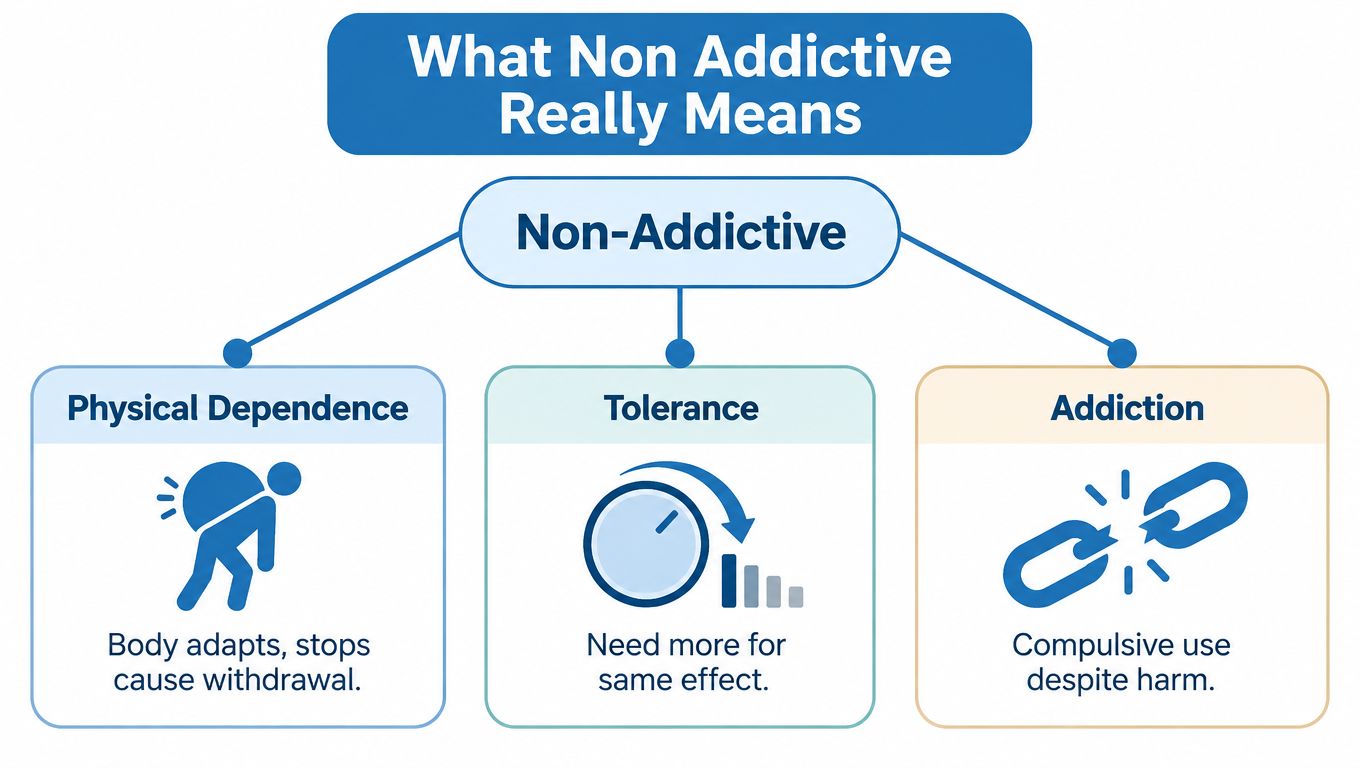
A medication can have low addiction potential and still need careful prescribing. Evaluate dependence, stopping effects, and abuse potential separately.
Daily Maintenance Medications for Chronic Anxiety
A person with chronic anxiety may spend ordinary days worrying about health, work, family, finances, or an undefined sense that something will go wrong. Daily maintenance medication targets that persistent baseline, rather than providing sedation for a panic spike or a performance event. The trade-off is time: lower dependence risk usually comes with slower relief.
SSRIs and SNRIs
Selective serotonin reuptake inhibitors, or SSRIs, reduce serotonin reuptake, leaving more available for signaling between nerve cells. Serotonin-norepinephrine reuptake inhibitors, or SNRIs, affect both serotonin and norepinephrine reuptake. Clinicians choose between these classes based on the anxiety diagnosis, other symptoms, previous treatment response, and side-effect priorities.
These medications became major options in anxiety treatment because reviews describe a lower side-effect burden than older tricyclic antidepressants and monoamine oxidase inhibitors. They also carry no recognized dependence syndrome under most authorities, which is one reason they remain central choices for long-term pharmacotherapy (historical review of anxiety medication).
Their timeline is measured in weeks, not hours. Some early changes may appear within 1 to 2 weeks, while a fuller response often takes 4 to 6 weeks. The exact course depends on the medication and the patient. Taking an SSRI or SNRI only when anxiety suddenly rises will not provide the intended effect. A consistent schedule matters.
Buspirone
Buspirone is a non-benzodiazepine anxiolytic used particularly for generalized anxiety disorder. As a 5-HT1A partial agonist, it offers an ongoing approach with low abuse potential and limited dependence concerns. Its role is persistent worry, not immediate control of a panic surge or a single presentation.
Relief may begin within 1 to 2 weeks, while optimal benefit often takes 3 to 4 weeks, and sometimes 4 to 6 weeks. Nausea, dizziness, and lightheadedness can occur. Comparative evidence found a small benefit in clinician-rated anxiety, along with more discontinuations from adverse events than with placebo (buspirone clinical review).
Consistency also applies to how buspirone is taken. Patients should take it either always with food or always without food, because food can change exposure. If an SSRI or SNRI has not helped enough or causes difficult side effects, a clinician may consider buspirone as an alternative or an augmentation strategy. Practical guidance is available in this overview of buspirone dosing for anxiety.
Expect maintenance medication to be steady rather than dramatic. The goal is fewer anxious thoughts, less avoidance, and more room to use coping skills.
Faster Options for Situational and Acute Anxiety
A presentation is approaching, your heart is racing, and your daily medication has not helped yet. The best option depends on the symptom you need to reduce. A medicine that settles shaking and a fast heartbeat may do little for intrusive worry, while a sedating option may help at night but interfere with daytime alertness. Lower dependence risk can also come with slower or less complete relief.
Hydroxyzine is one of the better-studied non-benzodiazepine options for generalized anxiety disorder and can provide relatively rapid calming. In randomized placebo-controlled trials totaling 723 patients, 41% of hydroxyzine-treated patients responded, compared with 18% who received placebo (Cochrane hydroxyzine review). Its main trade-off is sedation and sleepiness. That can make it more suitable for an acute episode, nighttime anxiety, or a short bridge while a daily treatment begins working than for situations requiring sharp concentration.
Propranolol targets the body's alarm signals rather than the anxious thoughts behind them. It can reduce a racing heart, shaking, and sweating, which makes it more relevant to performance anxiety, public speaking, or another defined event. It is less useful for continuous worry, rumination, or preventing panic disorder. A clinician must check for medical issues such as certain cardiovascular conditions or asthma before recommending it. This guide explains how long propranolol lasts, which helps with planning around a specific event.
Pregabalin may be considered for selected anxiety presentations when a clinician believes its benefits outweigh its risks. A 2023 network meta-analysis found improved anxiety symptoms over 1 to 4 weeks, with short-term reduction comparable to benzodiazepines and quetiapine in that analysis (pregabalin network meta-analysis). It is therefore not an instant solution for a panic spike. Misuse concerns exist in some markets, so non-benzodiazepine does not mean zero risk.
Medication | Typical Onset | Best For | Dependence Risk |
|---|---|---|---|
Hydroxyzine | Relatively rapid calming | Acute anxiety or a bridge, especially when sedation is acceptable | No known characteristic dependence syndrome |
Beta-blocker such as propranolol | Rapid effect on physical symptoms | Performance anxiety, tremor, racing heart, and sweating | Low addiction concern, but medical screening matters |
Pregabalin | Improvement can occur within 1 to 4 weeks (see the 2023 network meta-analysis cited above) | Selected anxiety presentations under careful supervision | Misuse concerns exist in some markets |
Buspirone | Early improvement within 1 to 2 weeks, with fuller benefit over several weeks (prescribing information) | Chronic generalized anxiety | Minimal abuse and dependence potential |
The medication should match the target: chronic worry, physical symptoms during a performance, or short-term acute distress. “Strong” is not the same as appropriate.
Why Benzodiazepines Are Different
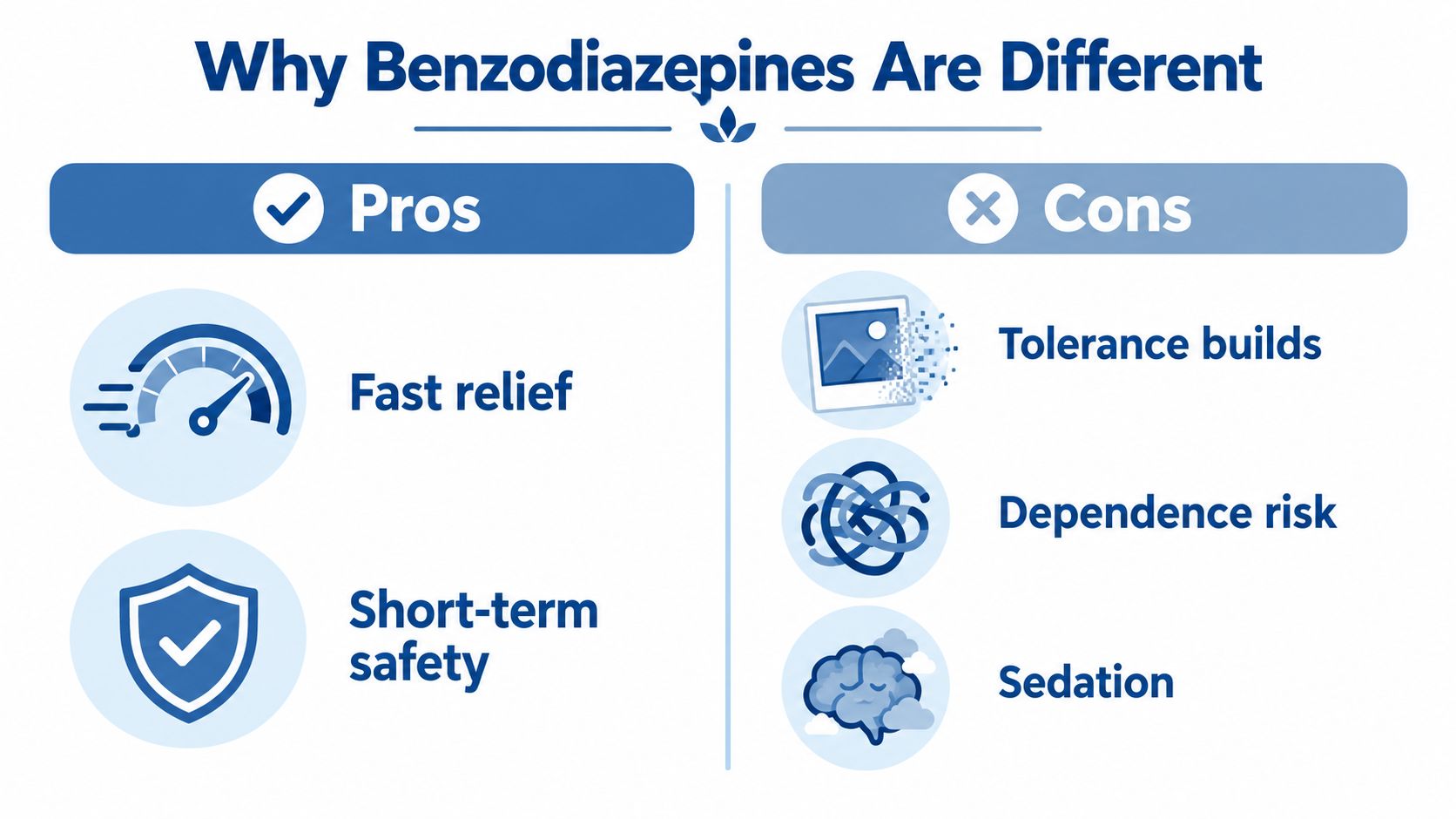
Benzodiazepines such as alprazolam, commonly known as Xanax, and lorazepam, commonly known as Ativan, work quickly. That speed can be clinically useful, especially in carefully selected short-term situations. It also creates the boundary that places them outside the non-addictive category.
The FDA boxed warning addresses abuse, addiction, physical dependence, and withdrawal reactions across the benzodiazepine class. Physical dependence can develop after prescribed use over several days to weeks. The FDA also warns that overdose and death risk rises when benzodiazepines are combined with opioids, alcohol, or illicit drugs (FDA benzodiazepine warning update).
That doesn't make benzodiazepines morally bad or medically useless. It means the benefits and risks need a narrower treatment window. Clinical guidance based on the FDA warning recommends the lowest effective dose for the shortest possible time, and patients shouldn't stop regular use abruptly because withdrawal can include severe symptoms, including seizures.
A balanced comparison
A patient with occasional, severe symptoms may receive a benzodiazepine under close supervision when a clinician believes the benefits outweigh the risks. A patient with daily generalized anxiety, a history of substance misuse, or a need for long-term treatment may have stronger reasons to consider an SSRI, SNRI, buspirone, therapy, or another non-benzodiazepine strategy.
If someone is already taking a benzodiazepine regularly, switching or tapering requires a personalized plan. This guide to benzo tapering protocols offers additional educational context, but it can't replace direct medical supervision. Patients should never design a rapid taper from an internet article.
For a focused discussion of the differences between hydroxyzine and alprazolam, see hydroxyzine versus Xanax. The key distinction is not merely speed. It's the combination of speed, reinforcement, dependence potential, stopping risk, and the reason the medication is being prescribed.
Combining Medication With Therapy and Lifestyle Changes
Medication can lower the volume of anxiety, but therapy teaches you what to do when anxious thoughts, physical sensations, or avoidance habits return. That combination matters because symptom relief can make it easier to attend therapy, practice new behaviors, sleep more consistently, and re-enter situations that anxiety has narrowed.
Cognitive behavioral therapy, or CBT, helps patients identify automatic thoughts and test whether those thoughts match the available evidence. Exposure-based CBT can help someone gradually approach feared situations instead of organizing life around avoidance. Dialectical behavior therapy, or DBT, adds skills for emotional regulation, distress tolerance, mindfulness, and interpersonal stress.
Trauma-focused treatment requires its own pacing and clinical judgment. A person whose anxiety is connected to traumatic experiences may need stabilization, grounding, and trauma processing rather than a medication-only plan. The diagnosis matters because generalized worry, panic attacks, obsessive symptoms, trauma-related hypervigilance, and performance anxiety don't respond to exactly the same strategy.
Build a daily foundation
Medication and therapy work better when the body has reasonable support. Useful habits can include:
Sleep hygiene: Keep a consistent sleep routine and reduce activities that keep the mind activated close to bedtime.
Movement: Regular exercise can provide a structured way to discharge tension and support mood regulation.
Stress management: Breathing practice, progressive muscle relaxation, journaling, and planned breaks can interrupt escalation.
Social support: A trusted person, peer group, or community resource can reduce isolation. The Kindness Community Foundation guide to mental illness support groups offers a starting point for understanding that kind of support.
Choosing a non-addictive medication doesn't mean choosing weak treatment. It often means choosing a slower, more sustainable approach that combines symptom reduction with skills that remain useful after the prescription changes.
Getting Started With Telepsychiatry in Florida
A psychiatric evaluation reviews your symptoms, timeline, sleep, medical history, current medications, substance use, previous treatment, and goals. The clinician also checks for conditions that can resemble anxiety, including mood or trauma-related disorders, medication effects, and medical contributors.
With HIPAA-compliant telepsychiatry, you can attend a secure video visit from anywhere in Florida using a phone, tablet, or computer. Your clinician can discuss whether an SSRI, SNRI, buspirone, hydroxyzine, beta-blocker, therapy referral, or another option fits your symptom pattern, including chronic worry, panic spikes, or performance anxiety. Follow-up visits track benefits and side effects and guide medication adjustments. Learn more about telemedicine psychiatry.

Refresh Psychiatry & Therapy offers psychiatric evaluations, medication management, and individual therapy for anxiety and related conditions through telepsychiatry in Florida. The practice accepts Aetna, United Healthcare or UHC, Cigna, Blue Cross Blue Shield, Humana, Tricare, UMR, and Oscar insurance plans. Coverage varies, so confirm benefits before scheduling.
Contact Refresh Psychiatry & Therapy or call (954) 603-4081. This blog is informational and does not constitute medical advice. Consult a qualified mental health professional for personalized guidance.
Refresh Psychiatry & Therapy provides psychiatric evaluations, medication management, and evidence-based therapy for non-addictive anxiety medication options. Call (954) 603-4081 or use the contact link above to request an evaluation and discuss a plan matched to your symptoms, health history, and goals.