
🛌 Online Psychiatrist Orlando Guide to Virtual Care

🛌 Online Psychiatrist Orlando Guide to Virtual Care
You may be reading this after opening several browser tabs, calling one office that never answered, and learning the next available local appointment is weeks away. That's a common Orlando experience. People often start by looking for a nearby psychiatrist, but what they really need is reliable access to ongoing care, not just a name on a map.
Online psychiatry can solve that problem, but only if it's set up correctly. A virtual visit isn't just a video chat. It's a clinical appointment with privacy standards, documentation rules, prescribing limits, and insurance details that affect whether treatment can continue smoothly. That matters if you're dealing with anxiety before work, depression while trying to keep up with school, ADHD medication questions, or a child's mood changes at home.
This guide is for adults, students, parents, and caregivers who want clear answers before booking. It's also for people who are understandably cautious. You might be wondering whether an online psychiatrist in Orlando is “real” care, whether Florida law allows it, whether your insurance will treat it like an office visit, and what happens if medication is part of the plan.
Introduction to Online Psychiatry in Orlando
A lot of people searching for an online psychiatrist in Orlando aren't looking for convenience first. They're looking for a realistic way to get seen at all. That distinction matters. If local schedules are full, if transportation is hard, or if getting across town feels impossible when you're already struggling, telepsychiatry stops being a luxury and starts becoming the practical front door to care.

An online psychiatry visit usually means meeting a psychiatrist from your phone, tablet, or computer in a private setting. If you'd like a simple overview of that format, telemedicine psychiatry is a helpful starting point. The visit can include an evaluation, diagnosis, medication management, and follow-up, depending on your needs and whether telehealth is a good clinical fit.
Why Orlando patients often start here
Orlando residents face the same problem many Florida communities do. Need is high, but access can be uneven. A Florida-focused coverage guide reports that Orange County has one mental health provider for every 350 residents, and it also notes broader shortage designations affecting millions of Floridians, which helps explain why telepsychiatry often becomes the most realistic access point rather than just the easiest one (Florida telehealth coverage guide).
Telepsychiatry works best when you think of it as continuity of care delivered through a screen, not a stripped-down substitute for real treatment.
What online care can and can't do
Online psychiatry can be a strong option for common outpatient concerns such as anxiety, depression, insomnia, trauma-related symptoms, and medication follow-up. It may be less appropriate when someone is in immediate danger, needs emergency stabilization, or has a condition that requires a more hands-on setting.
That's why the useful question isn't “Is virtual care good or bad?” It's “Is this the right level of care for my situation right now?” If you keep that frame in mind, the next steps become much clearer.
How Telepsychiatry Works and Why It Is Established Care
Think of telepsychiatry as a secure virtual exam room. You still meet with a psychiatrist at a scheduled time. You still review symptoms, history, medications, and goals. The difference is the setting. Instead of driving to an office, you join from a private location while using a HIPAA-compliant platform designed for healthcare.
What happens during the visit
A telepsychiatry appointment often looks very similar to an in-person psychiatric visit. The psychiatrist asks about:
Current symptoms such as worry, panic, low mood, sleep changes, focus problems, or mood swings
Past treatment including therapy, prior medications, hospitalizations, or side effects
Medical context like thyroid problems, substance use, pain, or other medications that can affect mood and attention
Daily functioning at work, school, home, and in relationships
The psychiatrist also performs a mental status exam by observation and conversation. That includes speech, affect, thought process, attention, memory, judgment, and safety assessment. If you've never done this before, virtual psychiatrist visits can feel much less mysterious once you know that the clinical structure is the same.
Later in the process, billing details can become an obstacle for practices and patients alike. If you want a plain-language look at one operational side of telehealth, this guide on how to prevent telehealth claim denials with Happy Billing explains the kinds of reimbursement issues that can interrupt continuity.
Why this is not a new experiment
Telepsychiatry has been around far longer than many people realize. The American Psychiatric Association notes that psychiatric videoconferencing began in the 1950s. The Nebraska Psychiatric Institute used early videoconferencing in 1959 for group therapy, long-term therapy, consultation-liaison psychiatry, and medical student training, and Massachusetts General Hospital provided psychiatric consultations in 1969 at a clinic in Logan International Airport (telepsychiatry history summary).
That history matters because it changes the frame. Online psychiatry isn't a recent improvisation. It's a long-standing clinical model that technology has made easier to use.
A short overview can help if you want to see the format discussed visually:
How Florida normalized virtual behavioral care
Florida's behavioral health system saw a major shift during the COVID-19 era. A statewide assessment reported more than a 3,000% increase in telehealth utilization, rising from 842 to 29,173 instances by April 2020, and more than 30% of all services had transitioned to telehealth by the end of that month. A Florida Medicaid telehealth report in the same source found psychiatry accounted for 10.1% of all telehealth visits in the measured period (Florida behavioral health assessment).
Those numbers don't mean telehealth fits every patient. They do show that, in Florida, virtual psychiatry moved from a niche option into routine behavioral care.
Benefits and Limitations of Seeing an Online Psychiatrist
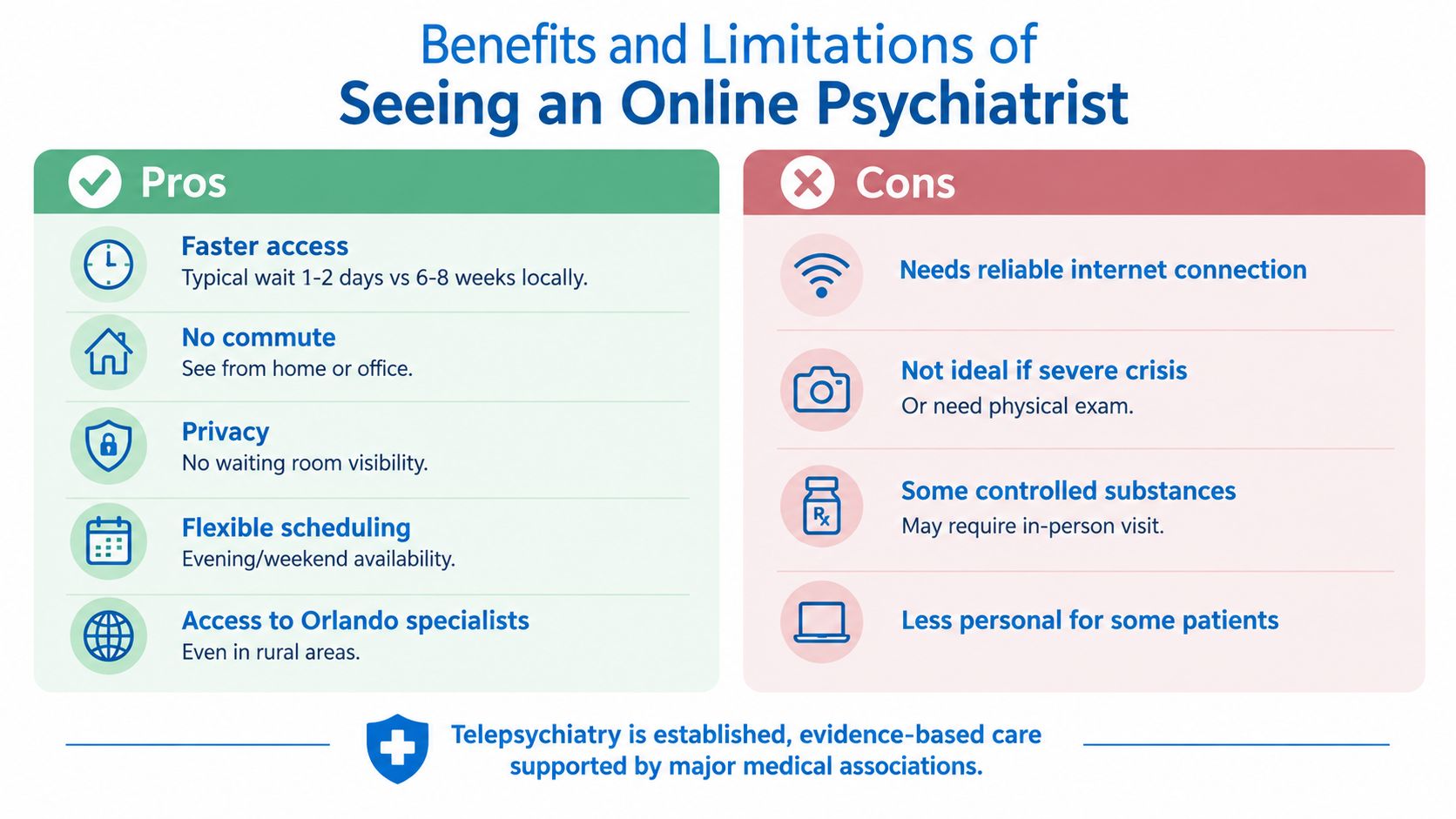
The biggest benefit of online psychiatry in Orlando is access. Not abstract convenience. Access. When local supply is tight, a virtual model lets a psychiatrist treat patients across Florida without needing a separate office in every neighborhood, as long as Florida's telehealth rules are met.
Where virtual care performs well
For many common outpatient conditions, telepsychiatry has a strong evidence base. A systematic review and meta-analysis found telepsychiatry was mostly equivalent to face-to-face treatment in efficacy and study completion across common psychiatric disorders, with no significant differences in 27 of 29 outcomes when diagnoses were pooled. Florida law also requires a clinician treating a patient located in Florida via telehealth to hold Florida authorization or register as an out-of-state telehealth provider, which gives the model a clear legal framework rather than a vague workaround (Florida telehealth statute).
A separate 2023 meta-analysis found psychiatric treatment delivered through telemedicine was equivalent to in-person care for PTSD, mood disorders, and anxiety disorders in treatment efficacy, patient satisfaction, and attrition rate. Another broad review in the same paper reported a medium effect for anxiety (SMD=0.44) and depression (SMD=1.31), with no significant overall effects for several other symptom groups, suggesting the clearest digital-care signal is in internalizing disorders rather than every psychiatric presentation (JMIR Mental Health review).
In practical terms, online care often works especially well for:
Anxiety and panic when the goal is regular follow-up, medication adjustments, and skills-based therapy
Depression when the patient can engage reliably from home and track changes over time
PTSD and insomnia when symptom monitoring and consistent visits matter more than physical exam findings
Medication continuity when travel, school schedules, or work make office attendance harder
Practical rule: Telepsychiatry is strongest when the main tasks are assessment, conversation, monitoring, and treatment adjustment.
Where a higher-touch model is safer
Virtual psychiatry also has limits. Some situations need in-person assessment, urgent intervention, or a more intensive level of care. That includes acute suicidality, unstable bipolar illness, severe diagnostic uncertainty, or cases where the patient can't maintain privacy or reliable participation through telehealth.
If you're unsure whether your situation fits, this discussion of conditions that are not a good fit for telehealth psychiatry offers a useful clinical filter.
A simple self-check
Ask yourself three questions:
Can I safely wait for an outpatient appointment?
Can I participate from a private, reasonably stable setting?
Is my main need evaluation, therapy, medication management, or follow-up rather than emergency stabilization?
If the answer to those is yes, an online psychiatrist in Orlando may be a very good fit.
Conditions Treated and the Integrated Medication Plus Therapy Model
People often assume psychiatry means medication and therapy means something separate happening elsewhere. In real practice, that split can make care feel fragmented. A more useful model is coordinated treatment, where diagnosis, medication decisions, therapy goals, and symptom tracking all inform each other.
Conditions commonly treated
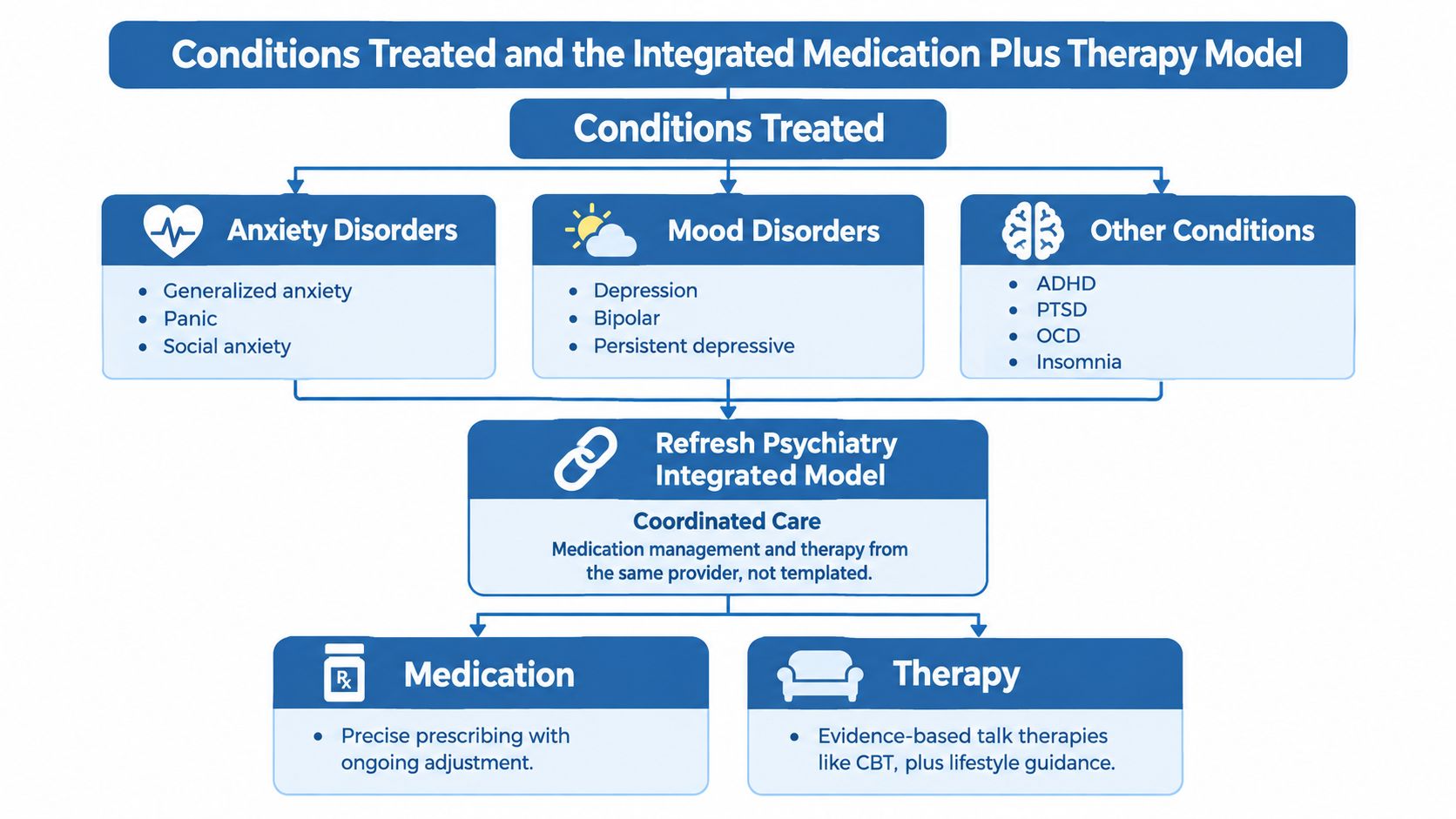
An online psychiatrist may evaluate and treat a broad range of outpatient concerns, including anxiety disorders, depression, ADHD, PTSD, bipolar disorder, OCD, insomnia, and related mood or trauma conditions. Not every diagnosis is equally suited to telehealth, but many are manageable when the patient is stable enough for outpatient care and the treatment plan is monitored carefully.
The virtual evidence is strongest for internalizing disorders such as anxiety, depression, and trauma-related symptoms. That doesn't mean other conditions are ignored. It means the psychiatrist should match the treatment setting to the clinical picture instead of forcing every problem into the same workflow.
What an integrated model looks like
In an integrated approach, medication isn't prescribed in isolation. It's linked to the patient's symptoms, sleep, stress patterns, side effects, and functioning. Therapy isn't generic either. It should address the specific loops keeping the problem going.
That may include:
CBT for identifying distorted thinking and changing avoidant behavior
DBT-informed skills for emotion regulation and distress tolerance
Psychodynamic work for longstanding relational patterns and self-understanding
Trauma-focused approaches when past experiences still shape present symptoms
One example of this kind of structure is Refresh Psychiatry & Therapy, a Florida telemedicine-only practice that provides psychiatric evaluations, medication management, and therapy for adults, children, and adolescents, including CBT, DBT, psychodynamic, and trauma-focused treatment.
The best psychiatric care doesn't feel templated. It feels like someone is paying attention to how your symptoms behave in your actual life.
Why coordination matters over time
A coordinated plan also creates room for things patients often don't realize psychiatry can address. That may include deprescribing when a medication is no longer helping, reviewing side effects that have been ignored for years, or using structured rating scales to check whether treatment is working instead of guessing.
Practices also have to help people find them in the first place. For readers curious about the operational side of outreach in behavioral health, this overview of digital marketing for mental health providers gives context for how psychiatric services communicate availability and specialties online.
What to Expect From Evaluation Through Follow Up
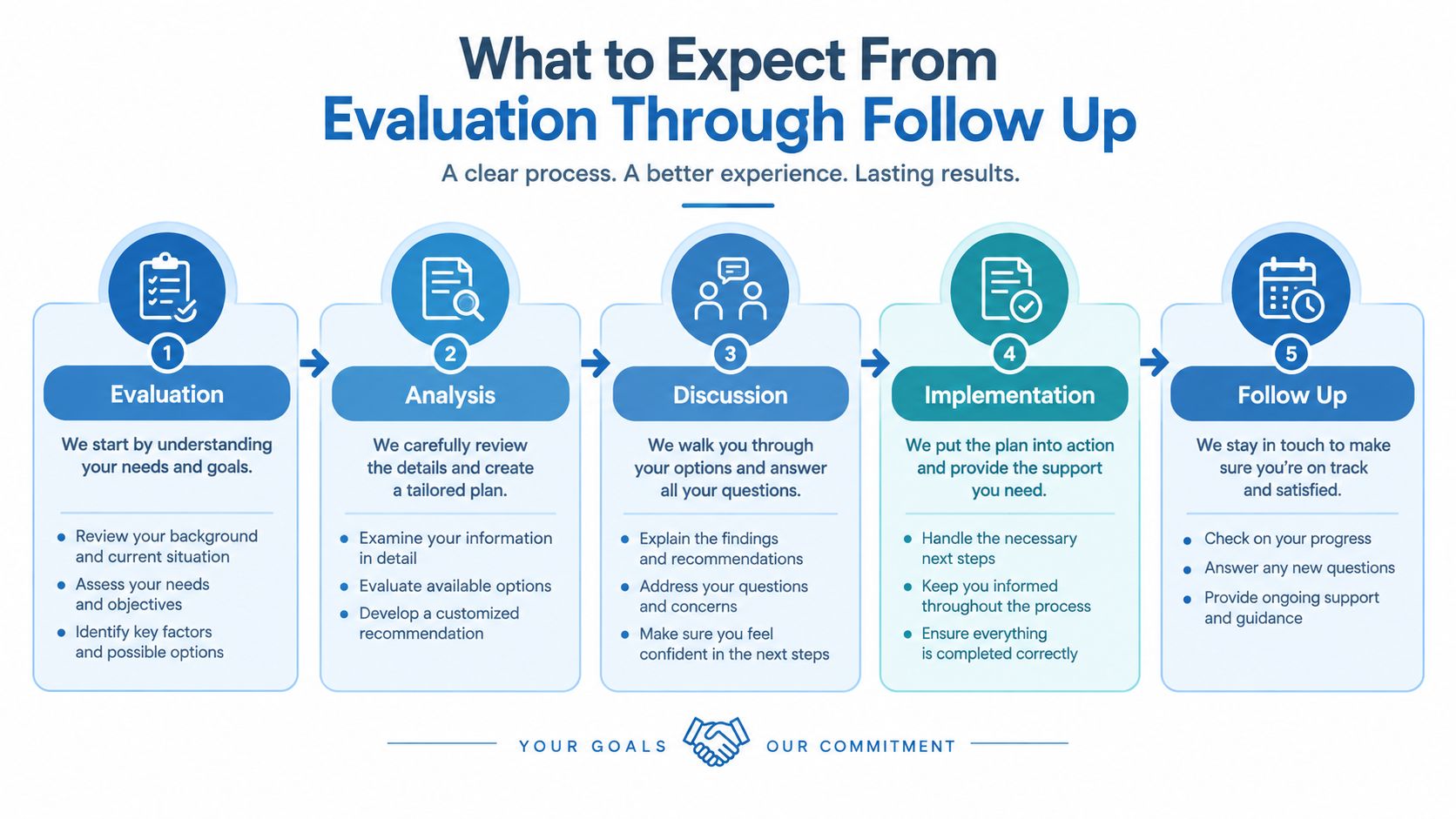
A first telepsychiatry visit usually feels less intimidating once you know the order of events. For many Orlando patients, the hard part is not willingness to get help. It is getting access to a psychiatrist who can continue care under Florida rules, insurance requirements, and medication policies.
Before the visit
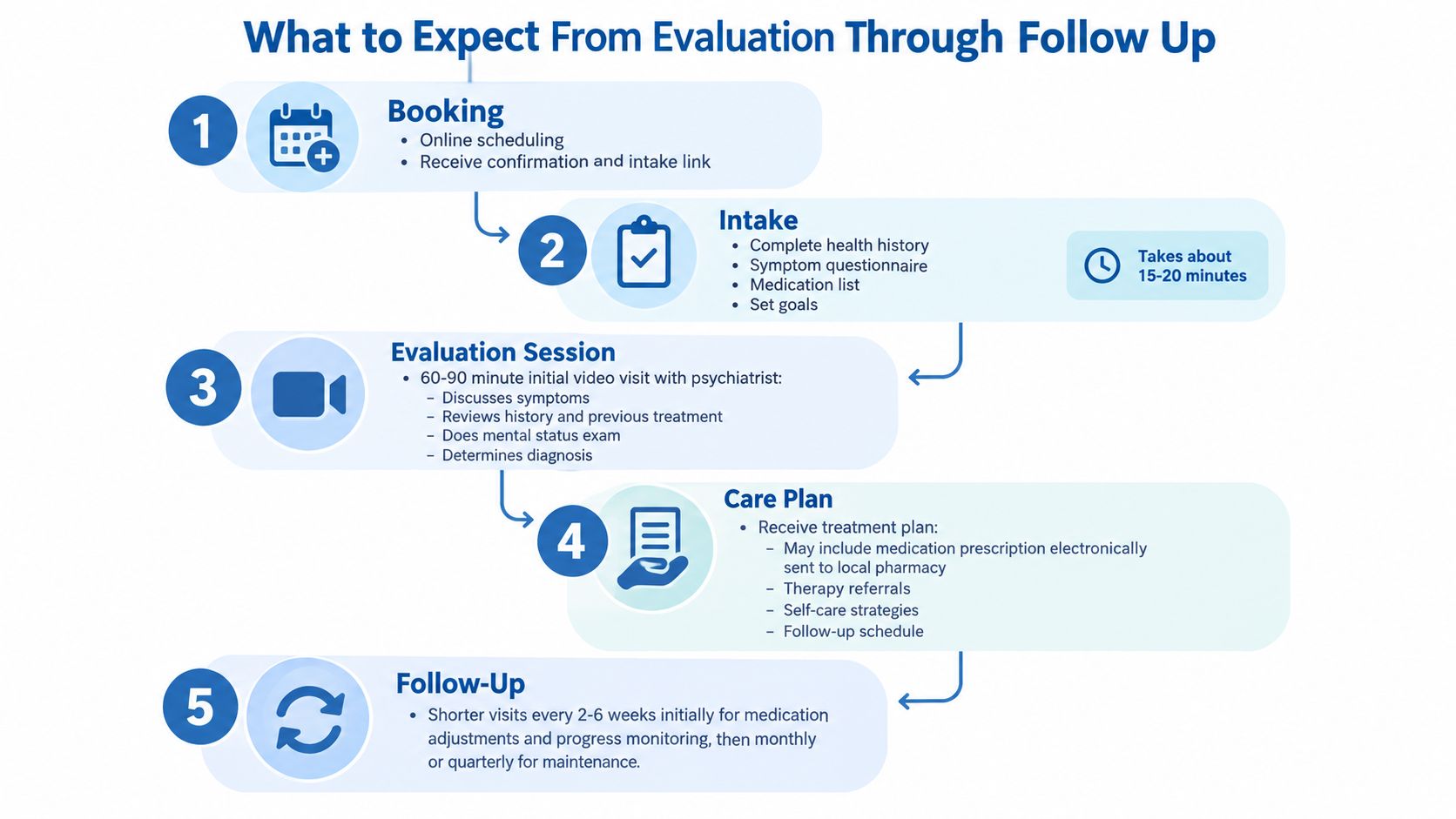
After scheduling, you will usually complete intake forms and consent paperwork. These forms give the psychiatrist a starting map. They often ask about symptoms, medical history, current medications, allergies, past treatment, substance use, and goals for care.
Accuracy helps. Even small details, such as whether a past medication caused insomnia or nausea, can change the plan.
It helps to prepare a short list before the visit:
Current concerns such as panic attacks, poor sleep, irritability, low motivation, or focus problems
Past medications and what happened with each one
Questions you want answered about diagnosis, therapy, side effects, school, or work functioning
If you want a clearer picture of the first appointment, this guide to what a psychiatric evaluation involves can help you know what the psychiatrist is assessing.
During the evaluation
The evaluation is a structured conversation, not a quiz and not a rushed prescription visit. A psychiatrist will ask what is happening now, when it started, what makes it worse or better, how it affects sleep and daily function, and what treatment you have already tried. Family history, medical conditions, trauma history when relevant, and substance use may also matter because mental health symptoms often overlap.
A good evaluation works like putting puzzle pieces on the table before deciding what picture they form. Anxiety can look like ADHD. Depression can look like burnout. Poor sleep can intensify nearly everything.
You may hear the psychiatrist narrow possibilities in real time. For example, they may explain that the symptoms could fit generalized anxiety, but they also want to sort out mood symptoms, attention problems, and sleep disruption before settling on a diagnosis.
If the diagnosis changes after a few visits, that often means the picture became clearer with time.
After the evaluation
The treatment plan may include medication, therapy, both, or a recommendation to gather more history first. That is a normal part of careful care. Starting treatment without enough information can create problems later, especially if medication questions, insurance restrictions, or refill rules come up.
If medication is prescribed, the psychiatrist should explain what it is for, how long it may take to help, common side effects, and when to contact the office. That conversation should feel clear, not mysterious.
Follow-up visits are usually shorter. Their job is to check the direction of treatment, much like adjusting glasses after the first fitting so the prescription matches what you are seeing day to day. These visits often review:
symptom changes since the last visit
side effects or trouble taking the medication as prescribed
whether the working diagnosis still fits
what to continue, change, or monitor next
Medication and continuity questions
Many patients ask whether an online psychiatrist can prescribe medication in Florida. For many psychiatric medications, yes. The practical issue is whether the treatment can continue smoothly after the first visit.
That depends on details patients do not always know to ask about at the start. The clinician must be authorized to treat patients located in Florida. Your insurance may have rules about telehealth billing or preferred pharmacies. Controlled medications, including some treatments used for ADHD or severe anxiety, may require added monitoring, closer follow-up, or other steps based on the medication and your clinical situation.
Those guardrails are part of safe prescribing. They are not a sign that online care is less real. They are part of how established telepsychiatry works when access is limited and continuity matters.
How to Choose an Online Psychiatrist in Orlando
A common Orlando scenario goes like this: you finally decide to get help, call a few offices, and learn the next opening is weeks away, the clinician is not in your network, or the practice does not manage the medication you may need. That is why choosing an online psychiatrist is not mainly about convenience. It is about finding care you can start and continue.
The first question is practical. Can this psychiatrist treat you legally and reliably while you are in Florida? If that piece is missing, everything else stops there.
Start with Florida authorization and clinical fit
A psychiatrist who sees patients by telehealth in Orlando must be authorized to treat patients located in Florida. Verify that directly with the practice before booking. A simple question works well: “Are you licensed in Florida or registered to provide telehealth to Florida patients?”
After that, look at fit in the same way you would look at fit with any specialist. Board certification matters. So does the age group they treat, the conditions they see often, and whether they work well with therapists, primary care physicians, or school supports when needed. Good telepsychiatry should feel organized, not improvised.
Crisis policy matters too. Telepsychiatry works well for many outpatient needs, but every practice should tell you clearly what to do if you are in immediate danger or need emergency care. Clear limits are part of safe treatment.
Check the rules that affect whether care can continue
Patients often focus on getting the first appointment. Continuity is the more important test.
Ask how the practice handles prescription refills, pharmacy problems, missed appointments, and follow-up frequency. If your treatment may involve a controlled medication, ask about the monitoring steps up front. That is similar to checking the road conditions before a long drive. You want to know whether the route is workable before you are halfway there.
Insurance needs the same kind of careful check. Even when telehealth is covered, details can still affect cost and continuity. Confirm whether the psychiatrist is in network, whether you need a referral, what your copay or deductible will be, and whether prior authorization applies.
Florida reimbursement rules can also shape access:
Florida Medicaid reimburses for real-time, two-way interactive telemedicine, according to the Center for Connected Health Policy Florida summary.
Private payer rules in Florida include an audio-only mental health provision for certain situations in the home, with reimbursement guidance outlined on the Center for Connected Health Policy parity topic page.
Mental health parity rules can also matter if a plan covers behavioral health services. Those rules are meant to limit unfair coverage restrictions compared with medical care. For patients, the practical takeaway is simple. If coverage answers do not make sense, ask for a clearer explanation before the visit.
Choosing an Online Psychiatrist in Orlando Comparison Checklist
Evaluation Criteria | What to Verify | Why It Matters for Orlando Patients |
|---|---|---|
Licensure status | Florida license or valid Florida telehealth registration | Confirms the psychiatrist can legally treat you while you're located in Florida |
Clinical scope | Adults only, or also children and adolescents | Helps families and students avoid booking with the wrong type of provider |
Conditions treated | Anxiety, depression, ADHD, PTSD, bipolar disorder, OCD, insomnia, and related concerns | Improves the odds that the psychiatrist is comfortable with your specific presentation |
Medication policies | How the practice handles controlled substances, refills, and pharmacy issues | Prevents treatment interruptions later |
Technology | HIPAA-compliant video platform and clear backup plan | Reduces privacy and continuity problems |
Insurance participation | In-network status, referral rules, prior authorization, copays, deductible | Determines whether care is actually affordable and sustainable |
Follow-up structure | Who handles messages, symptom monitoring, and urgent concerns | Shows whether the care model supports continuity rather than one-off visits |
If you want a broader framework for comparing options, this guide on questions to ask when finding a psychiatrist can help you screen practices more carefully before you commit.
Schedule Your Online Psychiatry Evaluation Today
Telepsychiatry is established care. For many Orlando patients, it's also the most realistic route into treatment when local access is limited, schedules are overloaded, or continuity keeps breaking down. The value isn't just staying home. The value is being able to start, continue, and adjust care within a legal, clinically appropriate framework.
If you're looking for an online psychiatrist in Orlando, focus on the pieces that determine whether care will work over time. Verify Florida authorization. Ask how medication management is handled. Confirm insurance details before the first appointment. Make sure the practice has a clear follow-up structure rather than a one-visit model.
For many people, taking the first step is the hardest part. Once the process becomes concrete, it usually feels much more manageable.
Contact us or call Refresh Psychiatry at (954) 603-4081 to schedule your evaluation.We accept Aetna, United Healthcare / UHC, Cigna, Blue Cross Blue Shield, Humana, Tricare, UMR, and Oscar insurance plans.
This blog is for informational purposes only and does not constitute medical advice. Please consult a qualified mental health professional for personalized guidance.
If you want a telemedicine-only option for psychiatric evaluation, medication management, and therapy anywhere in Florida, Refresh Psychiatry & Therapy offers HIPAA-compliant virtual care for adults, children, and adolescents. If you're trying to find a practical path into treatment in Orlando, it's a straightforward place to learn about the process and request an appointment.