
Anticipatory Anxiety: A Practical Guide to Relief in 2026

You're sitting in the waiting room, or maybe parked outside the dentist's office, and the appointment is still hours away. Nothing bad has happened yet, but your stomach is tight, your hands feel cold, and your mind is already running through every awkward, painful, or embarrassing outcome it can invent. That gap between “not yet” and “what if” is where anticipatory anxiety lives, and for a lot of people, it's the part of anxiety that does the most damage.
This isn't just ordinary nerves. The body can treat an upcoming event like it's already happening, which is why people feel real tension, dread, and avoidance before the trigger arrives. The burden sits inside a much larger anxiety picture, and that burden is substantial, with the World Health Organization reporting that anxiety disorders affected 470 million people globally in 2023, about 5.8% of the world's population, after earlier estimates of 301.39 million prevalent cases in 2019 and 359.21 million in 2021 across anxiety disorders overall (global anxiety statistics). In clinical practice, the point isn't to argue with the feeling. It's to understand why your brain is firing early, what keeps the loop going, and which treatments quiet it down.
When the Fear Shows Up Before Anything Does
The phone reminder says the appointment is at 3:00. It's 11:00, and the whole day already feels narrowed around that event. You can be at work, at home, or in the car, and still feel like you're standing in line for something unpleasant that hasn't started yet.
That's the lived experience many people call anticipatory anxiety. The mind moves ahead of the moment, and the body follows with a stress response that feels oddly premature but very real. Clinical literature has spent decades showing that anxiety isn't just a reaction to danger in front of you, it's also a reaction to expected danger, uncertainty, and the possibility of losing control.
The alarm can ring before the smoke ever appears.
What makes this pattern worth taking seriously is that it can become a self-reinforcing habit. If your brain learns that the safest move is to brace early, scan for problems, and pull back from the situation, it starts doing that more often. Over time, the feared event can matter less than the waiting, because waiting keeps the nervous system on alert for hours or days.
That's why this guide focuses on the mechanics, not just the feeling. The goal is to translate the sensation of dread into something more workable, so you can tell the difference between a normal pre-event surge and a pattern that needs treatment. If you've been living with this around appointments, social plans, work demands, parenting stress, or major life changes, the rest of this article gives you a practical map of what's happening and what helps.
What Anticipatory Anxiety Actually Is and Is Not
A patient may feel fine in the morning, then start checking their pulse, rereading messages, or mentally replaying a meeting that is still days away. That pattern is anticipatory anxiety. It is persistent worry, rumination, and body activation tied to a future event, especially when uncertainty starts to feel like danger. The reaction can begin days or weeks ahead of the event, and it often includes worst-case rehearsal, body scanning, and avoidance.
It also shows up across several anxiety disorders rather than standing alone as its own diagnosis. Clinically, it is common in generalized anxiety disorder, panic disorder, social anxiety disorder, and specific phobias. The trigger changes, but the loop is similar. The brain predicts threat, the body prepares, and short-term relief from avoidance or reassurance keeps the pattern going. A practical anxiety symptom checklist can help sort out whether the picture is broad anxiety, event-linked dread, or both.
Normal anticipation is proportionate and flexible. Anticipatory anxiety is sticky, feels larger than the situation calls for, and keeps running after the mind has already moved on.
Condition | Trigger | Time Frame | Core Fear | Somatic Symptoms |
|---|---|---|---|---|
Anticipatory anxiety | An upcoming event, state, or uncertainty | Often days to weeks before the event | “Something will go wrong before I can handle it” | Tension, stomach upset, shallow breathing, restless sleep |
Generalized anxiety disorder | Multiple everyday concerns | More days than not, often diffuse | Broad future worry across many domains | Muscle tension, fatigue, sleep problems |
Panic disorder | Bodily sensations or fear of another attack | Can surge before or after prior attacks | “I'll panic and lose control” | Racing heart, chest tightness, dizziness |
Social anxiety disorder | Social evaluation or performance | Before, during, and after social exposure | “I'll be judged or humiliated” | Blushing, tremor, nausea, sweating |
Specific phobia | A specific object or situation | Before exposure to the feared cue | “This will be unsafe” | Immediate autonomic arousal, avoidance |
A real-world example is someone worried about managing unexpected hair thinning. They may start checking mirrors, researching products, and putting off social plans long before they speak with a clinician. That is more than ordinary concern. The mind is organizing around a feared future loss, and the body is already acting as if the loss is present.
Why Your Brain Locks Onto Future Threats
The brain does not choose anticipatory anxiety because it wants to make life harder. It does it because uncertainty feels costly when the stakes feel personal. A major review of the threat-uncertainty model describes five linked processes, inflated estimates of threat cost and probability, increased attention to threat cues, deficient safety learning, avoidance behaviors, and heightened reactivity to uncertainty. That is why one uneasy thought can spread into an entire day.
The loop starts with prediction
The brain estimates danger, then scans for evidence that the prediction is right. Rumination becomes mental rehearsal, and hypervigilance turns into a search for confirmation. The regions most often tied to this network include the amygdala, bed nucleus of the stria terminalis, ventromedial prefrontal cortex, orbitofrontal cortex, dorsomedial and dorsolateral prefrontal cortex, and anterior insula. Researchers also describe this pattern in the broader stress response covered in General Adaptation Syndrome, where the body keeps preparing for demand before the demand arrives.
Practical rule: if your mind keeps replaying future scenes, it is usually trying to reduce uncertainty, not just overthink.
Avoidance teaches the brain that escaping worked. The relief is immediate, but it blocks corrective learning, so the next event feels just as dangerous or worse. The body then follows with sympathetic activation, which is why people describe feeling braced, keyed up, or physically ready for something that has not happened yet.
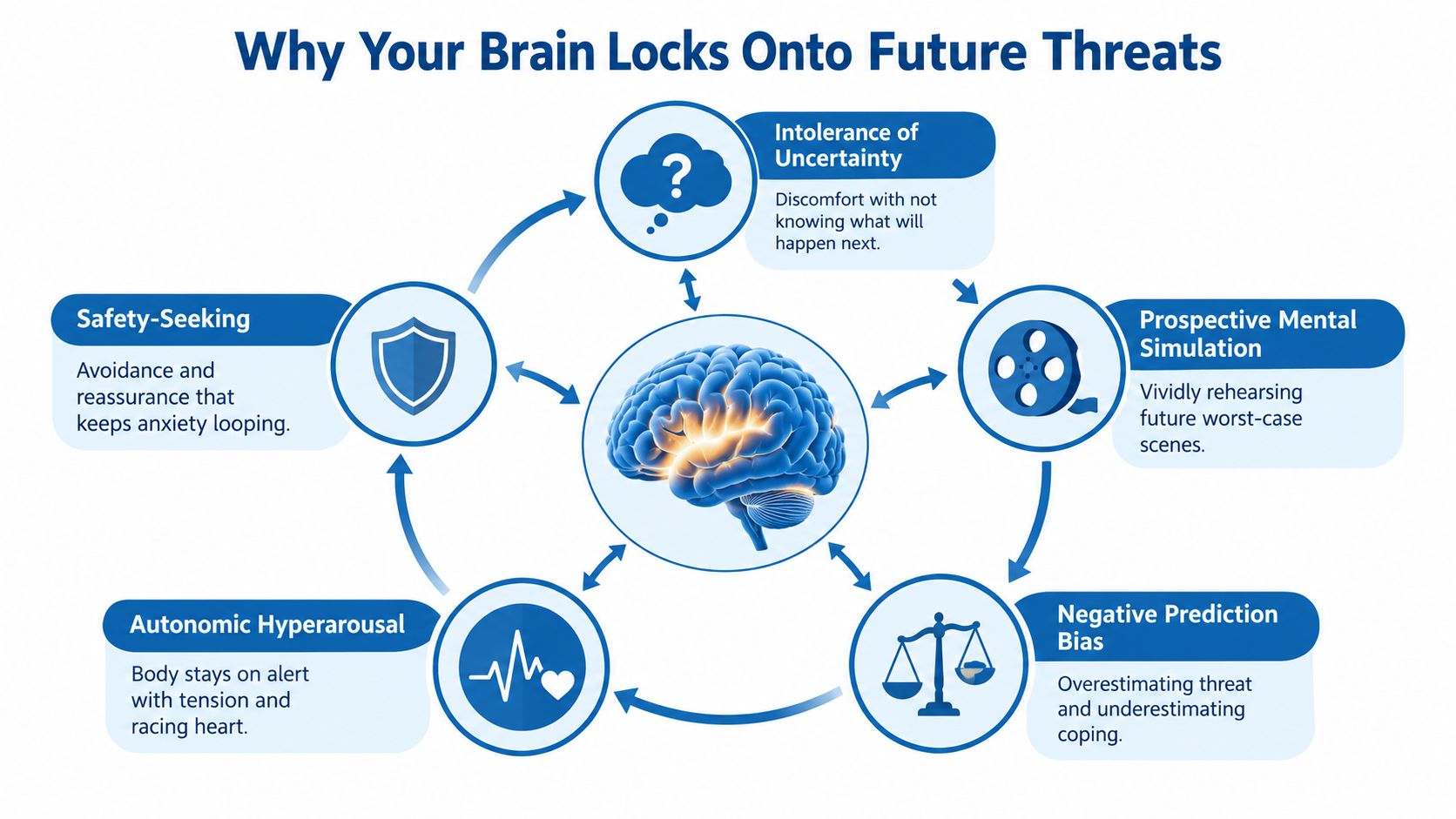
The plain-English version is straightforward. Uncertainty intolerance says, “I need to know.” Negative prediction bias says, “It will probably go badly.” Avoidance says, “I will feel better if I do not face it.” In practice, those patterns call for different treatment targets, which is why a single relaxation tip usually falls short. In CBT, the work often centers on testing predictions and reducing avoidance. In DBT, the focus may shift to distress tolerance and emotion regulation. Medication management can help lower baseline arousal when the body is stuck on high alert, but it does not replace the learning that changes the loop.
Signs Your Body Is Bracing for Something That Has Not Happened
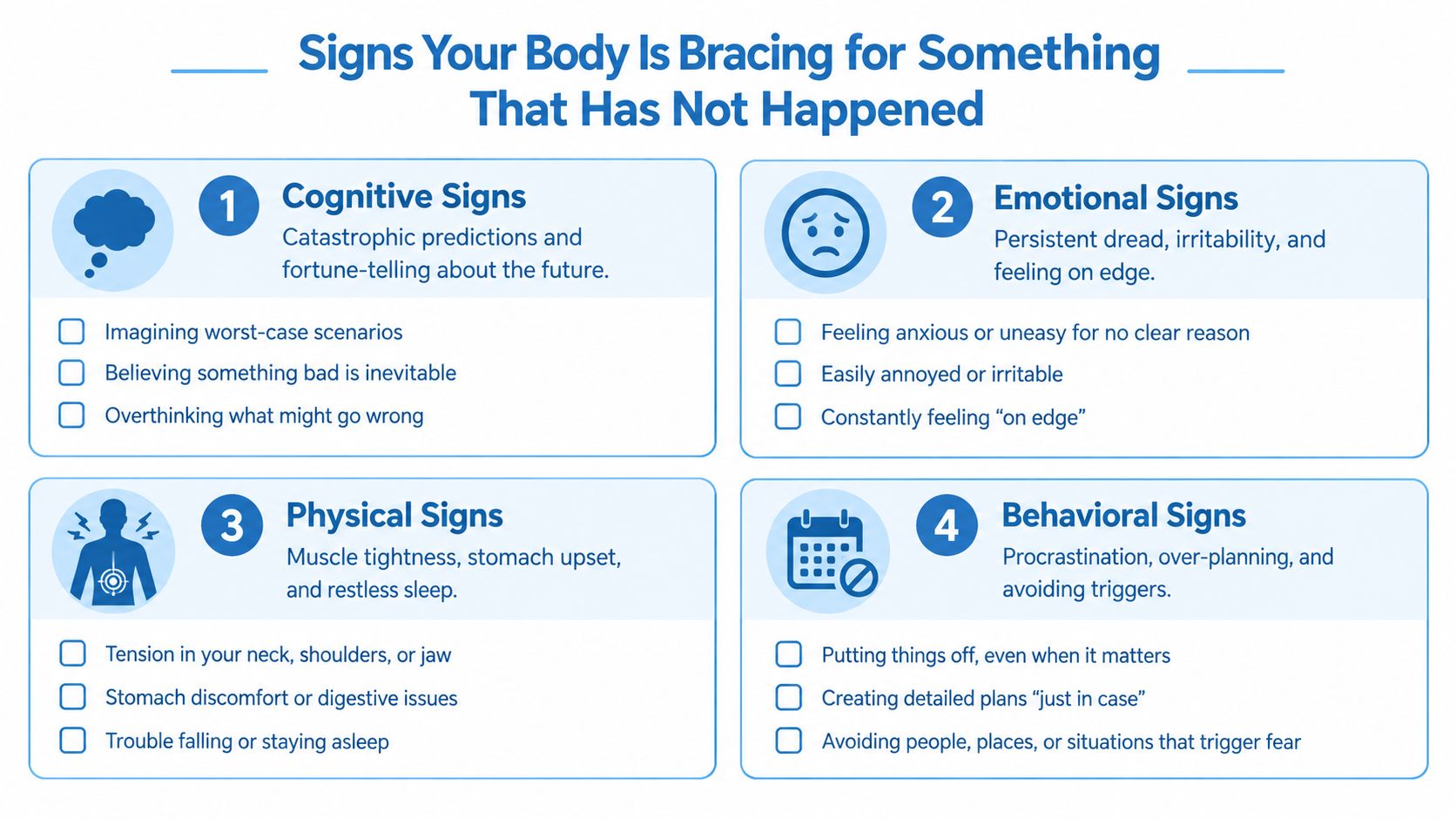
The pattern usually shows up in four clusters. Some people notice thoughts first, others notice a body that never seems to stand down, and many people get all four at once.
Cognitive signs
These are the thoughts that keep dragging you into the future. You may keep predicting the worst, assuming you know how things will unfold, or replaying possible mistakes before they happen. A person with anticipatory anxiety might read a text from a boss and instantly conclude they're in trouble, even when there's no evidence yet.
Emotional and physical signs
Emotionally, the experience often feels like dread, irritability, or emotional flattening. Physically, the body can stay on alert with chest tightness, shallow breathing, GI upset, muscle tension, poor sleep, or appetite changes. A lot of people think they're “just stressed,” but the body symptoms often show the stress is already taking up space before the event begins.
Behavioral signs
Behavior is where the pattern becomes easiest to spot. You might over-prepare, procrastinate, seek reassurance, cancel plans, or avoid anything that reminds you of the event. If you're comparing your experience with other anxiety patterns, the why-am-I-so-jumpy article can help you separate general hyperarousal from a more specific future-focused fear pattern.
A clinical threshold matters. When these symptoms show up most days for months, interfere with work or relationships, or push you into panic-level distress, they deserve an evaluation rather than another round of self-blame. Ask yourself one direct question, am I preparing for life, or am I living in rehearsal for a threat that hasn't arrived?
Evidence-Based Treatments That Target the Loop
The right treatment depends on which part of the loop is doing the most damage. If the fear is built on predictions, CBT targets the prediction itself. If uncertainty sets off emotional flooding, DBT skills can help you stay with discomfort without feeding it. If your body is already in alarm mode before your mind can catch up, medication can lower the physiological volume enough for therapy to work better.
CBT and exposure change the predictions
Cognitive behavioral therapy for anxiety does more than talk through feelings. It helps people test the assumptions under the dread, especially the belief that certain sensations, events, or conversations will end badly. In panic-focused CBT, interoceptive exposure brings on harmless body sensations on purpose so the brain stops treating them like danger. Exposure works by activating the fear structure and then giving the brain new information that disconfirms the old prediction (CBT and exposure review).
DBT skills help when logic isn't enough
When someone knows the worry is exaggerated but still cannot settle down, DBT skills are often more useful than debate. Radical acceptance reduces the fight with reality, distress tolerance gives the body a way to ride out uncertainty, and opposite action helps when avoidance has become the default response. These skills do not erase the problem. They keep the feeling from running every choice.
Medication can lower the body's alarm
For many patients, SSRIs and SNRIs are the most common first-line medication classes considered for ongoing anxiety, because they can reduce baseline arousal and make exposure or CBT more tolerable over time. See common anxiety medications for a practical overview of those options and a few others that come up in treatment planning. Buspirone is another option some prescribers use for persistent worry. Propranolol can be considered for strong physical symptoms, especially when the main issue is racing heart or trembling in performance-related situations, and short-term benzodiazepines may sometimes be used cautiously, though dependency risk and rebound symptoms are real trade-offs.
Medication choice should be individualized with a prescriber, because the same symptom pattern can call for very different strategies depending on timing, medical history, and co-occurring conditions.
Approach | What It Targets | Typical Timeline | Best For |
|---|---|---|---|
CBT with exposure | Catastrophic predictions, avoidance, fear learning | Weekly work over time with home practice | People whose anxiety grows around specific triggers or sensations |
DBT skills | Intolerance of uncertainty, emotional escalation, impulsive avoidance | Skills can start helping quickly with repetition | People who know the fear is excessive but still feel swept up by it |
SSRIs and SNRIs | Baseline anxiety, pervasive worry, physical tension | Gradual onset rather than instant relief | Ongoing anxiety that keeps returning across settings |
Buspirone | Persistent worry and tension | Usually gradual, not immediate | People who need a non-sedating medication option |
Propranolol | Physical symptoms, especially performance-linked arousal | Can work around the time it's taken, depending on the plan | Situations where the body symptoms are the main problem |
Benzodiazepines | Acute spikes of distress | Fast, but not a long-term answer | Short-term, carefully selected cases |
The trade-off is straightforward. Faster relief can come with more downside, while slower treatments often build a more durable result. In practice, therapy and medication are often combined rather than treated as competitors.
Coping Tools You Can Use This Week
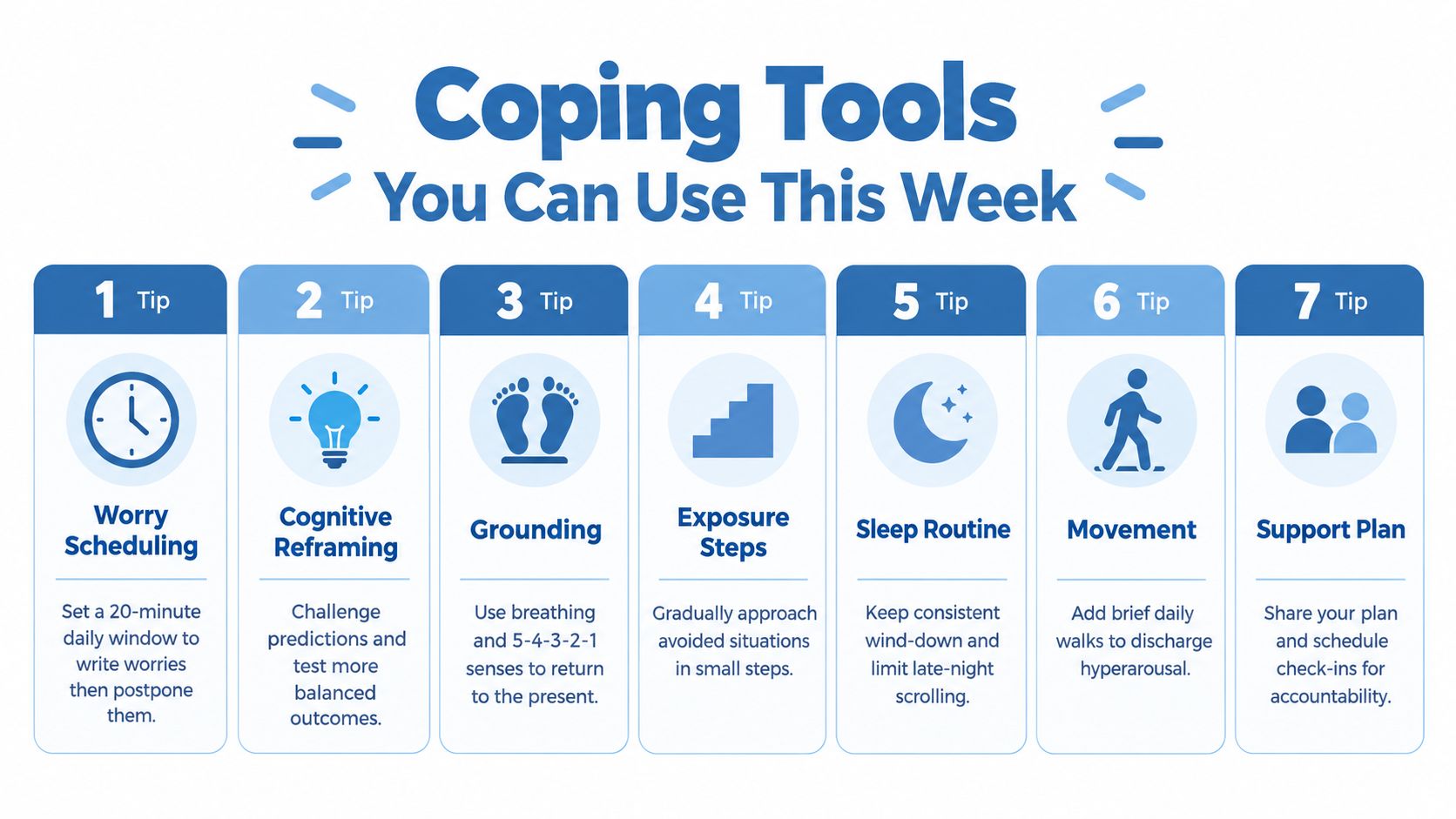
The most useful tools are the ones that interrupt the loop before it turns into a whole-day event. Worry scheduling works because it tells the brain that worry has a place, just not every minute. Exposure planning works because avoidance is what keeps the feared future feeling fragile and dangerous.
A simple weekly structure
Monday, Worry scheduling: Set a 20-minute window, write the worries down, and postpone them outside that window.
Tuesday, Exposure planning: Pick one low-stakes avoided task and do it on purpose.
Wednesday, Grounding: Use the 5-4-3-2-1 senses exercise and paced breathing at about six breaths per minute.
Thursday, Sleep protection: Keep a consistent wake time and reduce late-night news scanning.
Friday, Body regulation: Add a brief walk to discharge tension and lower arousal.
Saturday, Boundaries: Watch caffeine and alcohol intake if either tends to amplify symptoms.
Sunday, Review: Write what got easier, what stayed hard, and what needs a better plan next week.
That structure matters because anticipatory anxiety rarely responds to a single rescue technique. It improves when the brain gets repeated evidence that you can plan, tolerate uncertainty, and stay in the situation long enough for the fear spike to fall. If you're tempted to avoid everything until you feel calmer, that usually backfires.
Start small enough that you'll actually repeat the exercise, then build from there.
If you want a simple rule, use coping tools for the week, not just the moment. The point is to train the nervous system that future events can be approached, survived, and reviewed without panic taking over every hour.
Preparing for a Telepsychiatry Evaluation in Florida
A good psychiatric intake is organized, not intimidating. At Refresh Psychiatry, scheduling starts online or by phone, and the first step is completing digital forms that cover your history, prior diagnoses, current medications, and insurance details. That paperwork helps the clinician spend the video visit on the part that matters most, your actual symptom pattern.
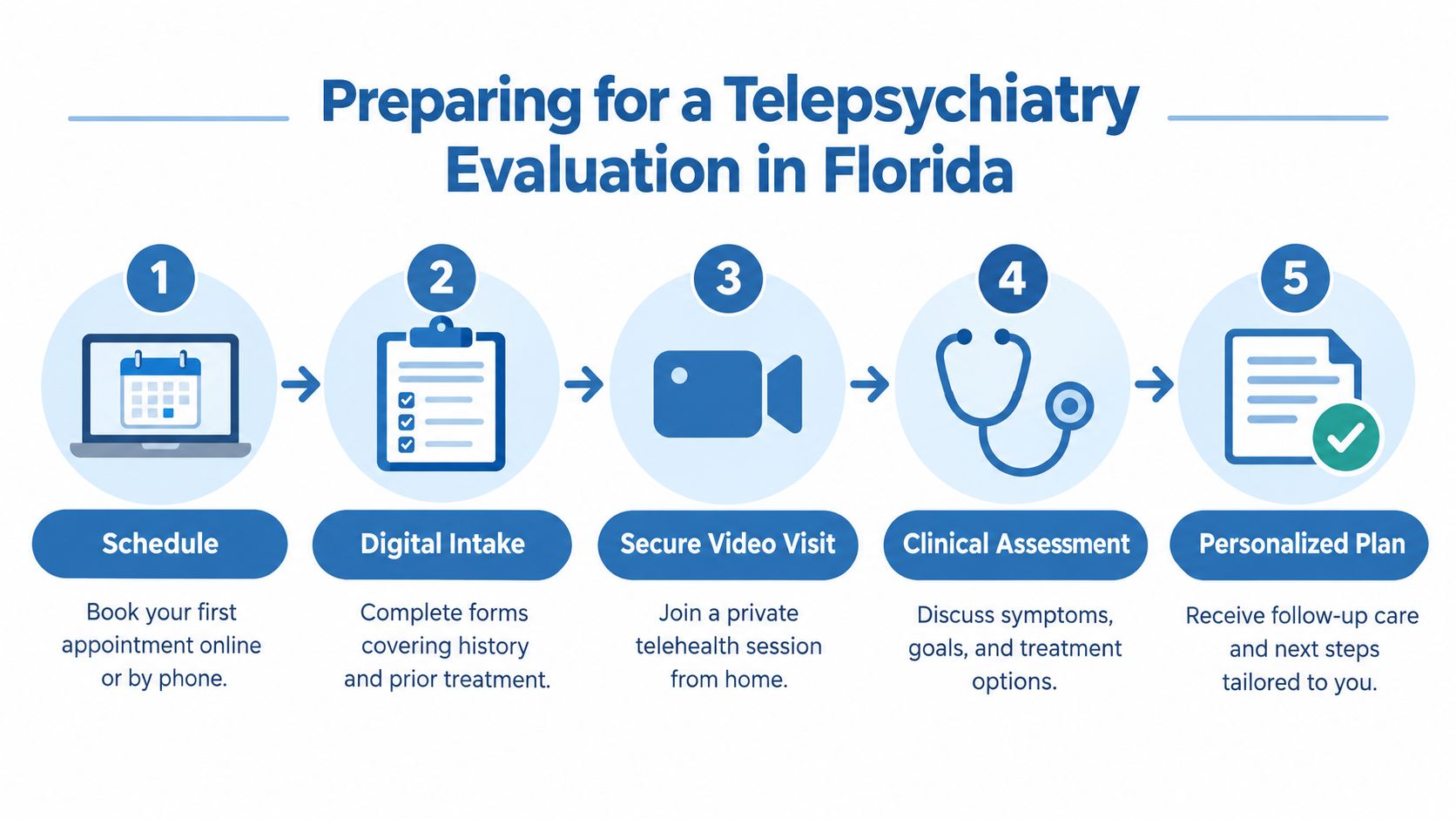
A typical diagnostic visit runs about 60 minutes and covers the timeline of symptoms, medical history, past treatment, and rule-outs for conditions like GAD, panic disorder, and PTSD. The psychiatrist then builds a collaborative formulation, which means the diagnosis is tied to the way your symptoms show up in daily life, not just a checklist.
If medication is appropriate, it's discussed alongside therapy so the plan matches the problem. Prescriptions can be routed to Florida pharmacies, and follow-up visits are used to adjust the approach as symptoms change. If the care plan includes psychotherapy, the psychiatrist can coordinate with the in-house therapist so CBT, DBT skills, and medication management aren't working in separate lanes.
For people who want a telemedicine-specific overview, the practice's telemedicine psychiatry page is a useful reference. Bring your medication list, a brief symptom timeline, and any questions you want answered about treatment choices, side effects, or next steps. A quiet room, a stable connection, and a few notes are usually enough.
Key Takeaways and How to Reach Refresh Psychiatry
Anticipatory anxiety is a future-oriented threat response, not just “worrying too much.” It can respond to CBT, DBT skills, and medication when indicated, especially when treatment targets the loop between prediction, body arousal, and avoidance. Early evaluation usually shortens the course because people stop spending months guessing at what's wrong and start treating the actual pattern.
Contact us or call Refresh Psychiatry at (954) 603-4081 to schedule your evaluation. We accept Aetna, United Healthcare/UHC, Cigna, Blue Cross Blue Shield, Humana, Tricare, UMR, and Oscar insurance plans. This blog is for informational purposes only and does not constitute medical advice. Please consult a qualified mental health professional for personalized guidance.
Refresh Psychiatry & Therapy offers Florida telepsychiatry for anxiety evaluation, medication management, and coordinated therapy in one care model. If future-focused dread is running your schedule, you can visit Refresh Psychiatry & Therapy to request a telepsychiatry intake and talk through what's driving the pattern.