
🛌 Wrong Antidepressant Signs and What to Do Next

🛌 Wrong Antidepressant Signs and What to Do Next
A lot of people land in the same uneasy place. You started an antidepressant because you wanted relief, or at least movement in the right direction. Instead, you feel flat, restless, foggy, more tired, more anxious, or unchanged. Then the question arrives fast: Am I on the wrong antidepressant?
That question matters, but it needs to be handled carefully. Feeling worse doesn't always mean the medication is wrong. Feeling numb doesn't always mean it has failed. And feeling no better after a short time doesn't automatically mean you need to stop. In clinic, the safest next step is usually not guessing. It's checking a few basics in order, then deciding what to do with your prescriber.
Introduction When Your Antidepressant Does Not Feel Right

A common first visit goes like this. Someone starts an antidepressant, gets through several days, and notices they are crying less but also feel emotionally flat. Someone else takes it as prescribed for a few weeks and says, "I am still dragging myself through the day. Nothing is shifting." A third person misses a few doses, then feels dizzy, shaky, and strange enough to assume the prescription was a bad choice from the start.
Those experiences can sound similar. In clinic, they point to different problems.
What usually needs checking first
Before calling it the wrong antidepressant, I check four practical points:
Was it taken consistently? Missed doses can create symptoms that look like the medication is failing.
Was the dose adequate? A dose that is too low may look like no response. A dose that is too high may be hard to tolerate.
Has there been enough time at that dose? Early side effects often show up before the benefits do.
What exactly feels wrong? No benefit, partial benefit, emotional blunting, agitation, nausea, insomnia, and withdrawal after missed doses each lead to different next steps.
Practical rule: Do not stop an antidepressant abruptly because a rough week made it feel discouraging. Sudden changes can cause withdrawal symptoms, rebound distress, and confusion about what is driving the change.
The timeline matters. Side effects such as nausea, headache, restlessness, sedation, or sexual problems often show up early. True nonresponse is a different question and usually needs a fair trial at a consistent dose before it can be judged. Withdrawal has its own pattern. It often starts after missed doses, a rapid taper, or stopping the medication, especially with shorter-acting drugs. Getting those categories right prevents a lot of unnecessary switching.
Early trial and error is common. In a large U.S. claims study, 8.6% of adults starting antidepressants for depression switched to a different antidepressant within the first 90 days, and a UK population study found 9.3% switched during the initial treatment episode, with 60% of those switches happening within eight weeks (antidepressant switching data).
What helps most right now
Bring specifics to the next appointment. Track sleep, appetite, motivation, anxiety, missed doses, emotional blunting, sexual side effects, nausea, agitation, and changes in daily functioning. If you also want to review interactions or basic medication risks, this guide on whether antidepressants are safe can help frame the discussion.
The goal is not to guess the answer alone. It is to sort out whether this is a medication that needs more time, a dose adjustment, a slower taper, support from therapy, or a selective next step such as pharmacogenomic testing when the history suggests it may be useful.
How to Tell You May Be on the Wrong Antidepressant
The phrase wrong antidepressant usually refers to one of four patterns. Mixing them together leads to bad decisions. Patients often say, "It's not working," when the underlying issue is either side-effect burden, partial response, or symptoms that worsened after a change in dose.
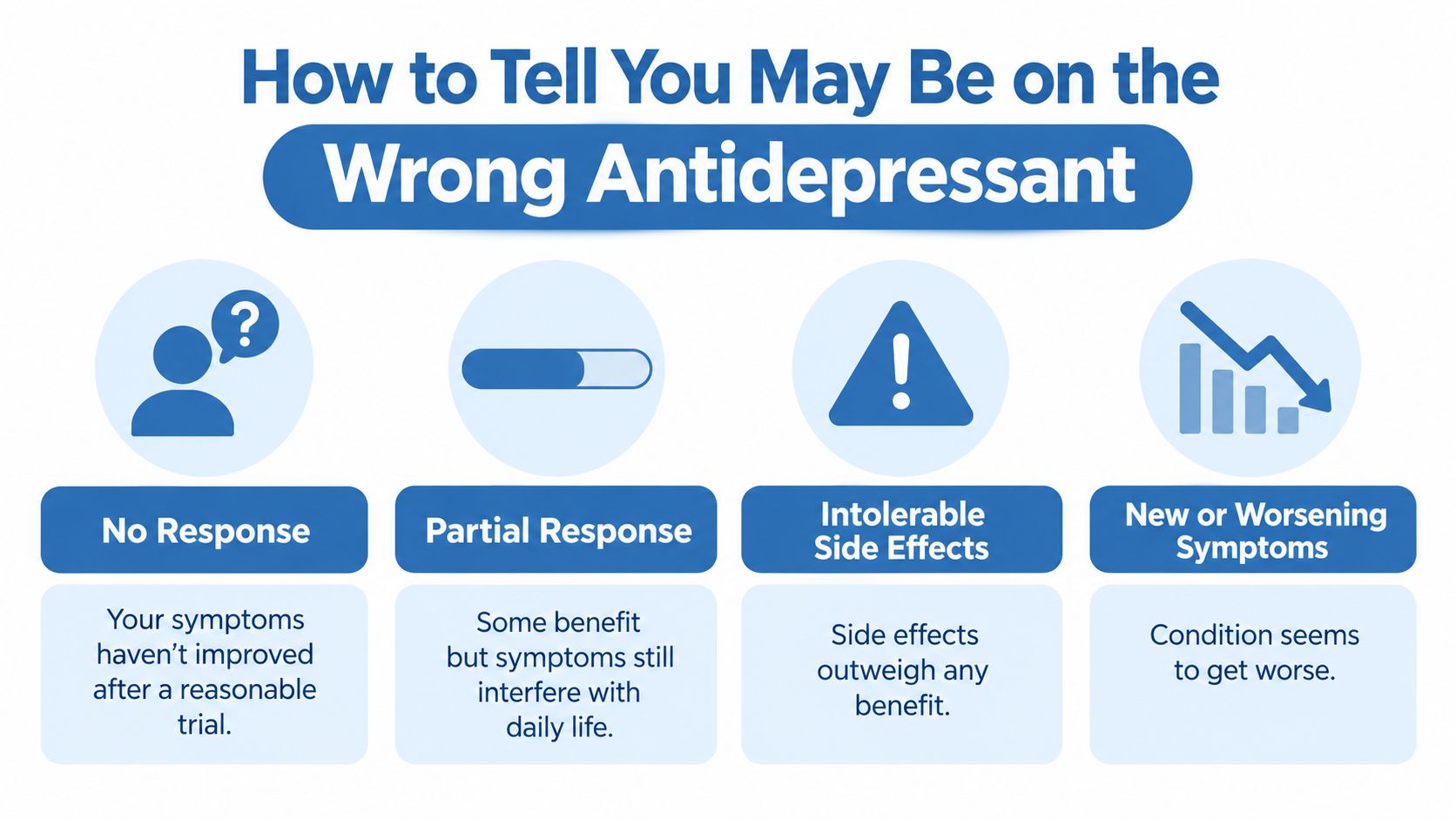
No response is different from partial response
A review on switching and stopping antidepressants notes that if there's no improvement after three to four weeks at an adequate dose, patients are unlikely to respond, and about a quarter of patients switched to a second antidepressant achieve remission (review of switching and stopping antidepressants). That doesn't mean every unchanged week equals failure. It means a complete lack of movement after an adequate early trial deserves reassessment.
By contrast, partial response can be easy to dismiss. Some people sleep a bit better, cry less, or get through work with less effort, but still feel depressed enough that daily life remains impaired. Historically, many antidepressants produce response in about 50% to 60% of patients, but remission is much lower, typically 20% to 30% for SSRIs, which is why "a little better" often doesn't feel like enough (clinical review on treatment of major depression).
Side effects can make an otherwise useful medication a bad fit
A medication can be biologically active and still be the wrong fit because the burden is too high. Common complaints include emotional blunting, activation, daytime sedation, gastrointestinal upset, sexual dysfunction, or sleep disruption. That's not the same as nonresponse.
If emotional flattening is what stands out, patients often need help putting language to it. This overview of emotional blunting on antidepressants can help you describe the pattern more accurately at your visit.
Sometimes the medication is "working" on paper while the person taking it feels less like themselves. That still matters.
New or worsening symptoms need prompt review
A few symptom shifts deserve more urgency. Marked agitation, sharply worse insomnia, sudden activation, or a noticeable drop in functioning after starting or changing a medication should be discussed quickly. So should any new suicidal thinking, self-harm thoughts, or symptoms that look more like mania than depression.
For readers trying to compare symptom patterns with a broader mental health overview, this plain-language guide from Empire Medical Wellness mental health is a reasonable companion resource.
A simple daily note is enough. Write down:
Mood: one sentence, not an essay
Sleep: better, same, or worse
Function: work, parenting, school, chores
Adherence: taken exactly as prescribed or not
Side effects: what, when, and how disruptive
Bring that log. It is often more helpful than memory.
Immediate Safety Steps and When to Seek Urgent Care
If your antidepressant feels wrong and you can't reach your prescriber today, focus on staying safe and keeping the situation observable. The worst move is a panicked medication change without a plan.
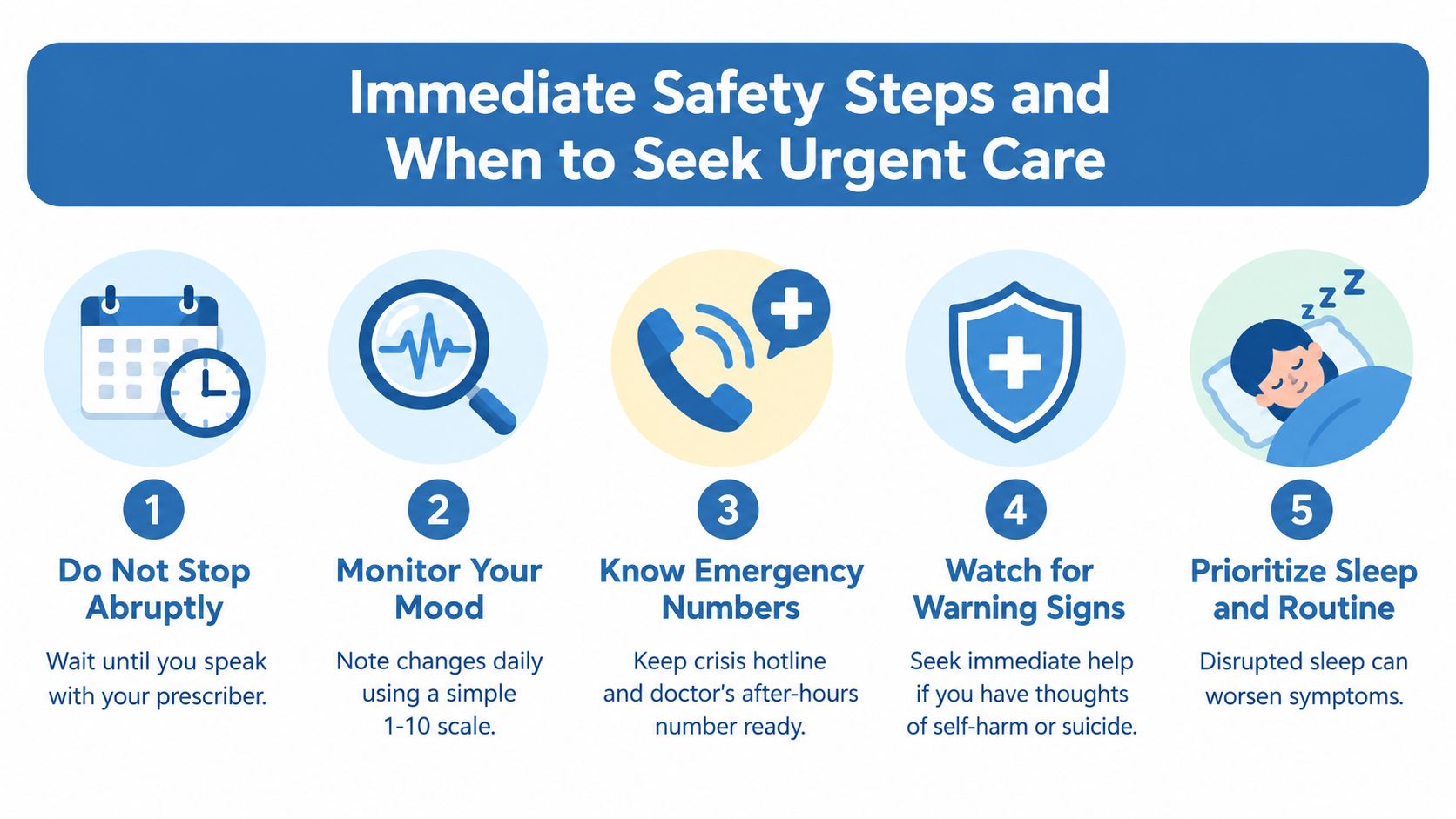
What to do in the next 24 to 72 hours
Start with these basics:
Keep taking it as prescribed unless a clinician tells you otherwise. Abrupt stopping can create a second problem.
Write down the timing. Note when you started, when the dose changed, and when symptoms changed.
Reduce avoidable noise. Alcohol, recreational drugs, and erratic sleep can make the picture harder to read.
Tell one trusted person what's going on. Ask them to check in, especially if your mood is worsening.
Keep your follow-up details nearby. Save the office number, after-hours instructions, and pharmacy information.
A short tracking template helps:
Dose today
Any missed doses
Mood change
Sleep last night
Anxiety or agitation
Physical symptoms
Big stressors
Substances used
Safety note: If you feel much more impulsive, unable to sleep, intensely agitated, or unlike yourself in a way that feels out of control, don't wait for a routine follow-up.
This is also a good time to know when psychiatric input should happen sooner rather than later. If you're unsure whether it's time, this guide on when to see a psychiatrist may help you judge the threshold.
A brief video can also help reinforce the safety mindset before making any medication changes:
When urgent care is the right choice
Seek immediate help through urgent psychiatric care, a crisis line, or emergency services if you have:
Thoughts of suicide or self-harm
Thoughts of harming someone else
Severe agitation or confusion
Very little sleep with rapidly escalating energy or impulsivity
Severe physical reactions that feel dangerous
You do not need to prove to yourself that it is "bad enough" before reaching out. If safety is in question, err on the side of getting evaluated.
How to Talk With Your Prescriber and What to Ask
A common visit goes like this. Someone starts an antidepressant, feels nauseated and wired in the first week, misses a few doses, then feels even worse after a dose change. By the time we meet, the main question is not, "Is this the wrong antidepressant?" The job is to sort out whether this is true nonresponse, side-effect intolerance, activation, withdrawal from inconsistent dosing, or a different diagnosis that needs a different plan.
That distinction changes what a careful prescriber recommends.
Before changing treatment, clinicians usually verify four basics: whether you are taking it consistently, whether the dose is high enough to matter, whether side effects are limiting the trial, and how long you have been at a therapeutic dose. NICE guidance supports considering a switch if there has been no response after about 1 month, while partial response may justify a bit more time before changing course. The same guidance notes that evidence for one antidepressant class being broadly better than another is limited, so switching classes is not automatically the smartest next step (NICE evidence review on antidepressant treatment steps).
In clinic, the timeline often gives the answer. Problems that start within days of starting or increasing a dose point more toward side effects or activation. Symptoms that appear after missed doses can reflect withdrawal, especially with shorter half-life medications. Little or no change after an adequate trial raises the question of true nonresponse.
Should You Stay Adjust Switch or Augment
Clinical Pattern | Consider Next | Key Questions to Ask |
|---|---|---|
No meaningful improvement after an adequate trial | Switch or reassess diagnosis, adherence, and dose | "Have I had a true trial at a therapeutic dose?" "Could missed doses or alcohol or cannabis be muddying the picture?" |
Some improvement, but you are still not functioning well | Adjust or augment | "Is this enough early benefit to build on?" "Would adding therapy or another medication make more sense than switching?" |
Clear benefit, but side effects are hard to live with | Adjust or switch | "Can we lower the dose, change timing, or use a medication with a better side-effect fit for me?" |
Sudden worsening after starting or increasing the dose | Prompt review | "Could this be activation, an interaction, or a sign we should reconsider the diagnosis?" |
Symptoms changed right after missed doses or a rapid taper | Reassess consistency before judging the medication | "Could this be withdrawal rather than relapse or failure?" |
Initial benefit, then progress stalled | Adjust, augment, or review outside factors | "Is the medication still doing enough to build on, or are stress, sleep, substances, or another condition getting in the way?" |
Bring a short timeline to the appointment. Start with the date you began the medication, the date of each dose change, any missed doses, what changed in your mood, and what physical symptoms showed up. That usually helps more than a long description of every bad day.
Questions that lead to useful answers:
About the trial: "Have I taken this at a high enough dose, for long enough, to judge it fairly?"
About what type of problem this is: "Does this look more like nonresponse, side effects, activation, or withdrawal from inconsistent dosing?"
About next steps: "In my case, would you favor a dose change, a switch, or augmentation?"
About therapy: "Which psychotherapy would best match what I am dealing with right now?"
About testing: "Is there any reason pharmacogenomic testing would help here, or is this decision better made from my symptom pattern and history?"
About monitoring: "What should I track over the next two weeks so we can make a cleaner decision?"
If you want help putting that conversation into words, this guide on how to talk to a doctor about depression gives a practical script.
Pharmacogenomic testing has a role, but it is selective. I consider it when someone has had unusual side effects, several unsuccessful medication trials, or a history that suggests metabolism may be part of the problem. It does not tell you which antidepressant will work best with certainty. It can sometimes help explain why a medication was poorly tolerated or why standard doses have gone badly.
Augmentation also deserves a direct discussion if the medication is helping some but not enough. In the original VAST-D trial, remission rates at 12 weeks were higher with bupropion augmentation or aripiprazole augmentation than with switching to another antidepressant, which is one reason augmentation can be a reasonable next step after partial response instead of abandoning a partly helpful medication (VAST-D trial publication in JAMA Psychiatry).
A good antidepressant visit is a decision visit. The goal is to leave knowing what problem you are treating, what trade-off you are accepting, what change comes next, and when you will reassess.
Switching and Tapering Without Confusing Withdrawal for Relapse
A common clinic scenario goes like this: someone lowers an antidepressant on Monday, feels dizzy and unsettled by Tuesday, then concludes the medication was wrong all along or the new plan is failing. That conclusion is understandable, but the timing often points somewhere else.
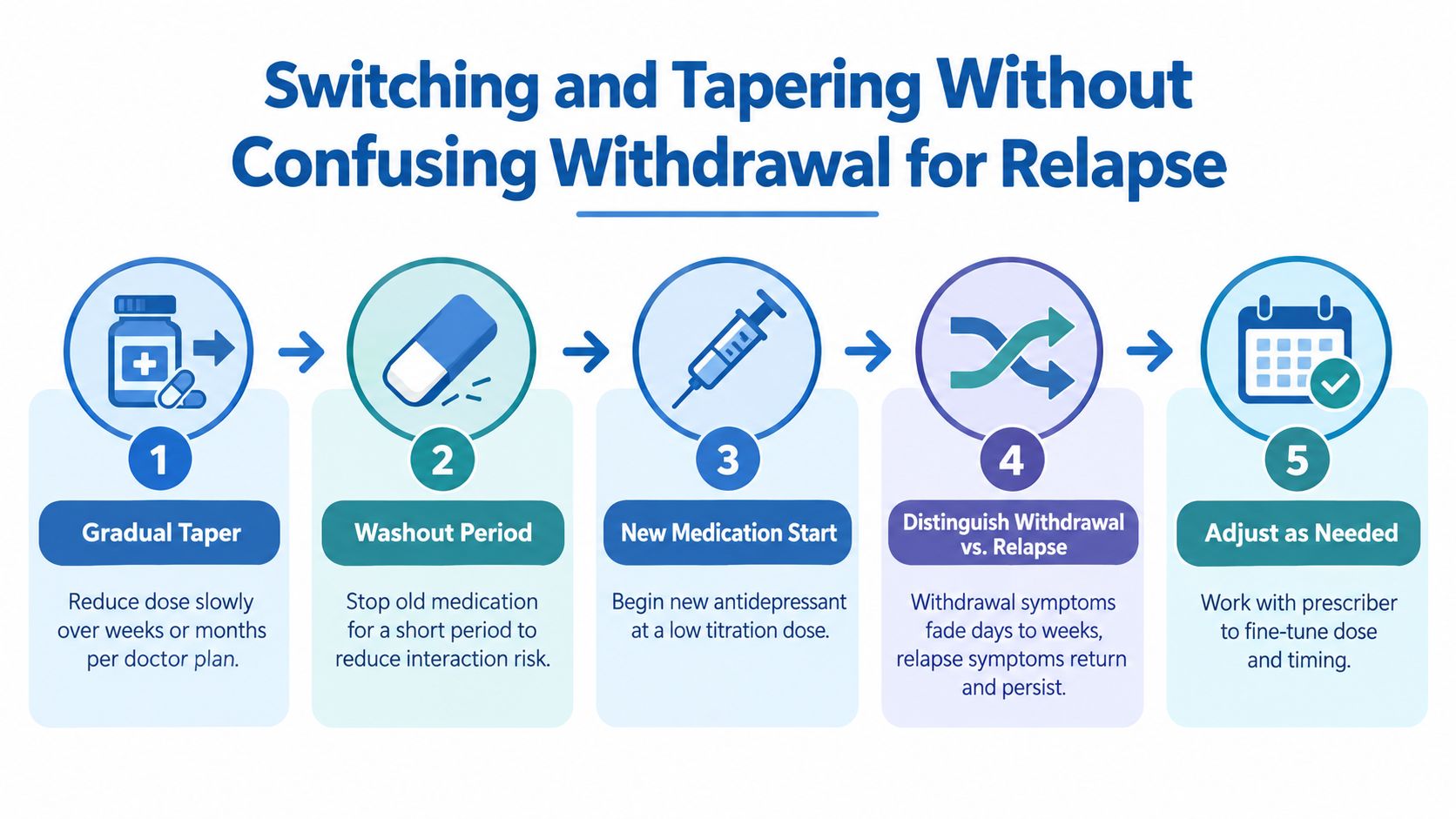
What withdrawal often looks like
The first question is usually about timing. If symptoms begin soon after stopping, missing doses, or cutting the dose down, withdrawal moves high on the list. Common discontinuation symptoms include dizziness, nausea, vertigo, and nervousness. A newer meta-analysis found about one extra withdrawal symptom on average at one week and no clear link to depressive symptoms, which helps explain why a bad switch can be misread as a bad diagnosis or a failed new medication (meta-analysis on antidepressant discontinuation and withdrawal symptoms).
In practice, withdrawal often feels more physical or neurologic than depressive. Patients describe feeling off balance, flu-like, nauseated, overstimulated, or “not like themselves” within days of the change.
What relapse usually feels like
Relapse tends to look more like your original depression returning. The pattern matters. Low mood, loss of interest, hopelessness, slowed thinking, guilt, poor concentration, and the same functional decline you had before treatment are more suggestive of the illness coming back than of withdrawal.
The timeline helps sort this out.
More suggestive of withdrawal: dizziness, nausea, vertigo, nervousness, “brain zaps,” or feeling physically strange soon after a dose reduction or stop
More suggestive of relapse: your familiar depression pattern returning and continuing rather than easing over several days
Could be either: anxiety, sleep disruption, irritability, and fatigue
I usually ask three plain questions: When did the medication change? When did the symptoms start? Do these symptoms feel like your usual depression, or do they feel different?
Why tapering still matters
Tapering is still the standard way to lower interaction risk and make a switch easier to read clinically. It also gives you a better chance of separating three different problems that get lumped together all the time: true nonresponse, side-effect intolerance, and discontinuation symptoms.
It is not perfect protection. Some people still develop withdrawal symptoms despite a careful taper, especially with medications such as paroxetine or venlafaxine. That does not mean the overall plan was wrong. It means the nervous system noticed the change.
One point I emphasize in clinic is that symptom onset within a day or two of stopping a medication usually deserves a withdrawal check before anyone labels it relapse. If a patient says, “I crashed right after I stopped it,” I want the sequence mapped out before changing the whole treatment strategy.
Keep expectations realistic after a switch
A second antidepressant can help. It is not always a dramatic reset. After an initial SSRI fails, STAR*D-level switch analyses found remission rates of about 18% for sertraline, 21% for bupropion SR, and 25% for venlafaxine XR, with no statistically significant differences. A later reanalysis estimated sustained remission after a step-2 switch at only 3.1% to 8.4% over 12 months (STAR*D switch reanalysis).
That is why the next move should be targeted. If the first medication caused early agitation, insomnia, sexual side effects, or emotional blunting, that is a tolerability problem. If it was taken at a fair dose for long enough with little benefit, that is closer to nonresponse. If the worsening happened right after a dose drop, withdrawal belongs near the top of the list. Those are different problems, and they lead to different decisions.
Stopping antidepressants can also produce discontinuation symptoms in a substantial minority of patients. A 2024 meta-analysis reported symptoms in about 31% after discontinuation, and the pooled estimate after adjusting for placebo discontinuation was about 15%, or roughly one in six to one in seven people (2024 antidepressant discontinuation meta-analysis). Severe symptoms appear uncommon but real, with one summary reporting severe symptoms in about one in 35 people, and noting higher likelihood with drugs such as paroxetine and venlafaxine (Charité summary of discontinuation data).
The practical takeaway is simple. Do not judge a medication switch by the first rough day alone. Judge it by the symptom pattern, the timing, and whether the new problems match depression, withdrawal, or side effects.
Getting the Right Fit With Telepsychiatry Therapy and Selective Testing
A better antidepressant fit usually comes from coordinated care, not from medication roulette. That means reviewing diagnosis, looking at symptom patterns over time, treating insomnia and anxiety when they are part of the picture, and using psychotherapy alongside medication instead of waiting for a pill to do every job.
Where therapy changes the outcome
If your current medication is helping only partway, therapy often changes what happens next. CBT can help with depressive thinking patterns and avoidance. DBT skills can help when distress tolerance and emotional swings are part of the problem. Trauma-focused work matters when past experiences keep driving current symptoms. For people trying to choose a therapist for online depression, the most useful question isn't "Who's available first?" It's "What type of therapy matches the problem I'm having?"
For some Florida patients, telepsychiatry makes this easier to sustain because follow-up is simpler when visits fit normal life. Refresh Psychiatry & Therapy offers statewide telepsychiatry, medication management, and therapy in a coordinated model, which is one practical option when antidepressant treatment needs closer review.
When genetic testing helps and when it doesn't
Pharmacogenomics is often oversold. It is not a universal answer to the wrong antidepressant problem. Current reviews and guidance say the most clinically actionable markers are CYP2D6 and CYP2C19, with selected roles for CYP2B6, while SLC6A4 and HTR2A are not considered clinically actionable for antidepressant prescribing (review of antidepressant pharmacogenomics).
That makes testing most useful in selected situations:
Prior nonresponse
Dose-limiting intolerance
Polypharmacy
Suspected exposure mismatch, where the body may be processing a drug too slowly or too quickly
If you're curious how this works in real treatment planning, this overview of Genomind testing and psychiatric medication decisions is a helpful starting point.
Current guidance also does not support routine DNA testing as a blanket fix. The French RNPGx guidance recommends CYP2D6 and CYP2C19 genotyping before antidepressant initiation in higher-risk patients and suggests dose reduction of about 25% to 50% for partial metabolic deficiency (RNPGx guidance summary). Used selectively, that can improve safety and dosing decisions. Used indiscriminately, it often creates more confidence than clarity.
Contact us or call Refresh Psychiatry at (954) 603-4081 to schedule your evaluation. We accept Aetna insurance information, United Healthcare and UHC insurance information, Cigna insurance information, Blue Cross Blue Shield insurance information, Humana insurance information, Tricare, UMR, and Oscar insurance plans.This blog is for informational purposes only and does not constitute medical advice. Please consult a qualified mental health professional for personalized guidance.
If you're trying to figure out whether you have the wrong antidepressant, Refresh Psychiatry & Therapy provides telepsychiatry evaluations, medication management, and therapy for Florida patients who need a careful review of symptoms, side effects, withdrawal concerns, and next-step options. The goal is to make a clear plan, not just swap medications blindly.