
💔 Rejection Sensitive Dysphoria Guide for Adults

You send a carefully written message, then notice the other person has seen it but hasn't replied. Your chest tightens. A neutral delay begins to feel like proof that you've done something wrong. Within minutes, you may feel shame, anger, panic, or an urge to withdraw, even though you don't yet know what the silence means. Rejection sensitive dysphoria gives language to this kind of sudden, painful emotional reaction.

Introduction to Rejection Sensitive Dysphoria and Why It Matters
The experience can appear in ordinary moments. A supervisor edits your work, a friend changes plans, a partner uses a different tone, or a teacher says an assignment needs revision. Other people might experience these events as disappointing or mildly uncomfortable. You might experience them as an emotional emergency, with a rapid shift into self-criticism, tears, anger, avoidance, or silence.
That response can affect relationships, work, school, and daily decisions. You may stop applying for opportunities because criticism feels unbearable. You may overexplain a small mistake, ask for repeated reassurance, or end a relationship before the other person has a chance to reject you. Children and teenagers may refuse activities, leave social settings, or react intensely to feedback. The behavior can look defiant or dramatic from the outside, while the person inside may feel frightened and exposed.
Understanding the pattern matters because shame often adds a second layer of suffering. Someone may think, “I'm too sensitive,” “I'm difficult,” or “I can't handle normal life.” A more accurate view is that an intense reaction deserves careful assessment. The term rejection sensitive dysphoria isn't a formal diagnosis, and it shouldn't replace evaluation for ADHD, anxiety, depression, trauma-related symptoms, autism, or other conditions.
If you've been wondering why you feel so emotional, this guide can help you organize the experience without rushing into self-diagnosis. It explains what the term means, how rejection-related distress may look at different ages, where it overlaps with other conditions, and how therapy, medication evaluation, and everyday skills can work together.
Refresh Psychiatry & Therapy provides Florida telepsychiatry and therapy services for people seeking a clearer understanding of emotional regulation and related concerns. The aim isn't to label every painful reaction. It's to identify patterns, understand triggers, and find support that fits the whole person.
What Rejection Sensitive Dysphoria Really Means
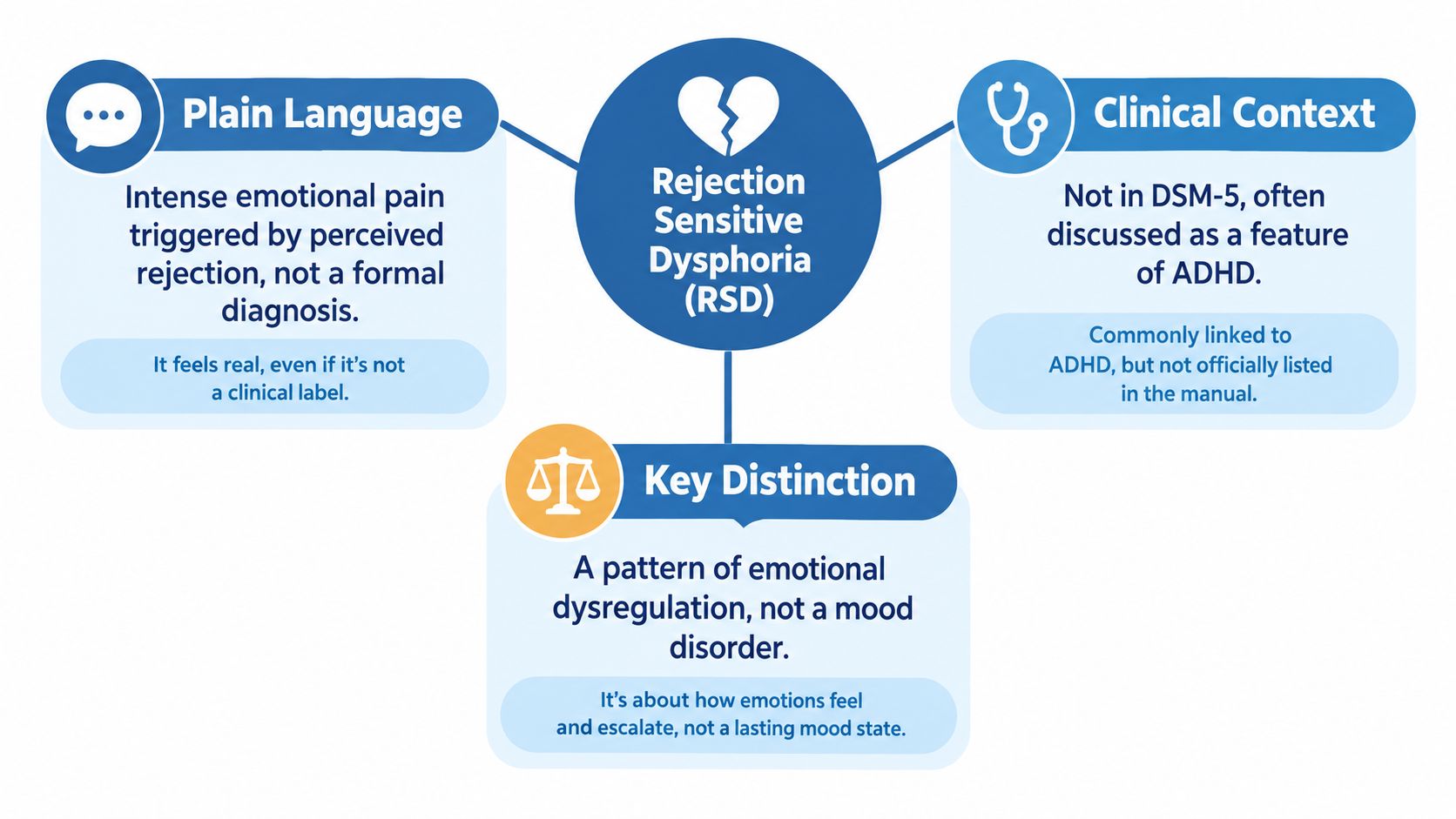
In plain language, rejection sensitive dysphoria describes sudden, intense emotional pain after real or perceived criticism, rejection, failure, or disappointment. The trigger may be direct, such as someone saying your work needs improvement. It may also be ambiguous, such as a delayed text or a brief facial expression that your mind interprets as disapproval.
The word “dysphoria” refers to an experience that feels difficult to bear. The reaction can involve sadness, shame, anger, anxiety, physical discomfort, or a strong wish to escape the situation. It isn't a preference for praise, and it isn't proof that the other person intended harm.
Core idea: Rejection sensitive dysphoria is a descriptive label for intense distress linked to real or perceived rejection or criticism. It isn't a standalone psychiatric diagnosis.
RSD is not listed as a formal diagnosis in the DSM-5 or ICD-11. Current literature treats it as a descriptive concept, often discussed alongside emotional dysregulation in ADHD, while direct scientific evidence remains limited and specific intervention trials for RSD haven't been established (peer-reviewed review of the current evidence).
A sensitive emotional smoke alarm
A useful analogy is an emotional smoke alarm. A standard alarm responds to smoke, but an overly sensitive alarm may sound when toast burns. The alarm isn't imaginary. It's signaling danger, but its intensity or timing may not match the situation.
The sequence often looks like this:
A cue appears. Someone offers feedback, doesn't respond, or changes their behavior.
Your brain assigns meaning. The cue becomes “I failed,” “They're upset,” or “I'm about to be abandoned.”
The body reacts. Your heart may race, muscles may tense, or your stomach may drop.
Emotion surges. Shame, anger, panic, or sadness arrives quickly.
Protection takes over. You may apologize repeatedly, argue, shut down, avoid, or leave.
The interpretation can be accurate, partly accurate, or mistaken. The emotional pain still feels real. Pausing between the cue and the conclusion creates room to check what happened before acting on the alarm.
The concept has historical roots in clinical descriptions from the 1960s, when psychiatrist Paul Wender described ADHD patients who showed a “horrifying and instant response to rejection or failure.” Psychiatrist William Dodson later popularized the term in the 1990s to describe sudden, intense reactions associated particularly with ADHD (historical and research overview). For readers comparing sensitivity, attention, and neurodivergence, this discussion of HSP and ADHD may provide useful context.
How Rejection Sensitive Dysphoria Shows Up Across Ages
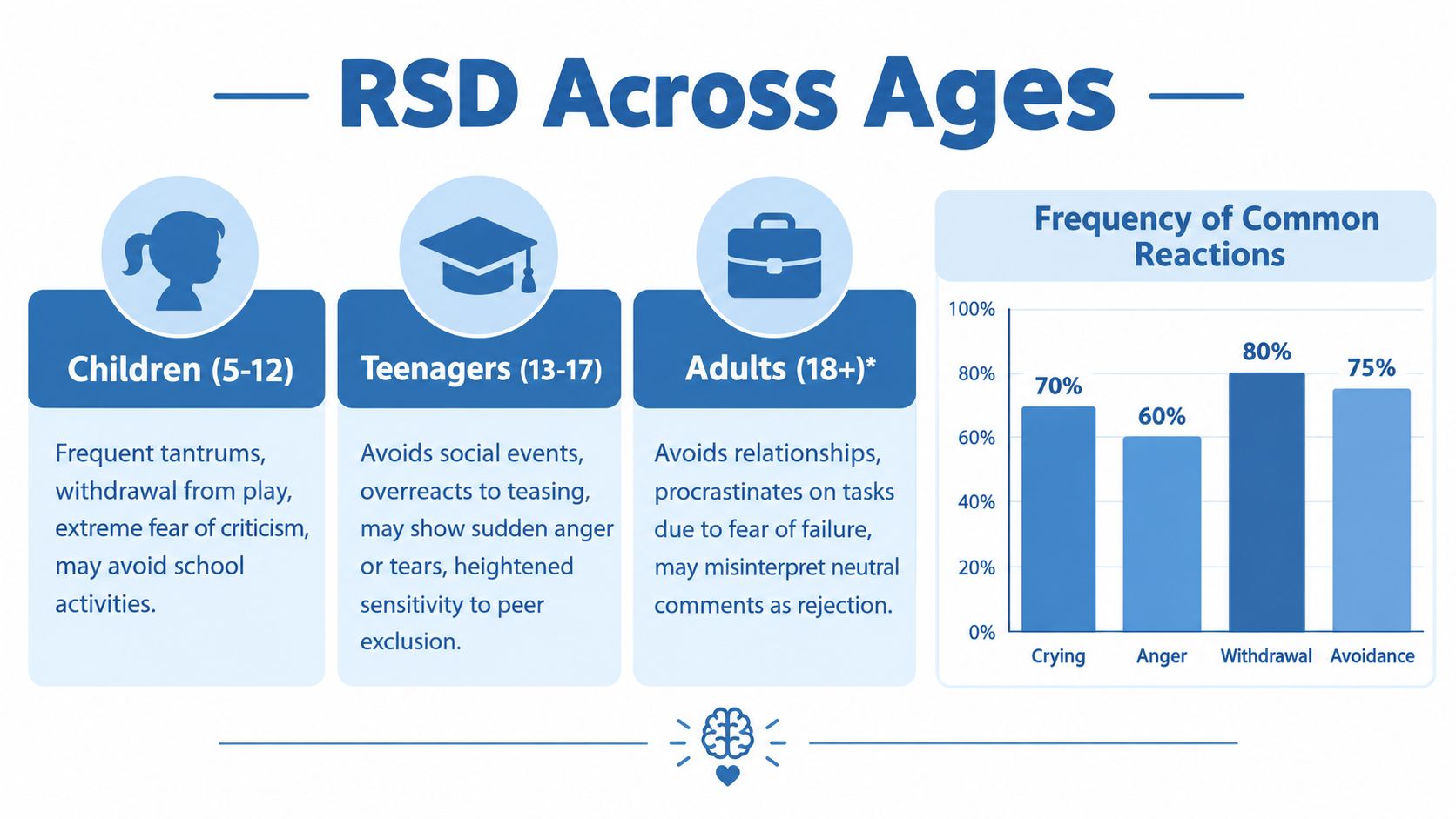
Age changes the way emotional pain gets expressed. A child may not have the vocabulary to say, “I'm interpreting your correction as rejection.” Instead, the child may throw a pencil, cry, hide, or insist on leaving the activity. Adults may describe the same underlying experience with more nuanced language, but their protective behavior can still be avoidance, anger, people-pleasing, or withdrawal.
Children and school-age patterns
A child might become distressed after losing a game, receiving a corrected paper, or being left out of a group. The child may refuse to try again, say “I'm stupid,” or avoid activities where an adult or peer could evaluate performance. Caregivers may see tantrums, sudden tears, refusal to attend school events, or withdrawal from play.
A helpful response separates the feeling from the conclusion. “You felt embarrassed when the teacher corrected the answer” validates the emotion without confirming that the teacher rejected the child. Calm co-regulation, a brief pause, and a specific plan for trying again can work better than a long lecture during the emotional peak.
Teenagers and peer evaluation
Adolescents often face intense social comparison. A missed invitation, teasing, a group chat response, or a disappointing grade may feel like a verdict on identity and belonging. Some teenagers withdraw from friends, abandon activities, pursue perfectionism, or react with sudden anger and tears.
Adults can ask concrete questions: “What happened first?” “What did you think it meant?” and “What else could explain the behavior?” These questions help distinguish an observable event from the story attached to it, without dismissing the teenager's distress.
Adults at work and in relationships
Adults may accept too much criticism, avoid dating, delay submitting work, or leave a conversation before hearing reassurance. Someone might reread an email repeatedly, interpret a neutral comment as contempt, or become angry when a partner asks for a change. Another person may mask distress by appearing agreeable, then shut down later.
There are no population-wide prevalence estimates for RSD itself, because researchers don't have an agreed case definition or validated epidemiologic instrument. Emotional regulation difficulty associated with ADHD offers useful context, with significant difficulty reported in about 25–45% of young people with ADHD and 30–70% of adults with ADHD in a peer-reviewed summary (summary of ADHD emotional regulation and RSD prevalence limitations). Those figures describe ADHD-related emotional regulation difficulty, not a confirmed prevalence rate for RSD.
Recognition should lead to curiosity, not a label. Track the trigger, the interpretation, the body response, and what you did next. That record gives a clinician more useful information than a checklist alone.
Rejection Sensitive Dysphoria and Its Connection to ADHD and Mood Conditions
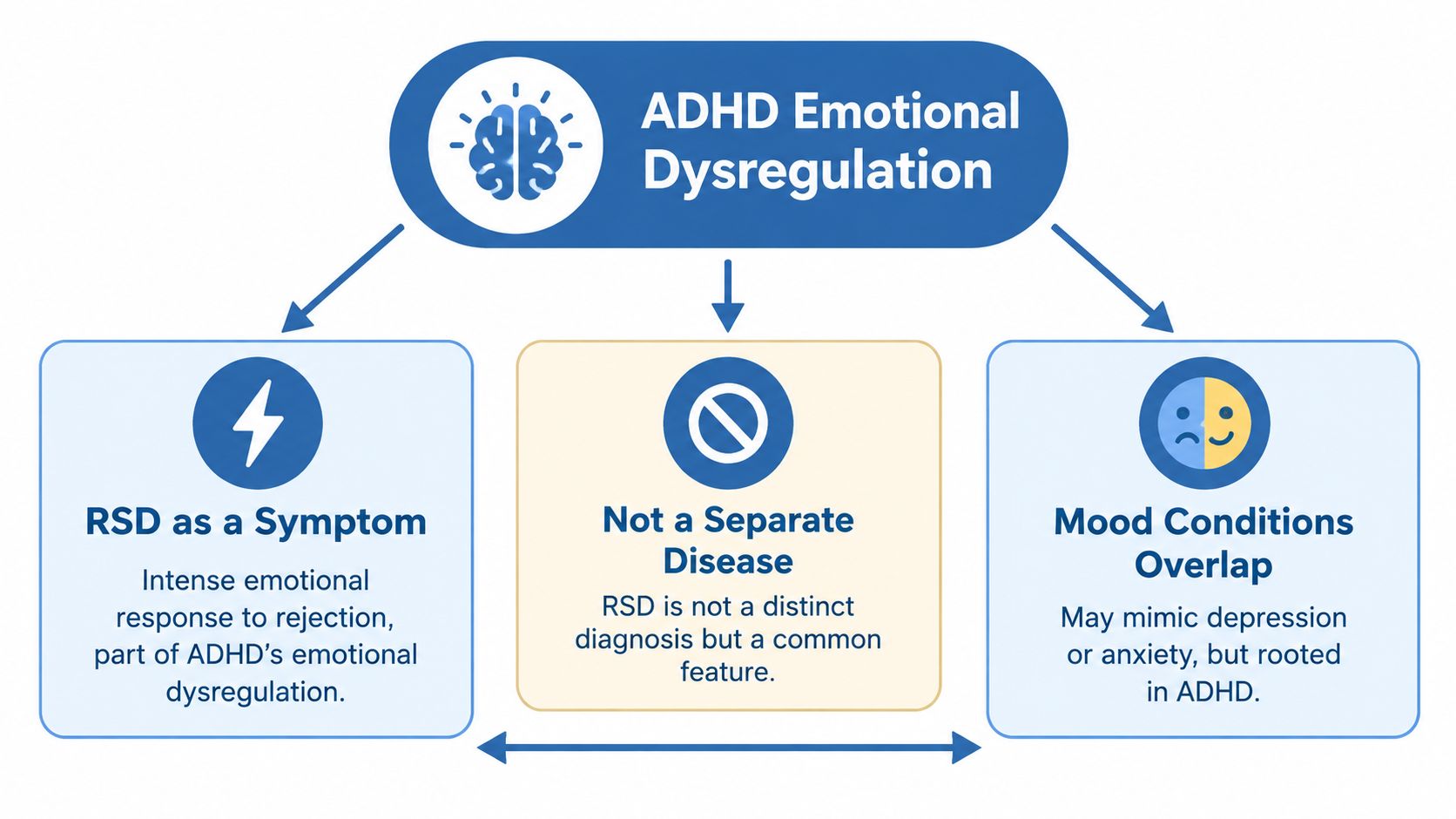
The strongest consistent association is between RSD-like experiences and ADHD-related emotional dysregulation. Clinical sources describe RSD as appearing most often in people with ADHD, but they frame it as a pattern or feature rather than a separate disease (Cleveland Clinic overview of RSD).
ADHD can affect attention, impulse control, working memory, and the speed with which a person shifts between emotional states. Social history also matters. Repeated criticism, exclusion, misunderstanding, masking, or inconsistent support can teach someone to scan constantly for signs of disapproval. The resulting pattern may reflect both neurobiology and environment, not one simple cause.
Autistic people, children, adolescents, and people with trauma histories are often underrepresented in RSD discussions. A 2026 scoping review of autistic adults screened 1,285 records and found only 12 eligible studies, illustrating how limited the evidence remains beyond ADHD-focused adult samples (PROSPERO registered review and evidence gap). That limitation makes broad claims about who experiences RSD unsafe.
Where the overlap becomes confusing
Experience | What may overlap | What requires closer assessment |
|---|---|---|
ADHD and RSD-like distress | Rapid emotional reactions to criticism, rejection, or failure | Whether longstanding ADHD symptoms are present across settings |
Autism-related rejection sensitivity | Distress after social misunderstanding, exclusion, or changes in expectations | Sensory needs, communication differences, masking, and developmental history |
Anxiety | Fear of negative evaluation and avoidance | Whether worry extends beyond rejection cues and persists across situations |
Depression | Shame, withdrawal, hopelessness, and low confidence | Whether symptoms remain for sustained periods beyond a specific trigger |
Trauma-related reactions | Threat detection, shame, and strong responses to interpersonal cues | Trauma history, re-experiencing, avoidance, and changes in safety perception |
A person can have more than one contributing condition. A resource such as Wald Behavioral Health ADHD may help readers learn about ADHD, but educational material can't determine whether a particular emotional reaction comes from ADHD, autism, anxiety, trauma, depression, or a combination.
For an overview of attention symptoms and terminology, see ADD versus ADHD symptoms. A careful evaluation should consider age, developmental history, relationships, sleep, substance use, medical factors, trauma, and mood changes rather than treating RSD as an explanation for everything.
Telling Rejection Sensitive Dysphoria Apart From Similar Conditions
A useful differential diagnosis starts with the pattern over time, not one dramatic episode. Ask what triggers the reaction, how quickly it begins, how long it lasts, whether it occurs only around rejection, and whether other symptoms appear when no interpersonal cue is present.
How RSD Compares to Commonly Confused Conditions
Condition | Typical Trigger | Emotional Pattern | Key Distinguisher |
|---|---|---|---|
RSD-like emotional dysregulation | Real or perceived criticism, rejection, failure, or disappointment | Rapid, intense shame, sadness, anger, or panic | Descriptive label, not a DSM-5 or ICD-11 diagnosis, with limited direct research |
Social anxiety | Social evaluation, scrutiny, embarrassment, or anticipated judgment | Persistent fear and avoidance around social performance | Fear may occur before social situations, even without a specific rejection event |
Major depression | May follow stress, but doesn't require an interpersonal trigger | Low mood, loss of interest, fatigue, guilt, and impaired functioning | Symptoms tend to persist beyond one rejection cue and affect broader areas of life |
Bipolar disorder | Mood episodes aren't defined by ordinary criticism or rejection | Distinct periods of depression or elevated or irritable mood | Clinicians assess episode duration, sleep changes, energy, impulsivity, and impairment |
Borderline personality disorder | Interpersonal conflict, perceived abandonment, or instability | Intense shifts in emotion, relationships, self-image, and behavior | Diagnosis requires a broader, enduring pattern across relationships and identity |
Autism-related sensitivity | Social misunderstanding, exclusion, unpredictability, or sensory-social overload | Distress may include shutdown, overwhelm, anger, or withdrawal | Developmental communication patterns, restricted interests, and sensory features may be relevant |
These categories can overlap. A person with ADHD may also have social anxiety. A person with trauma-related symptoms may react to criticism because it resembles earlier danger. Someone with borderline personality disorder may experience abandonment fears, while an autistic person may struggle after a confusing social interaction. The same outward behavior can arise from different mechanisms.
A clinician will usually want examples from several settings, including home, school, work, and close relationships. Bring medication history, sleep patterns, family observations when appropriate, and a timeline showing whether symptoms are episodic, situation-linked, or longstanding.
The purpose of evaluation isn't to argue over whether the word RSD applies. It's to identify the most accurate treatment targets. Readers exploring interpersonal patterns may also find this discussion of BPD triggers useful, provided they treat it as education rather than a self-diagnosis.
Evidence Based Treatment and Everyday Coping Strategies That Help
Treatment should match the underlying pattern. Because RSD isn't an official diagnosis and specific intervention trials remain limited, clinicians generally address the conditions and skills connected to the distress. A coordinated plan may include psychotherapy, ADHD assessment and treatment, trauma-focused care, mood treatment, or support for anxiety.
Therapy can change the sequence
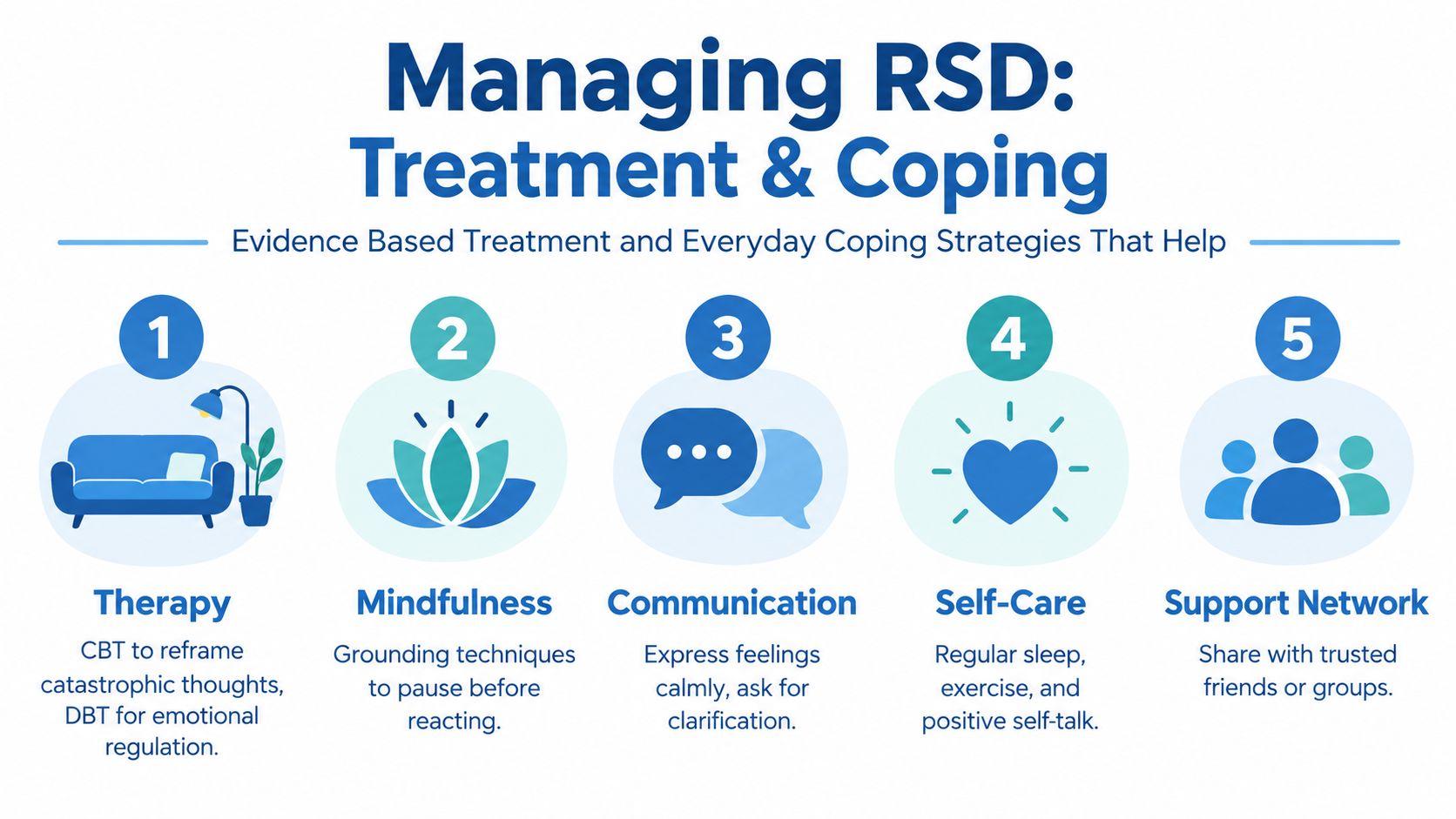
Cognitive behavioral therapy, or CBT, helps identify automatic conclusions such as “They corrected me, so they must dislike me.” You practice testing the thought against evidence and creating a more balanced interpretation. Dialectical behavior therapy, or DBT, teaches distress tolerance, emotion regulation, mindfulness, and interpersonal effectiveness. Trauma-focused therapy may be appropriate when current reactions connect to past experiences of threat, humiliation, or abandonment.
Medication decisions belong with a qualified prescriber. If ADHD contributes to emotional dysregulation, treating ADHD may reduce the intensity or frequency of emotional surges for some people. If anxiety, depression, bipolar disorder, trauma symptoms, or another condition is present, the clinician may consider treatments directed at that condition. Medication should never be started, stopped, or adjusted without professional guidance.
Skills for the moment of impact
Use a short sequence when the emotional alarm activates:
Pause your behavior. Don't send the angry message, quit the project, or end the relationship during the first surge.
Name the experience. Say, “I'm feeling rejected,” rather than, “I've been rejected.”
Check the facts. Write down what the person said or did, separate from your interpretation.
Regulate the body. Try paced breathing, cold water on your face, grounding through your senses, or a brief walk.
Ask for clarification. “I noticed your message sounded brief. Are you upset with me, or are you busy?”
Practical rule: Delay the irreversible decision until your body has returned closer to baseline.
Caregivers can co-regulate by lowering their voice, using fewer words, and validating emotion without endorsing an inaccurate conclusion. “I can see that feedback hurt. We'll figure out what it means after we both calm down” is often more helpful than “You're overreacting.”
Regular sleep, movement, meals, supportive relationships, and self-compassion won't erase rejection-related distress, but they can improve the capacity to respond rather than react. A structured evidence-based mood tracking app can help you record triggers, interpretations, intensity, and recovery, especially when you review the pattern with a clinician. You can also learn practical DBT skills for emotional regulation.
When to Seek Care and How Refresh Psychiatry and Therapy Can Support You
Seek professional support when rejection-related reactions repeatedly disrupt work, school, relationships, parenting, sleep, or your willingness to pursue meaningful opportunities. Contact a clinician promptly if distress leads to self-harm thoughts, unsafe behavior, severe isolation, or an inability to manage daily responsibilities. A crisis or emergency service is appropriate when immediate safety is at risk.
A evaluation looks beyond the RSD label. The clinician may review attention and executive functioning, emotional patterns, mood episodes, anxiety, trauma, autism-related experiences, sleep, medical history, medications, and substance use. For children and teenagers, caregiver and school information can clarify whether the pattern appears across settings.
Refresh Psychiatry & Therapy offers psychiatric evaluation, medication management, and individual therapy through Florida telepsychiatry. Its integrated model may include CBT, DBT, psychodynamic therapy, and trauma-focused approaches, with coordinated follow-up and HIPAA-compliant virtual visits. The practice serves adults, children, and adolescents, and can evaluate ADHD, anxiety, depression, PTSD, bipolar disorder, OCD, insomnia, and related concerns.
Insurance information is available through the practice's individual resources for Aetna, UnitedHealthcare and UHC, Cigna, Blue Cross Blue Shield, Humana, Tricare, UMR, and Oscar. Coverage can depend on your plan and benefits, so confirm details before scheduling.
This blog is for informational purposes only and does not constitute medical advice. Please consult a qualified mental health professional for personalized guidance.
If rejection-related pain is affecting your relationships, work, school, or confidence, Refresh Psychiatry & Therapy can help you pursue an evaluation and coordinated psychiatric or therapy care through Florida telepsychiatry. Contact us or call Refresh Psychiatry at (954) 603-4081 to schedule your evaluation. We accept Aetna, United Healthcare/ UHC, Cigna, Blue Cross Blue Shield, Humana, Tricare, UMR, and Oscar insurance plans.