
🛌 Health Anxiety Explained and How to Find Relief

You notice a flutter in your chest while lying in bed. Within minutes, you're searching symptoms online, comparing serious diagnoses, and checking your pulse again. Reassurance from a recent appointment helps briefly, but the fear returns as soon as you notice another sensation. Health anxiety can make ordinary uncertainty feel like an emergency, yet the pattern is understandable, treatable, and responsive to the right support.
Understanding Health Anxiety and Why It Feels So Real
Health anxiety is more than caring about your health. Individuals notice a symptom, look for sensible information, and decide whether medical care makes sense. Health anxiety becomes a problem when worry about having or developing a serious illness remains intense, keeps returning, and continues despite reassurance or reassuring medical findings.
Consider someone who feels mild stomach discomfort after dinner. A balanced response might be to observe it, consider common explanations, and contact a clinician if it persists or becomes concerning. With health anxiety, the same sensation may immediately become evidence of a dangerous disease. The person may search late into the night, ask loved ones for reassurance, schedule repeated visits, or avoid care altogether because receiving bad news feels unbearable.
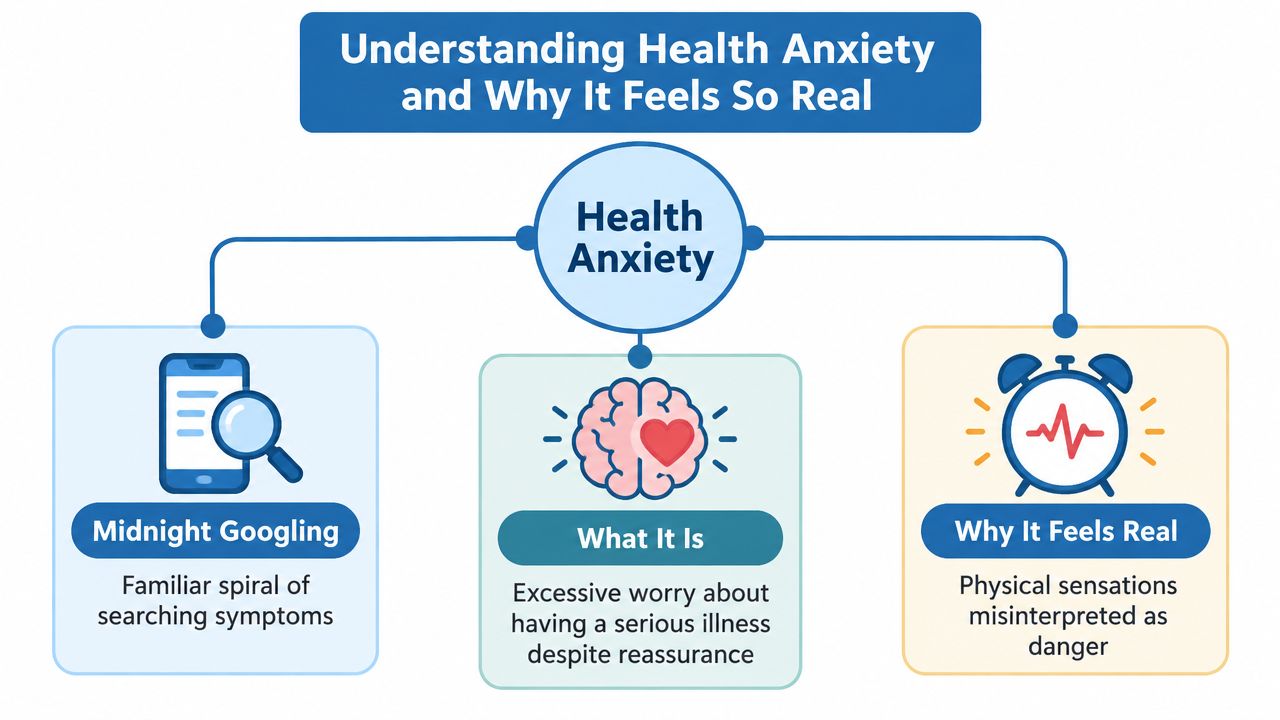
Why the sensations feel convincing
Think of the brain as having an internal alarm system. Its job is to notice possible danger and prepare the body to respond. Anxiety can make that alarm overly sensitive, so a normal heartbeat, muscle twitch, headache, or change in digestion gets interpreted as a threat rather than a passing body signal.
The alarm then creates genuine physical effects. Your heart may beat faster, your muscles may tighten, and your breathing may change. Those sensations feel real because they are real, but the mind may read them as proof that something is medically wrong. That interpretation increases fear, which creates more bodily arousal and strengthens the alarm.
A useful distinction: Health anxiety doesn't mean symptoms are imaginary. It means fear may be assigning the most dangerous explanation to sensations that can have many possible causes.
This pattern can also resemble other anxiety concerns, including irrational fears. A qualified professional can help determine whether health worry is the central problem and whether another condition is present alongside it. You don't have to settle the diagnosis by yourself through online searches.
How Common Is Health Anxiety Today
A person may spend hours checking a symptom, schedule repeated appointments, or visit an emergency room whenever reassurance fades. That pattern is more common than many people realize, and it reflects a treatable worry loop rather than a personal weakness.
A 2024 review estimated health anxiety prevalence in the general adult population at 2.1% to 13.1%. In medical settings, estimates ranged from 7% to 19.9% (review of health anxiety prevalence). The range varies because researchers use different definitions, screening tools, and study populations. The concern may be especially visible in clinics because people who fear illness are already seeking medical answers there.
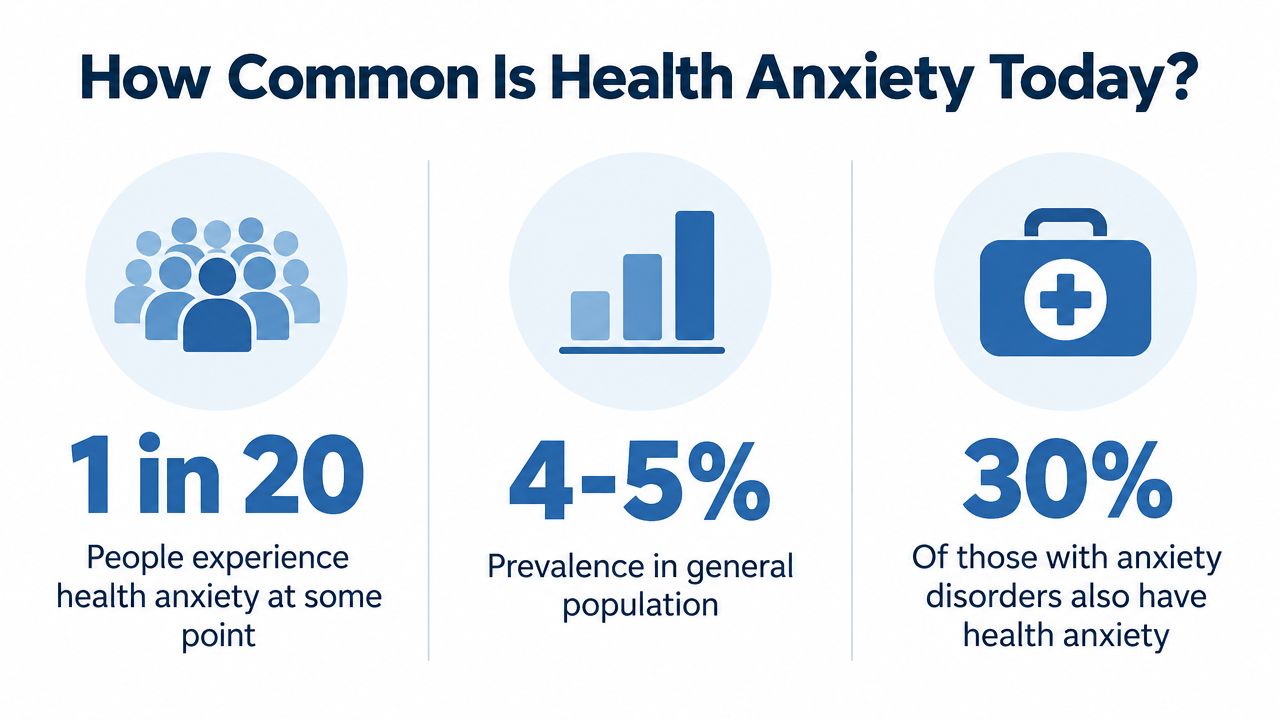
Putting the numbers in perspective
A separate analysis reported a 5.7% lifetime prevalence for health anxiety or hypochondriasis, with earlier studies finding rates as high as 20% among hospital out-patients. Repeated testing, frequent appointments, and avoidable healthcare use can follow when reassurance provides relief only briefly.
Health anxiety also sits within the wider anxiety field. A major review of anxiety disorders reported pooled 1-year prevalence of 10.6% and lifetime prevalence of 16.6%, while a global analysis found an adjusted current prevalence of 7.3% across 44 countries (systematic review and meta-analysis of anxiety disorders). A systematic review of university student samples from 1985 to 2017 found that mean Illness Attitudes Scale scores rose by 4.61 points. Greater exposure to health information and symptom checking may contribute, but these findings do not establish one cause.
The practical meaning is straightforward. A percentage cannot determine whether your symptoms are serious or whether health anxiety is involved. It shows that this pattern affects people across community and medical settings. In Florida, telepsychiatry can make evidence-based evaluation and treatment easier to access, helping you address the worry loop without repeated emergency-room visits or endless testing. If your mind keeps returning to medical danger, thoughtful care can help restore confidence in your body and your decisions.
Recognizing the Symptoms of Health Anxiety
Health anxiety usually appears through a combination of thoughts, body sensations, and behaviors. One person may repeatedly seek medical reassurance. Another may avoid appointments, tests, or conversations about illness. Both patterns can grow from the same fear.

Emotional and physical signs
Emotionally, you may notice a persistent preoccupation with serious illness, rapid movement toward worst-case explanations, or difficulty accepting that uncertainty is part of health. A minor headache can become a feared neurological disease. A skipped beat can feel like evidence of a dangerous heart problem. Negative test results may calm you briefly, but they don't create lasting confidence.
Anxiety can also produce physical sensations that intensify the original concern. Chest tightness, dizziness, stomach upset, trembling, muscle tension, changes in breathing, and a racing heartbeat can all become objects of close attention. The sensation itself may be uncomfortable, while the interpretation adds another layer of distress.
The worry loop: A sensation appears, the mind predicts danger, anxiety increases, the body becomes more activated, and the new sensations seem to confirm the prediction.
Behavioral signs
Your actions often reveal the cycle more clearly than any single thought. Look for patterns such as:
Checking: Measuring your pulse, examining your skin, testing your strength, monitoring breathing, or repeatedly inspecting one body area.
Searching: Entering symptoms into search engines, reading serious-disease forums, or repeatedly reviewing medical information.
Reassurance seeking: Asking family, friends, doctors, or online communities to confirm that you're safe, then needing reassurance again soon afterward.
Care seeking: Scheduling repeated appointments or requesting tests primarily to reduce fear rather than because a clinician has recommended follow-up.
Avoidance: Delaying medical care, avoiding exercise, skipping social activities, or staying away from people and places associated with illness.
A brief record can help you identify the pattern without turning tracking into another checking ritual. Note the trigger, the feared illness, what you did next, how long relief lasted, and what happened afterward. A clinician may also use an anxiety symptom checklist to organize the discussion.
Use this educational video as another way to reflect on the cycle, not as a substitute for an evaluation.
What Causes Health Anxiety and What Keeps It Going
Health anxiety rarely comes from one isolated cause. A person may have a family history of anxiety, a personal experience with illness, strong sensitivity to bodily changes, or a period of high stress. A frightening diagnosis in someone close to you, a personal health scare, or repeated exposure to alarming health information can activate the concern.
A helpful analogy is a smoke detector set too sensitively. A properly adjusted detector responds to a real fire. A highly sensitive one may sound when toast burns, and once the alarm starts, everyone in the room searches for danger. The alarm isn't fake, but its interpretation is too broad for the situation.
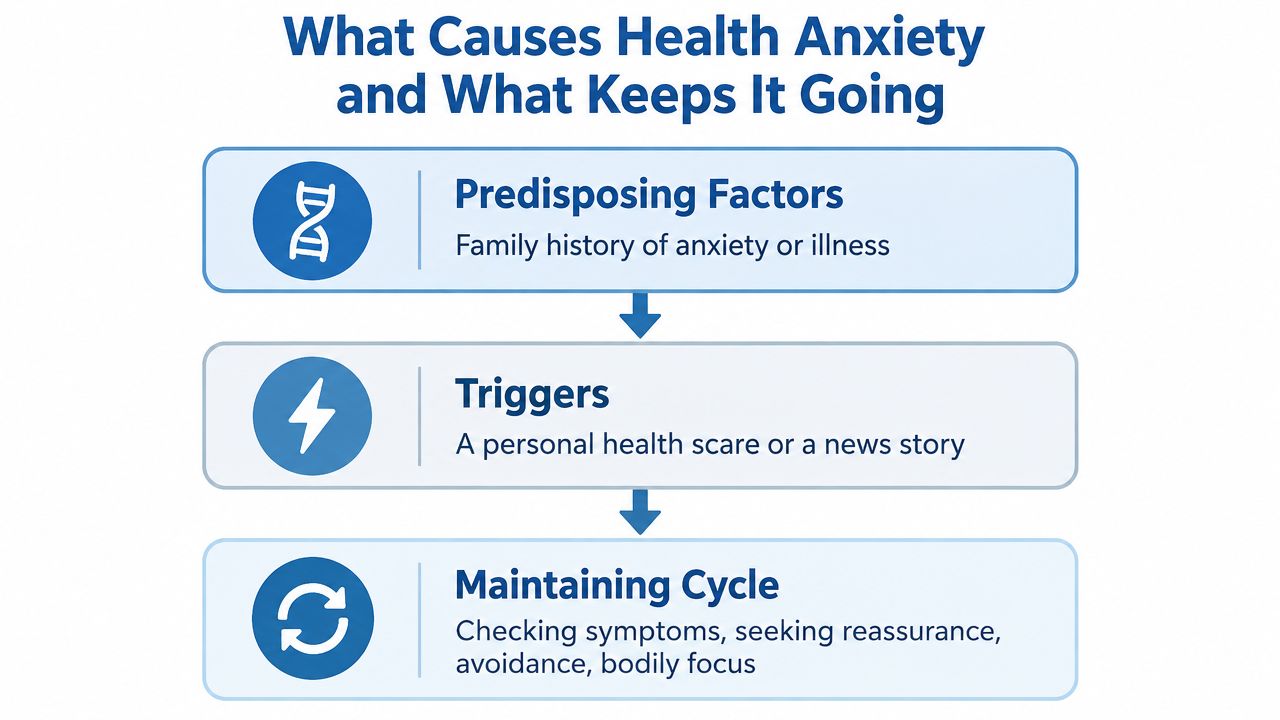
The feedback cycle
The cycle often follows this sequence:
A trigger appears. You notice a sensation, hear a health story, or remember a previous illness.
Attention narrows. You monitor the body more closely, noticing ordinary fluctuations that might otherwise pass without comment.
The mind assigns danger. “What if this is serious?” becomes “This probably means something is seriously wrong.”
A safety behavior follows. You search, check, seek reassurance, schedule care, or avoid the feared situation.
Relief arrives briefly. The behavior lowers anxiety for a moment, teaching the brain to repeat it next time.
Uncertainty returns. Because no reassurance can prove every feared possibility impossible, the cycle begins again.
Intolerance of uncertainty is central here. It involves an excessive inability to accept that a negative outcome could occur, even when its probability is small. Learning about cortisol and night waking may also help you understand how stress and disrupted sleep can interact with nighttime worry, without assuming that every night symptom signals disease.
The cycle creates treatment opportunities. Therapy can target catastrophic interpretations, attention habits, checking, reassurance seeking, and the demand for absolute certainty. Guidance about anxiety and control can also help clarify the difference between responsible health decisions and attempts to control every possible outcome.
How Health Anxiety Is Assessed and How It Differs From Other Conditions
A careful evaluation begins with curiosity, not judgment. A psychiatrist or therapist may ask when the worry began, what triggers it, how often you check or seek reassurance, how much time it takes, and how it affects sleep, work, relationships, and daily activities. They'll also review your medical history and current symptoms, because mental health assessment should not dismiss genuine physical concerns.
Clinicians may screen for depression and other anxiety conditions, ask about panic episodes or compulsive behaviors, and consider whether a medical evaluation is needed. Ruling out relevant medical causes matters, while also recognizing that repeated testing isn't a reliable way to treat an anxiety loop once appropriate medical concerns have been addressed.
Comparing common concerns
Condition | Primary Focus of Worry | Key Distinguishing Feature |
|---|---|---|
Health anxiety | Having or developing a serious illness | Health-related fear remains intense despite reassurance or limited physical findings |
Generalized anxiety | Multiple areas of life, such as finances, family, work, and health | Worry spreads across several domains rather than centering mainly on illness |
Panic disorder | Sudden surges of intense fear and physical arousal | Concern often centers on another panic episode or its consequences |
OCD | Intrusive thoughts and urges, which can include contamination or illness fears | Repetitive compulsions or mental rituals are used to neutralize distress |
Somatic symptom disorder | Distressing physical symptoms and the response to them | The symptoms themselves are prominent, along with disproportionate thoughts, feelings, or behaviors |
Illness anxiety disorder | Fear of serious illness with minimal or absent somatic symptoms | The central concern is illness, even when bodily symptoms are limited |
These categories can overlap. A person may have health anxiety alongside OCD, panic, depression, or generalized anxiety, so a label should follow a full assessment rather than a single online checklist. If you're unsure whether repetitive health behaviors resemble compulsions, reviewing OCD versus anxiety with a professional can make the distinction clearer.
The goal isn't to prove that you are imagining symptoms. It's to identify which process is causing the most suffering and choose care that addresses it accurately.
Evidence Based Treatment and Self Help Strategies That Work
Treatment works best when it targets the mechanisms maintaining the worry, not just the content of the latest feared diagnosis. Cognitive behavioral therapy for severe health anxiety has been linked to improvement through reduced perceived disease risk, less attention to bodily symptoms, and greater tolerance of uncertainty (randomized trial of internet-based CBT).
A later primary-care randomized controlled trial included 204 participants with somatic symptom disorder or illness anxiety disorder and compared internet-delivered with face-to-face CBT. Greater improvement was predicted by higher pre-treatment health anxiety, bodily preoccupation or checking, prevention and planning, anxiety sensitivity, and depression symptoms, while no moderators distinguished the two CBT formats (primary-care CBT trial). This supports discussing format based on access, preference, clinical needs, and continuity rather than assuming one delivery method is automatically superior.
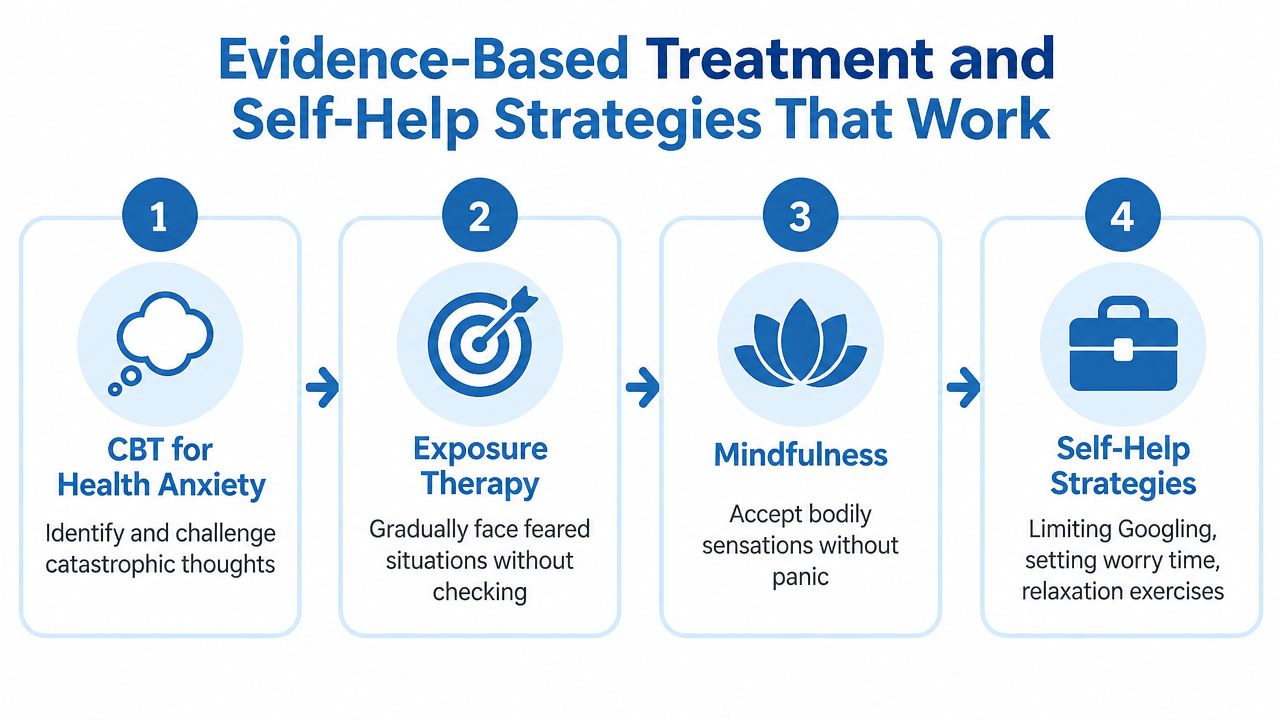
Practical ways to interrupt the loop
Challenge the prediction: Write the feared explanation beside other plausible explanations. Ask what evidence supports each possibility and whether the thought is treating uncertainty as proof of danger.
Delay checking: When you want to search or inspect your body, wait for a planned interval while doing something absorbing. The aim isn't to ignore medical needs. It's to stop anxiety from dictating every immediate action.
Practice response prevention: Gradually face a safe, agreed-upon trigger without performing the usual reassurance behavior. A therapist can help design this carefully, especially when avoidance is extensive.
Set a health-information boundary: Use a limited, intentional time for reliable medical information. Avoid escalating from one search to alarming forums and endless symptom comparisons.
Return attention to the present: Notice your feet on the floor, name objects in the room, slow your breathing, and describe sensations without adding a diagnosis. Mindfulness teaches observation without automatic alarm.
Schedule worry time: Write concerns down and reserve a specific period to review them. Outside that period, remind yourself that the worry has a place, but it doesn't need to control the entire day.
Medication may be considered when anxiety, depression, insomnia, or related symptoms are significantly impairing. A psychiatrist can review benefits, risks, interactions, and whether medication management should be combined with therapy. Other approaches, including mindfulness-based work, trauma-focused therapy, DBT skills, or psychodynamic therapy, may fit depending on the person's broader history.
When to Seek Help and How Refresh Psychiatry Supports Florida Patients
Health anxiety deserves professional attention when it repeatedly disrupts your life. Consider scheduling an evaluation if you're checking your body or searching symptoms compulsively, seeking reassurance that never lasts, visiting medical settings repeatedly without emotional relief, avoiding necessary care, losing sleep, or struggling at work and in relationships.
You don't need to wait until the worry becomes overwhelming. A psychiatric evaluation can organize the pattern, consider medical and psychological factors, identify co-occurring conditions, and create a plan that may include therapy, medication, or both. This approach is more useful than repeatedly chasing each new feared diagnosis through emergency visits or unnecessary testing.
Refresh Psychiatry & Therapy is a telemedicine-only Florida practice offering HIPAA-compliant video visits statewide. Care may include psychiatric evaluation, medication management, and coordinated individual therapy using approaches such as CBT, DBT, psychodynamic therapy, and trauma-focused care. Virtual appointments can reduce travel and make follow-up easier for people who feel overwhelmed by traditional care logistics.
Insurance and access also matter. Refresh Psychiatry & Therapy accepts Aetna, United Healthcare/ UHC, Cigna, Blue Cross Blue Shield, Humana, Tricare, UMR, and Oscar insurance plans, with self-pay options also available. Patients comparing Florida mental health resources may find the WeekdayDoc psychiatry jobs Florida page useful for understanding the broader psychiatric care environment, but employment information isn't a substitute for clinical treatment.
For practical guidance about deciding whether an appointment is appropriate, review when to see a psychiatrist. A secure telepsychiatry visit can give you a structured place to discuss the worry loop without having to solve it alone.
Refresh Psychiatry & Therapy offers Florida telepsychiatry for health anxiety, including psychiatric evaluations, coordinated medication management, and evidence-based therapy aligned with your symptoms and goals. Visit Refresh Psychiatry & Therapy or call Refresh Psychiatry at (954) 603-4081 to schedule your evaluation. We accept Aetna, United Healthcare/ UHC, Cigna, Blue Cross Blue Shield, Humana, Tricare, UMR, and Oscar insurance plans. This blog is for informational purposes only and does not constitute medical advice. Please consult a qualified mental health professional for personalized guidance.