
💊 Vyvanse vs Concerta for ADHD Care

What good is a longer-lasting ADHD medication if you can't eat dinner, fall asleep, or reliably refill it? Vyvanse vs Concerta is less about which medicine is stronger and more about which treatment helps you function consistently without unacceptable trade-offs.
A useful comparison starts with your day: getting out the door, finishing work, managing homework, eating normally, and winding down. Your previous medication response, health history, and pharmacy access matter as much as a symptom score.
Vyvanse and Concerta at a Glance
Vyvanse and Concerta are both prescription stimulants for ADHD, but they belong to different medication classes. Vyvanse contains lisdexamfetamine, an amphetamine prodrug. Concerta contains extended-release methylphenidate delivered through an osmotic-release oral system, or OROS.
Both are Schedule II medications approved for ADHD from age 6 onward. Their milligram doses are not interchangeable, and the FDA prescribing information for Concerta does not establish one as the best choice for everyone.
Vyvanse vs Concerta snapshot
Feature | Vyvanse | Concerta |
|---|---|---|
Generic name | Lisdexamfetamine | Methylphenidate extended release (OROS) |
Class | Amphetamine prodrug | Methylphenidate |
Approved for ADHD | Ages 6 and older | Ages 6 and older |
Commonly cited duration | Up to about 14 hours | About 12 hours |
How it turns on | Converted to dextroamphetamine | Early coat plus osmotic release; swallow whole |
Controlled status | Schedule II | Schedule II |
Duration estimates are planning ranges, not guarantees. A medication may remain active after its helpful effect on attention or organization has faded.
Compare function, not just focus
A student may finish classwork more easily but eat little at lunch and struggle to fall asleep. An adult may focus through meetings but feel unusually irritable at home. These are different parts of the same decision: whether the benefit is worth the effect on sleep, appetite, and day-to-day comfort.
The better option depends on the person's response to each medication class and whether the treatment remains practical to take and refill. A useful comparison asks what improves, what becomes harder, and whether the person can continue the treatment as prescribed.
The right medication is one a person can take consistently, with useful benefits and manageable risks.
For another stimulant comparison, see our Concerta vs Adderall guide. For educators comparing tutoring software, this comparison reviews features of tutoring operations tools.
Medication choice calls for clinical assessment, not a potency ranking. This overview is educational and does not determine an individual prescription.
How Each Stimulant Lasts Through the Day
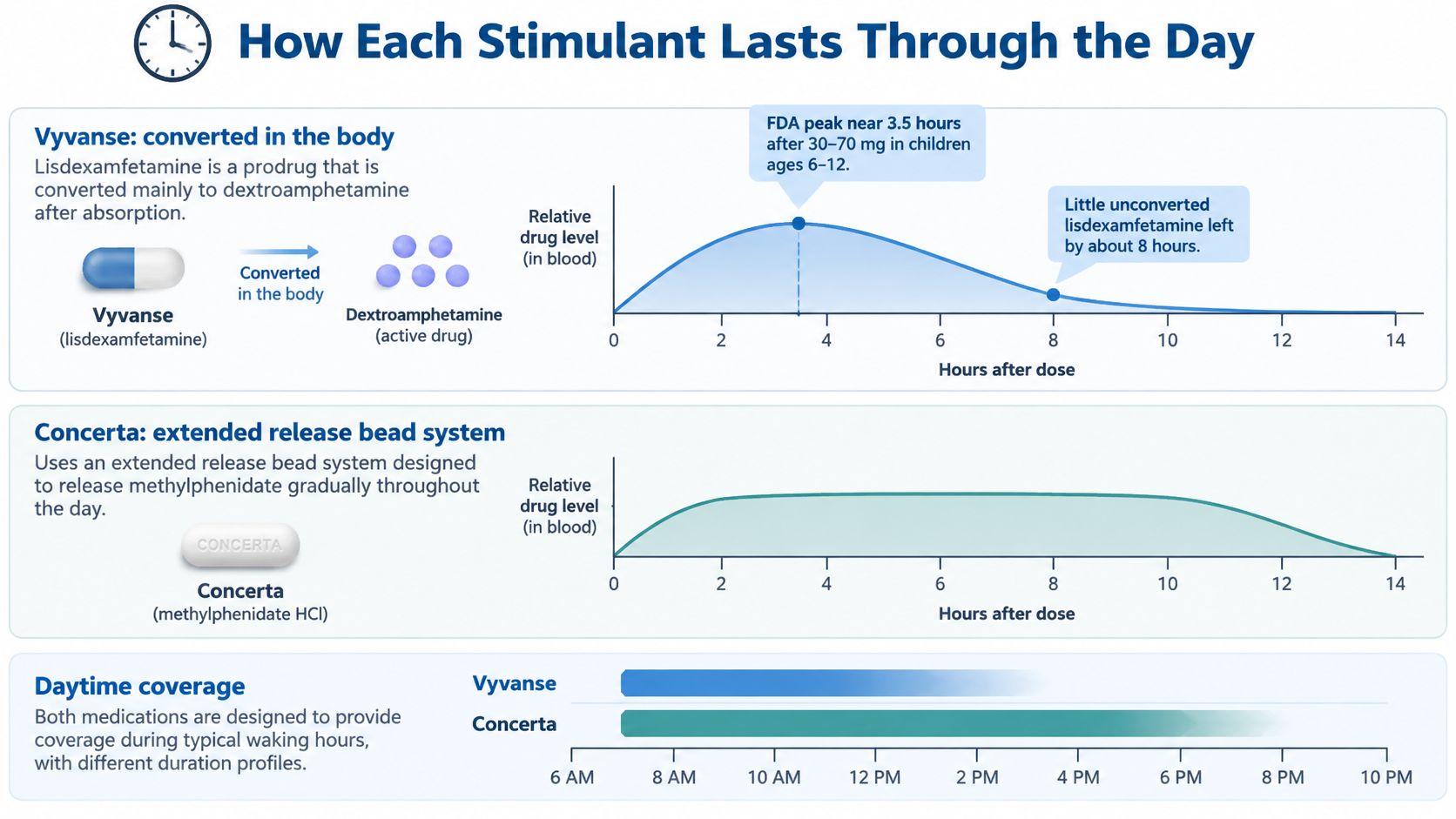
Vyvanse and Concerta extend their effects in different ways. Vyvanse is converted in the body into its active stimulant, while Concerta releases methylphenidate gradually from a specially designed tablet.
The illustration shows their different daily profiles.
Morning administration and the rising effect
Vyvanse is a prodrug: the body converts the swallowed medicine into its active stimulant, primarily dextroamphetamine. In children aged 6–12, the FDA prescribing information for Vyvanse reports that dextroamphetamine reaches peak concentrations about 3.5 hours after a 30–70 mg dose. Unconverted lisdexamfetamine generally becomes non-quantifiable by 8 hours.
That 8-hour figure does not mark when the useful effect ends. The converted active drug drives the ongoing effect, and peak blood concentration does not pinpoint when someone will first notice a change in attention.
Concerta uses a different release system. Its outer coating provides an early portion of methylphenidate, followed by controlled delivery through an osmotic tablet system, not a bead system. One person may find Concerta's morning effect more usable; another may prefer how Vyvanse builds.
Afternoon benefit and evening trade-offs
Vyvanse is often described as lasting longer than Concerta, which is commonly cited at about 12 hours, but these are planning ranges rather than guarantees of coverage. Even when a medication is still active, its helpful effect on a particular task may have faded.
Later coverage may help a parent managing homework after work. For someone whose main demands fall during the workday and who already has trouble sleeping, a prolonged effect may be less welcome.
A longer label is not automatically a better day.
Food, metabolism, dose, and the task at hand can all affect how the timing feels. Difficulty with demanding paperwork may return before difficulty with routine household tasks, so describe what changes and when rather than saying the medication is “wearing off.”
The guide to how long Vyvanse lasts can help you describe the pattern more precisely.
This video offers another way to compare the medications.
Track the day to make follow-up discussions more concrete:
Morning start: Getting dressed, leaving home, and beginning tasks.
Early and late afternoon: Sustained attention, impulsivity, and task completion.
Dinner and bedtime: Appetite, irritability, and time needed to fall asleep.
Physical monitoring: Blood pressure, pulse, and uncomfortable stimulant effects.
Starting Doses and Weekly Titration
Starting doses provide a reference point, not a target everyone should reach. The prescriber adjusts treatment according to symptom improvement, side effects, and health measures such as pulse and blood pressure.
Who | Medicine | Start | Weekly step | Maximum |
|---|---|---|---|---|
Ages 6 and older | Vyvanse | 30 mg morning | 10 or 20 mg | 70 mg once daily |
Children 6–12 new to methylphenidate | Concerta | 18 mg morning | 18 mg | 54 mg daily |
Adolescents new to methylphenidate | Concerta | 18 mg morning | 18 mg | 72 mg daily |
Adults new to methylphenidate | Concerta | 18 or 36 mg morning | 18 mg | 72 mg daily |
The Vyvanse FDA prescribing label lists a starting dose of 30 mg each morning, with clinician-directed increases of 10 or 20 mg at approximately weekly intervals, up to 70 mg once daily.
The Concerta FDA prescribing label specifies 18 mg weekly increases, the age-based maximums shown above, and tablet strengths that allow dosing up to those maximums. The starting doses of Vyvanse and Concerta are not equivalent milligram-for-milligram.
Treat the schedule as a review framework
A weekly interval creates a chance to review the response. It does not mean the dose must go up each week.
The prescriber looks for meaningful gains in daily functioning while checking for appetite loss, insomnia, anxiety, tics, or changes in pulse and blood pressure. Better concentration paired with worsening physical symptoms may call for a different adjustment, not continued escalation. A useful follow-up report describes specific changes, such as starting assignments with fewer reminders, finishing documentation, or interrupting less often.
Administration details matter
Vyvanse may be taken with or without food. Its label recommends taking it in the morning and warns against afternoon dosing because it may cause insomnia. Taking Concerta later than prescribed can also interfere with sleep.
Concerta must be swallowed whole, not cut, crushed, or chewed. If swallowing is difficult, ask the prescriber what to do rather than altering the tablet.
When the prescribing instructions allow a Vyvanse capsule to be opened, its contents still make up the prescribed morning dose. Opening it does not create an extra afternoon dose or authorize dividing treatment without supervision.
If treatment is not helping enough or side effects are hard to manage, the next step may be a smaller adjustment, another formulation, a switch between stimulant classes, or a discussion of non-stimulant treatment. The Vyvanse medication guide for ADHD offers more information to discuss with the prescriber.
What Trials Show for Children and Adults
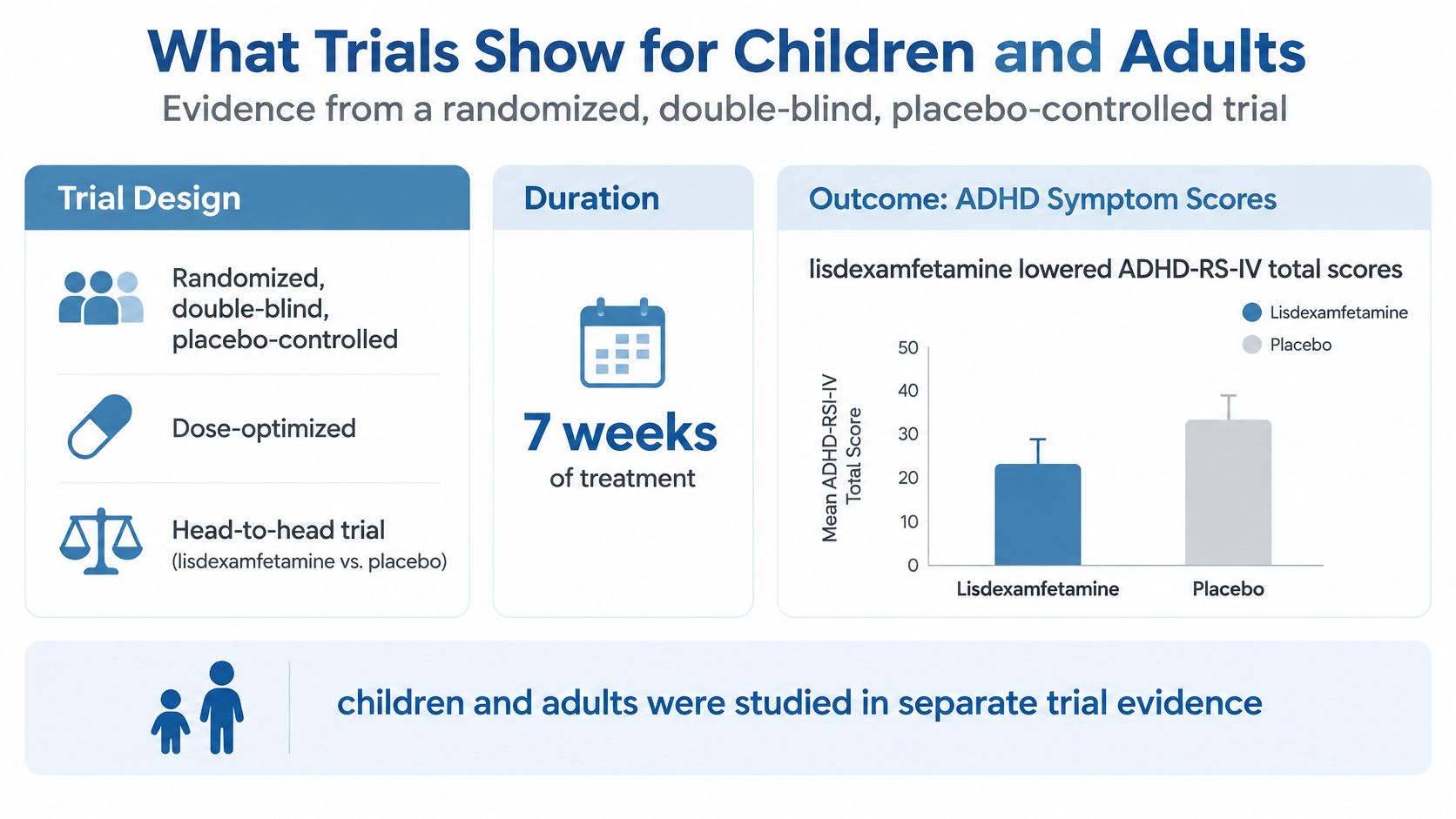
In one head-to-head trial, children and adolescents had a greater average reduction in ADHD symptoms with lisdexamfetamine than with OROS methylphenidate. The 7-week randomized, double-blind, placebo-controlled trial used dose-optimized treatment. The difference in ADHD-RS-IV scores favored lisdexamfetamine by 5.6 points (95% CI, −8.4 to −2.7; p < 0.001; effect size 0.541). Clinician-rated improvement also favored lisdexamfetamine, with 17.4 percentage points more participants rated improved on CGI-I (95% CI, 5.0–29.8; p < 0.05), according to the European Psychiatry head-to-head comparison.
That result describes an average difference in one pediatric trial. It does not predict which medicine will work better for a particular child or establish a winner for adults.
The following illustration summarizes trial evidence; it is not a personalized ranking.
Interpreting the trial measures
ADHD-RS-IV measures symptom severity. CGI-I captures a clinician's overall assessment of improvement. Neither measure alone shows whether a child's appetite, sleep, homework, or relationships improved along with symptoms.
A larger score change may matter if it improves daily functioning. Yet a smaller change may be more sustainable when sleep and eating remain comfortable. The better choice depends on the whole pattern, including how well the medicine works and whether the person can keep taking it.
Response, tolerability, titration, and other conditions shape the individual treatment choice.
What adults should take from pediatric evidence
Adults should not treat a pediatric average as a forecast of their own response. Previous benefit from a stimulant class, work demands, anxiety, blood-pressure concerns, and past side effects can help inform the choice.
An adult who functioned well on methylphenidate has a different starting point from someone who stopped it because of persistent discomfort. A pediatric comparison alone is not a reason to choose an amphetamine.
Pediatric Vyvanse assessments included morning, afternoon, and early-evening observations. That supports tracking how symptoms change across the day rather than treating “all-day coverage” as a complete measure of benefit.
Neither product is established for preschool-age children. Concerta labeling also notes limits in the evidence on long-term methylphenidate effects in children, so treatment needs ongoing reassessment rather than a one-time judgment of success.
Side Effects, Interactions and Abuse Risk
Both medicines can reduce appetite, interfere with sleep, and affect mood or cardiovascular measurements. Other possible effects include headache, stomach upset, dry mouth, anxiety, and irritability. The important question is not just whether an effect occurs, but whether it interferes with eating, relationships, safety, or daily functioning.
Vyvanse's extended effect may preserve afternoon attention while delaying dinner appetite or bedtime. Concerta isn't automatically easier to tolerate: anxiety, irritability, insomnia, and increased blood pressure are among adverse reactions associated with treatment discontinuation.
Separate ordinary discomfort from warning symptoms
A prescriber needs to know about persistent appetite loss, worsening anxiety, new tics, or repeated difficulty falling asleep. In children, growth monitoring includes height and weight, not just asking whether lunch was eaten.
Stimulant warnings also include serious cardiac risks in people with serious heart disease, new or worsening psychiatric symptoms, circulation changes in fingers or toes, and concerns about seizures in vulnerable patients. Seek urgent medical attention for chest pain, fainting, severe shortness of breath, or alarming psychiatric changes.
Before starting either medicine, disclose:
Heart history: Known serious heart disease, concerning symptoms, or uncontrolled blood pressure.
Medication allergies: Any previous allergic reaction to the product or its ingredients.
Recent MAOI use: An MAOI within the past 14 days is a reason not to start either stimulant without medical clearance.
Psychiatric and neurological history: Mania, psychosis, seizures, escalating tics, or substance-use concerns.
Review the whole medication list
Bring prescription medicines, supplements, over-the-counter products, and any other stimulants to the review. MAOIs are particularly important, but some blood-pressure medicines and drugs affecting mood or seizure risk also need attention.
Don't use alcohol to counteract stimulation or help you fall asleep. Alcohol can add impairment and make it harder to judge how you're responding.
Both medications carry misuse, addiction, and diversion risks. Vyvanse's conversion requirement limits immediate amphetamine delivery compared with an immediate-release amphetamine, but it doesn't make the medication abuse-proof. Concerta's hard tablet must remain intact, and its release system likewise doesn't eliminate misuse risk.
Store securely: Keep the medication locked and away from children or visitors.
Never share: Another person's symptoms don't make your prescription appropriate for them.
Follow the prescription: Don't increase the dose, double up, or improvise around a shortage.
If stimulant effects are unacceptable, our stimulant vs non-stimulant ADHD medication comparison can help you prepare for a different treatment discussion.
When Life Makes One Option More Practical
Which option fits the situation
Situation | Often discuss first | Reason |
|---|---|---|
Need coverage into late afternoon | Vyvanse | Often described as lasting up to about 14 hours |
Methylphenidate already worked | Concerta | Stay with the class that helped |
Amphetamine worsened anxiety, appetite, or mood | Concerta | Different stimulant class |
Methylphenidate wore off early or felt edgy | Vyvanse | Prodrug amphetamine with a later peak |
Pharmacy cannot keep the preferred drug in stock | Whichever is fillable, with the prescriber | Missed doses undo a trial advantage |
Uncontrolled heart risk, recent MAOI, or escalating misuse | Neither until cleared | Shared Schedule II warnings |
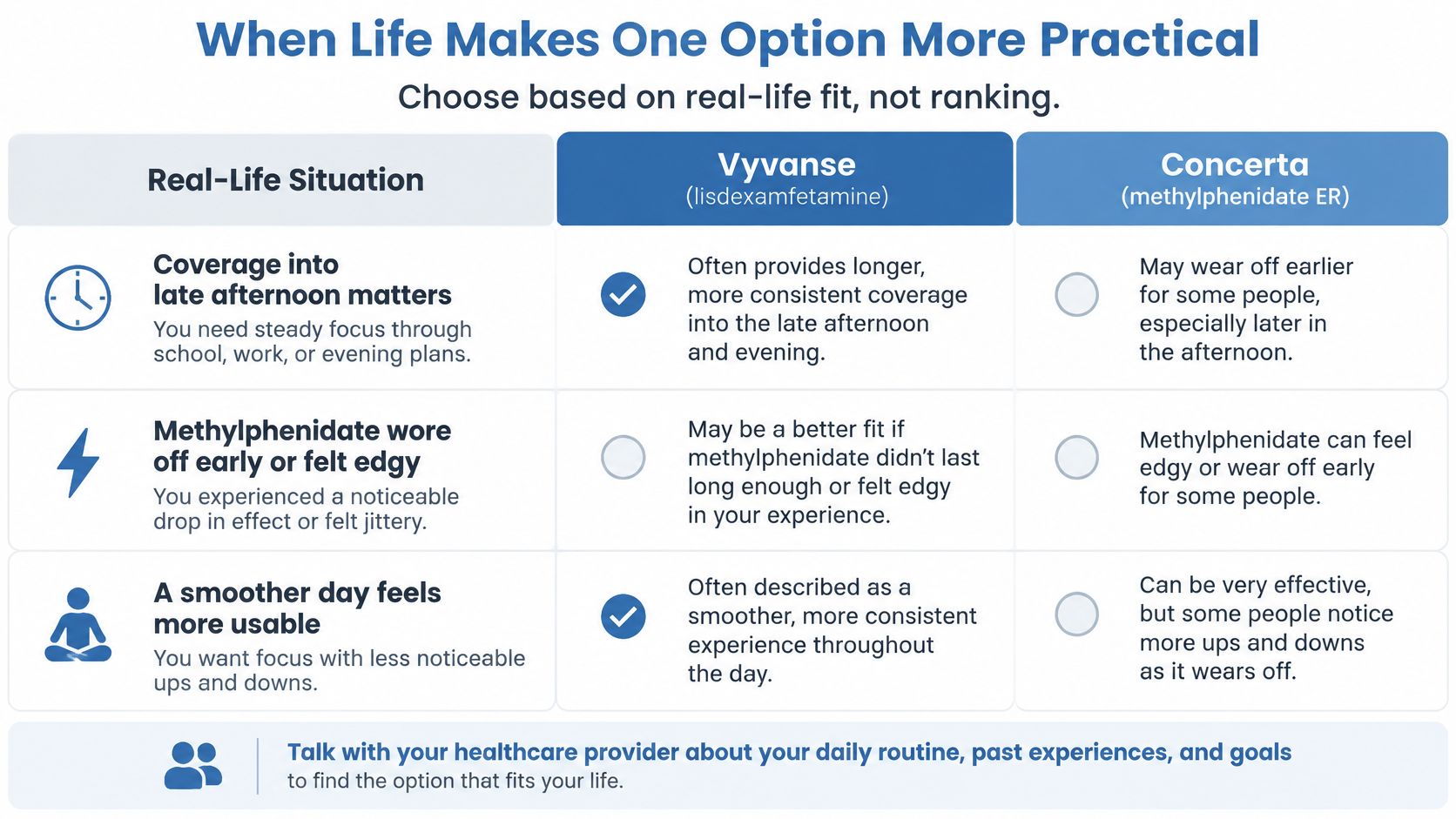
These are discussion starting points, not rules for choosing your own prescription. Feeling edgy on methylphenidate doesn't guarantee an amphetamine will feel better, and an uncomfortable amphetamine experience doesn't establish that Concerta will be symptom-free.
This decision aid emphasizes real-life fit rather than a winner.
Bring a record of what actually happened
Write down what improved, what became harder, and when each change occurred. Include missed tasks, meals, sleep difficulties, irritability, and observations from teachers or family when relevant.
A clinician can compare specific patterns more reliably than a general memory that a medicine was good or bad. If an earlier trial ended quickly, explain whether the problem was side effects, lack of benefit, difficulty obtaining it, or something else.
When a prescribed medicine doesn't suit a patient, our clinicians may adjust the dose, switch medications, or explore other treatment options. Therapy and a non-stimulant also belong in the conversation when stimulant trials haven't produced a workable result.
Continuity belongs in clinical decision-making
Treatment has to remain obtainable as well as tolerable. The DEA stimulant safety presentation documents shortage pressure affecting both methylphenidate and lisdexamfetamine presentations, underscoring why continuity planning belongs in the treatment discussion.
We're in-network with Aetna, UnitedHealthcare/UMR, Cigna, Humana, AvMed, and Oscar Health, so most patients pay only their standard copay. Your individual benefits still need verification.
A medicine that fits the day beats a medicine that wins a trial but can't be used consistently.
Coverage, Cost and Supply Continuity
Will the prescribed medicine be available when it is time to refill it? The DEA stimulant safety presentation shows that shortage listings for both methylphenidate and lisdexamfetamine rose between March 2024 and March 2025. Those listings do not indicate whether a specific Florida pharmacy has a particular product in stock today.
Both medicines are controlled substances. Pharmacy availability and prior-authorization requirements can affect whether a prescription can be filled as written.
Make a refill contingency plan
Contact the prescriber before you run out. Explain how much medication remains and describe any difficulty filling the prescription.
Ask the pharmacy about availability before the refill date. Stock and ordering options can vary.
Avoid unsupervised substitutions. Don't borrow pills, double doses, or convert milligrams yourself.
Keep your treatment record accessible. Include what helped, any unwanted effects, and why previous medicines were stopped.
Review the response after a change. Track sleep, appetite, mood, blood pressure, and everyday functioning.
Verify the product and the benefits
Generic options include lisdexamfetamine and methylphenidate extended release. Extended-release methylphenidate products can use different delivery systems, so check the exact prescription rather than assuming all ER formulations are interchangeable.
Your copay depends on your plan, formulary, product, and authorization requirements. Refresh Psychiatry accepts Aetna, United Healthcare/UHC, Cigna, Blue Cross Blue Shield, Humana, Tricare, UMR, and Oscar insurance plans.
Check your network benefits with your insurer before booking. Ask separately about visit coverage and prescription coverage, since coverage for one does not establish coverage for the other.
Book a Florida ADHD Evaluation
How can you tell whether Vyvanse, Concerta, or another approach fits your needs over time? Stimulant treatment calls for regular review. The FDA Concerta prescribing information states that controlled trials do not establish how long a person with ADHD should be treated.
That uncertainty makes follow-up important. A clinician can reassess whether treatment still helps and whether its effects on sleep, appetite, blood pressure, mood, and daily functioning are manageable.
Prepare for a collaborative evaluation
Refresh Psychiatry & Therapy offers Florida telepsychiatry evaluations using evidence-based tools and thorough assessments to clarify symptoms and treatment needs. Medication is not always recommended, and the decision to use it is collaborative.
Bring your medication history, reasons you stopped any medications, relevant medical history, and examples of difficulties at home, school, or work. Anxiety, depression, trauma symptoms, and sleep problems can also affect attention, so mention them during the assessment.
Our guide to finding an ADHD specialist explains what to consider when seeking an evaluation. Board-certified psychiatrists provide medication management and can prescribe controlled medications when appropriate.
Use follow-up to revise the decision
Follow-up helps turn an initial Vyvanse-versus-Concerta choice into an individualized plan. Refresh Psychiatry monitors progress and adjusts medication as needed, including changing the dose, considering another medication, or exploring other treatment options if side effects arise.
Review whether medication supports school, work, relationships, and daily organization. Also discuss appetite, sleep, weight, blood pressure, heart rate, mood, adherence, and whether the current dose remains appropriate.
Medication management and therapy are coordinated within the practice. The goal is a treatment plan that fits your needs and is practical to continue, not a choice based only on a comparison chart.
For an individualized discussion of Vyvanse, Concerta, or alternatives, visit Refresh Psychiatry & Therapy to request a Florida telepsychiatry evaluation. Bring your medication history and daily symptom log to discuss benefits, side effects, and a plan you can maintain. Use the online scheduling page to request an appointment. Refresh Psychiatry & Therapy accepts Aetna, United Healthcare/UHC, Cigna, Blue Cross Blue Shield, Humana, Tricare, UMR, and Oscar insurance plans. This article is for informational purposes only and is not medical advice. Consult a qualified mental health professional for personalized guidance.