
How Long Do SSRIs Take to Work? a Timeline Guide

Many notice some benefit within 2-4 weeks, but the full therapeutic effect is typically assessed at 6-8 weeks, and feeling nothing at two weeks doesn't mean the medication won't work. So why do so many judge an SSRI after three rough days, when the medicine hasn't had a fair chance to help yet?
That early mismatch is confusing because side effects can start before mood improves. You might feel nauseated, restless, or sleepy while your depression or anxiety still feels exactly the same. Understanding what usually changes first, what changes later, and what should never be waited out can help you stay safe without giving up too soon.
How Long Do SSRIs Take to Work
If you're asking how long do SSRIs take to work, the honest answer depends on what you mean by working. A small early shift isn't the same as a reliable, overall improvement. Noticeable benefits generally require about 2-4 weeks, and people who have no benefit after 4-6 weeks should consult a clinician about dose adjustment or changing medication, according to NHS Inform guidance on SSRIs. That's different from expecting a full effect in the first week.
Think of it in three stages rather than on one date. First there's early adjustment, when your body is getting used to the medicine. Then there's an early signal, which might be slightly less anxiety, a little better sleep, or appetite or energy starting to move. Finally there's the fuller assessment, when you and your clinician can judge whether the dose and medication are right.
Why different symptoms move at different speeds
Depression and anxiety aren't single symptoms. Your sleep might settle before your motivation returns. Your thinking might feel less stuck before you're able to enjoy things again, or your energy might lift before your mood clearly does.
That uneven pattern is normal, and it doesn't mean you're doing something wrong. It also doesn't mean a tiny improvement in sleep proves the SSRI will fully treat your depression. You're watching for a direction of change over weeks, not a dramatic overnight switch.
Judging an SSRI only in the first few days is usually premature, unless you're having severe or concerning reactions that need prompt help.
What a fair trial actually means
A fair trial means taking the medicine consistently, at a dose your prescriber considers therapeutic, long enough for a meaningful review. Skipping doses, stopping because of a bad day, or doubling up on your own makes the picture much harder to read. It can also make side effects worse.
You shouldn't stop suddenly or change the dose without your prescriber's guidance. If you're worried the medicine isn't helping, bring that concern to a follow-up visit with specific notes. What changed, what hasn't, and what's hard to tolerate are all useful pieces of information.
What the Research Says About SSRI Timelines
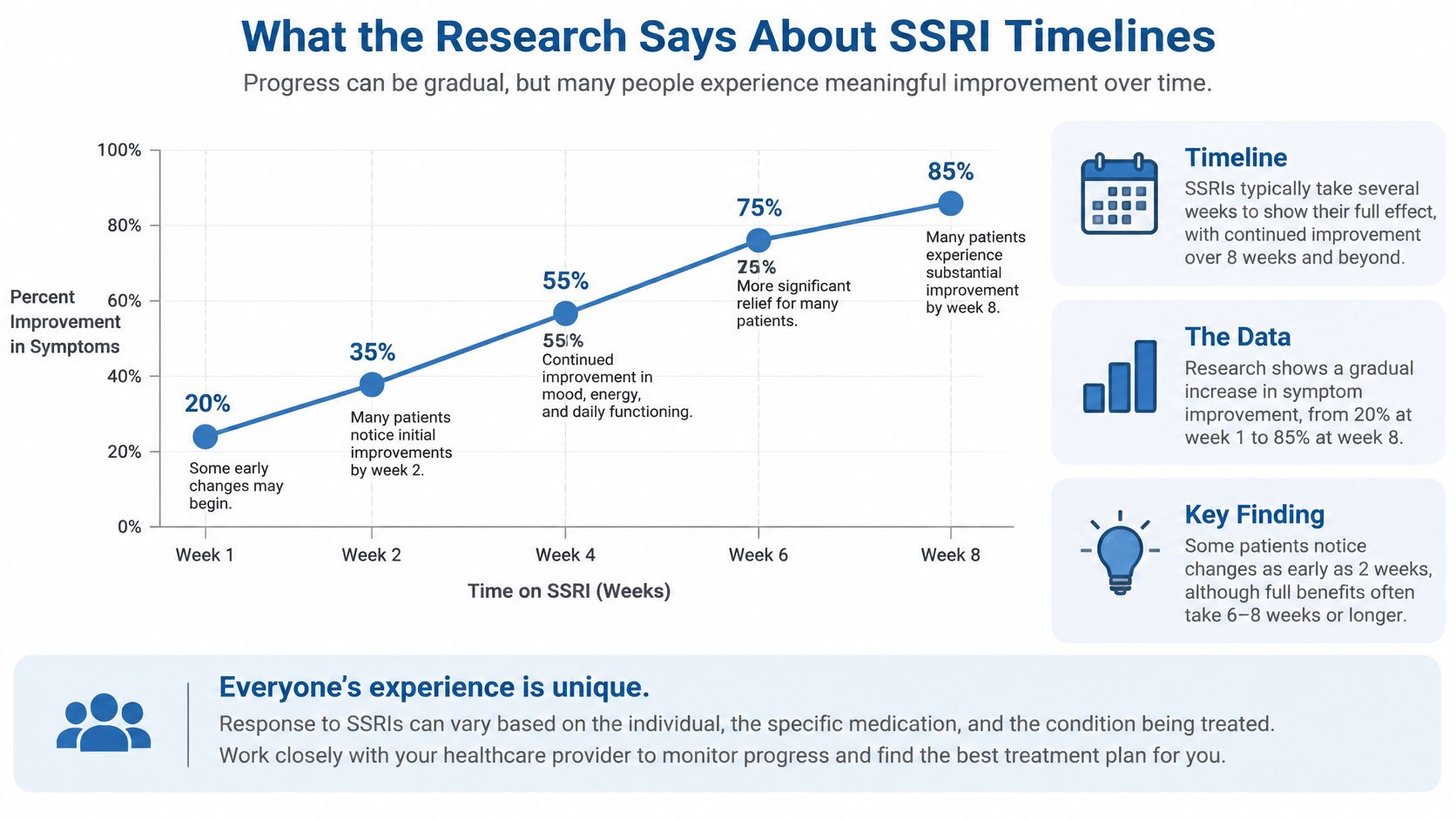
Clinical evidence supports a gradual pattern, but it also shows that improvement can begin earlier than the traditional endpoint suggests. A 2022 systematic review found that the greatest response often occurs during the first 2 weeks, and one meta-analysis found that approximately 50% of the eventual response effect had been achieved by week 4, as summarized in BMJ Medicine's review of SSRI response timing. That supports checking in around week 4 instead of waiting automatically.
An earlier systematic review and meta-analysis also found measurable symptomatic improvement by the end of the first treatment week compared with placebo, with benefits continuing to accumulate, though more slowly, for at least six weeks, according to JAMA Psychiatry research on early SSRI improvement. Early change is therefore possible. It just isn't proof of full response.
The chart below shows that gradual trajectory across the first eight weeks.
Early signal versus full response
An early signal might be crying less, feeling slightly less on edge, or noticing that a hard morning doesn't ruin the whole day. A full response is broader. It includes mood, interest, functioning, and your ability to get through work, school, family life, and ordinary tasks.
Weeks 1-2: Some benefit may emerge, but side effects and adjustment often dominate.
Around week 4: Your clinician can look for meaningful early response and decide whether to optimize treatment.
Weeks 6-8: This is a common window for judging whether the trial has been adequate at an appropriate dose.
That distinction matters if you've read sweeping claims online. Our guide to common antidepressant myths can help you separate realistic expectations from promises that no medicine can make.
Why mood and anxiety may shift before functioning does
Symptom-level findings add another useful detail. Depressed mood and psychic anxiety can show relatively quick, strong direct effects, while effects on other symptoms may be weaker or absent. In plain language, you might feel emotionally lighter before concentration, motivation, sleep, or day-to-day functioning substantially improve.
That doesn't make the early change meaningless. It means you should track more than one thing. A short daily note on mood, anxiety, sleep, energy, and functioning gives your clinician a clearer picture than trying to remember three weeks later how you felt.
A Week-by-Week Guide to What You Might Feel
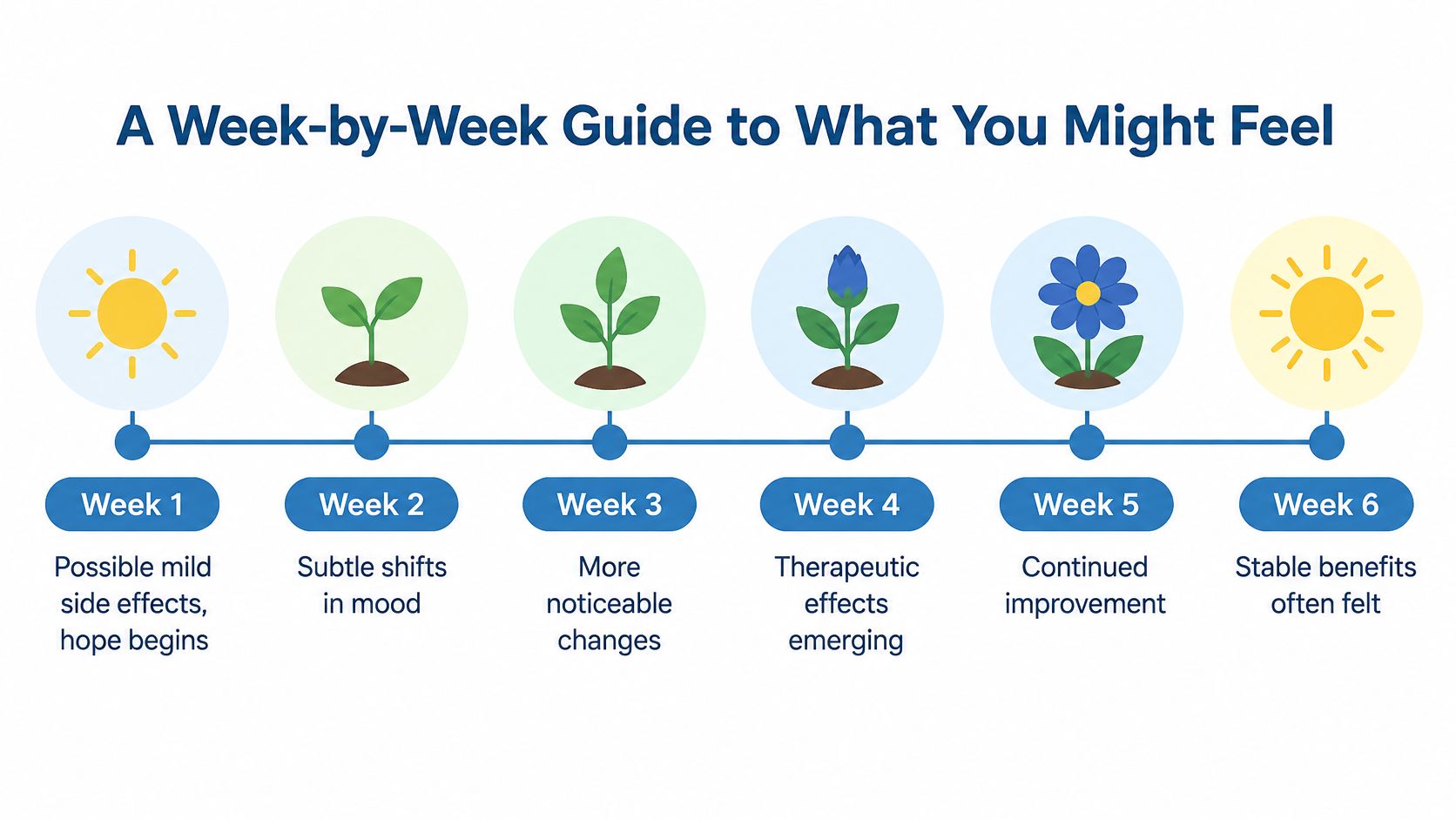
No two people follow the same calendar, but a typical pattern helps you recognize what's expected. The timeline below maps the first six weeks so you can place your own experience in context.
Week 1 adjustment comes first
During the first several days, you may notice nausea, headache, restlessness, sleep changes, or feeling a bit wired or tired. Mood often hasn't moved yet. That's frustrating, but it isn't unusual.
Try not to grade the medicine on mood alone this week. Note when you take it, whether food helps your stomach, and how you're sleeping. Those details help your prescriber decide whether a timing change or other adjustment could make the early period easier.
Week 2 small shifts may appear
By week 2, some early physical effects may be settling, while others are still present. You might notice a subtle change in anxiety, rumination, appetite, sleep, or energy before you notice clear mood improvement. Or you might feel nothing at all.
Feeling nothing at this point isn't definitive. A 2025 longitudinal analysis found that assessments in the first two weeks were insufficient to reliably predict eventual remission, and patients without improvement at two weeks still had an estimated 40-50% chance of responding by 12 weeks, as reported in a longitudinal analysis of early SSRI nonresponse.
A useful question at week 2: Am I safe, tolerating the medicine, and taking it consistently, even if my mood hasn't clearly changed yet?
Weeks 3-4 the first real checkpoint
Week 3 can feel like a gap. Your body may be more adjusted, but your mood may still lag. By week 4, however, you and your clinician can usually look for an early pattern. Are panic, worry, tearfulness, or low mood easing at all? Are you functioning even slightly better?
If there's some improvement, continuing and reassessing may make sense because response can keep developing. If there's none, that doesn't automatically mean switching that day. Your clinician will want to check adherence, dose, tolerability, diagnosis, and other treatment factors first.
This short video walks through that early waiting period in plain language.
Weeks 5-6 benefits often become clearer
For many people, weeks 5 and 6 are when improvement feels less subtle. You might start a task with less resistance, recover from a setback faster, or notice interest returning in small ways. Sleep, energy, and functioning may catch up more slowly.
If nothing has changed after a consistent, adequate trial, don't change the plan alone. Persistent symptoms warrant professional review, and there are next steps beyond waiting longer.
Early Side Effects vs Therapeutic Benefits
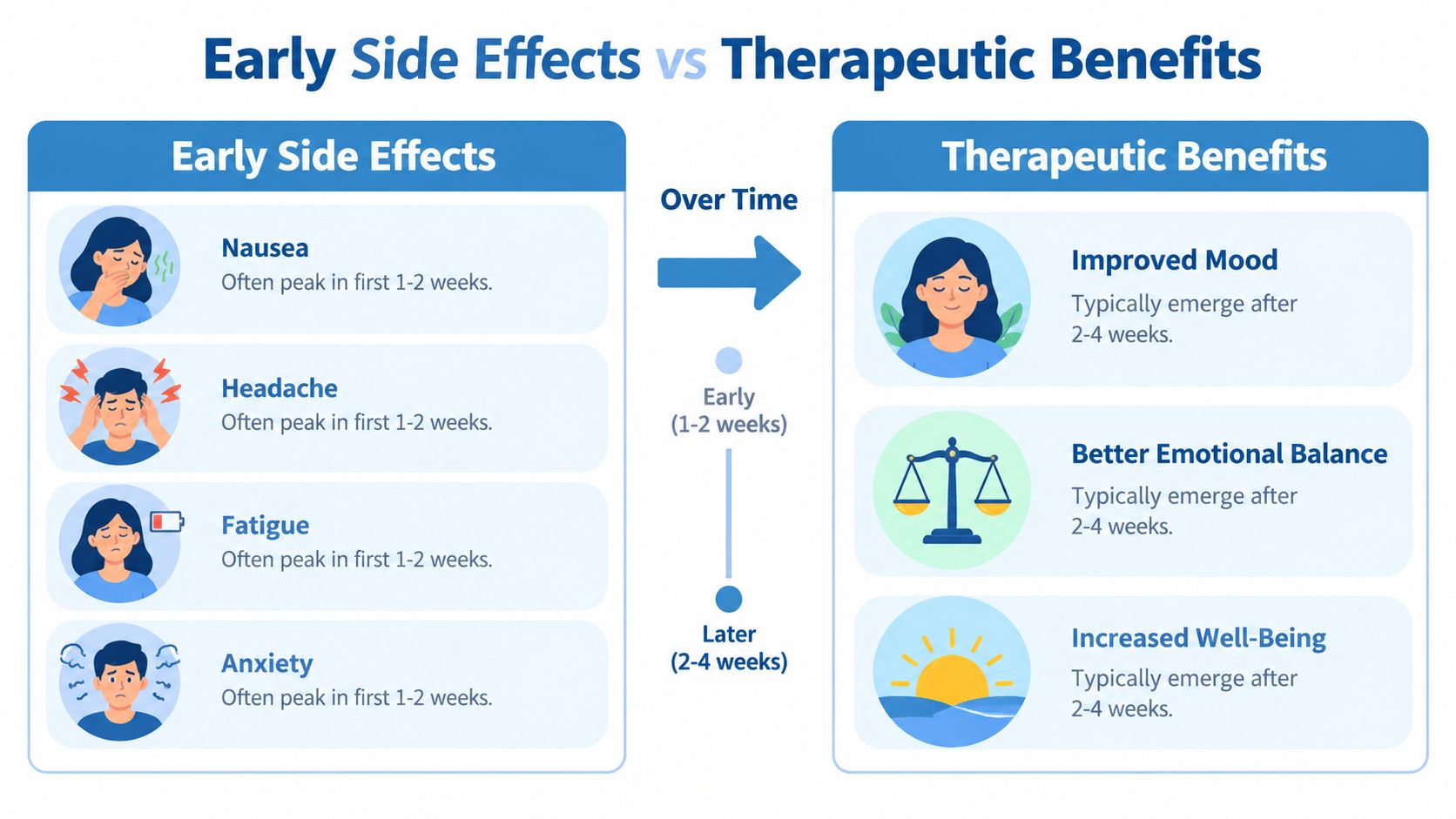
The hardest part for many people is that the uncomfortable effects often arrive on a faster schedule than the helpful ones. NICE notes that SSRIs can initially cause activation, including increased anxiety, agitation, and sleep problems, while the full anxiety-reducing effect develops gradually over at least a week, and it recommends review within two weeks, or after one week for people aged 18-25 or those with suicide-risk concerns, in NICE guidance on anxiety treatment with SSRIs. That early review isn't a formality. It's how your clinician checks safety and tolerability while benefit is still building.
The diagram below contrasts what tends to show up early with what tends to emerge later.
Effects that are often early and manageable
Nausea or stomach upset: Often most noticeable at the start and sometimes easier when the dose is taken with food, if your prescriber agrees.
Headache, tiredness, or feeling wired: Track whether it's mild, steady, improving, or interfering with daily life.
Sleep changes: You might feel drowsy or have trouble falling asleep, and dose timing sometimes matters.
Temporary anxiety or jitteriness: Mild activation can happen early, especially when you're being treated for anxiety.
Mild doesn't mean you have to endure it. Tell your clinician what's happening, because small changes can improve tolerability. Sexual effects are another concern people often delay mentioning, and our article on SSRI sexual side effects explains why it's worth raising them directly.
Benefits that usually take longer
Therapeutic benefits tend to build more gradually. You may first notice less emotional distress, less psychic anxiety, or fewer looping thoughts. Improved motivation, concentration, pleasure, and functioning can take longer to become obvious.
This is why day-by-day scoring can mislead you. A rough Tuesday in week 3 doesn't erase a generally improving trend. A weekly note is often more informative than checking your mood every hour.
Red flags that should not be waited out
Some experiences need prompt clinical contact, not patience. Call urgently for suicidal thoughts, severe agitation, or mania-like symptoms. Also get help promptly for severe inner restlessness where you can't sit still, markedly reduced need for sleep, unusual impulsivity, racing thoughts, or feeling unusually driven or restless.
If you feel unsafe, can't settle, or notice a dramatic change in sleep, energy, and behavior, contact your clinician or urgent services right away rather than waiting for the next routine visit.
Factors That Affect How Quickly SSRIs Work
Your neighbor's timeline won't predict yours. The medicine chosen, the dose, the condition being treated, and your own biology all shape how treatment unfolds. A slower response isn't a personal failure, and it isn't proof that no medication will help.
The image below shows several of the paths your clinician considers when response is slower than expected.

Dose and consistency matter
If you start on a low dose, your prescriber may increase it after seeing how you tolerate the medicine. That means the assessment clock isn't only counting days since your first pill. It's also counting time at an appropriate therapeutic dose.
Consistency matters just as much. Missing doses often, stopping and restarting, or taking the medicine at wildly different times can blur both benefit and side effects. If cost, forgetfulness, or side effects are getting in the way, say so. That's practical information, not something to hide.
What clinicians check when there's no improvement
If an SSRI is taken consistently at a recognized therapeutic dose and there's no improvement after about four weeks, clinicians should investigate adherence, dose adequacy, comorbid medical or psychiatric conditions, and psychosocial factors rather than automatically escalating treatment, according to NICE depression guidance on reviewing antidepressant response. In other words, the next step is careful review, not guesswork.
That review may include whether the diagnosis is complete, whether anxiety, ADHD, PTSD, bipolar disorder, thyroid problems, sleep problems, alcohol or cannabis use, or another medication is affecting the picture. It may also include whether therapy, sleep support, or other care should be part of the plan. Some patients also ask about pharmacogenomic testing, and our overview of the GeneSight test and its cost explains what that type of testing can and can't tell you.
Why switching too early can backfire
Changing medicines every two weeks can leave you with repeated startup effects and no adequate trial of anything. On the other hand, staying on a medicine indefinitely without benefit isn't helpful either. The goal is a timely, informed decision based on tolerability, safety, dose, and symptom trajectory.
What to Expect and When to Call Your Clinician
Follow-up early in treatment has a specific job. Your clinician is checking benefit, adverse effects, adherence, suicide risk, activation, and possible manic symptoms while the medicine is still building effect. You're not bothering anyone by reporting a problem early. You're giving your prescriber the information needed to keep treatment safe.
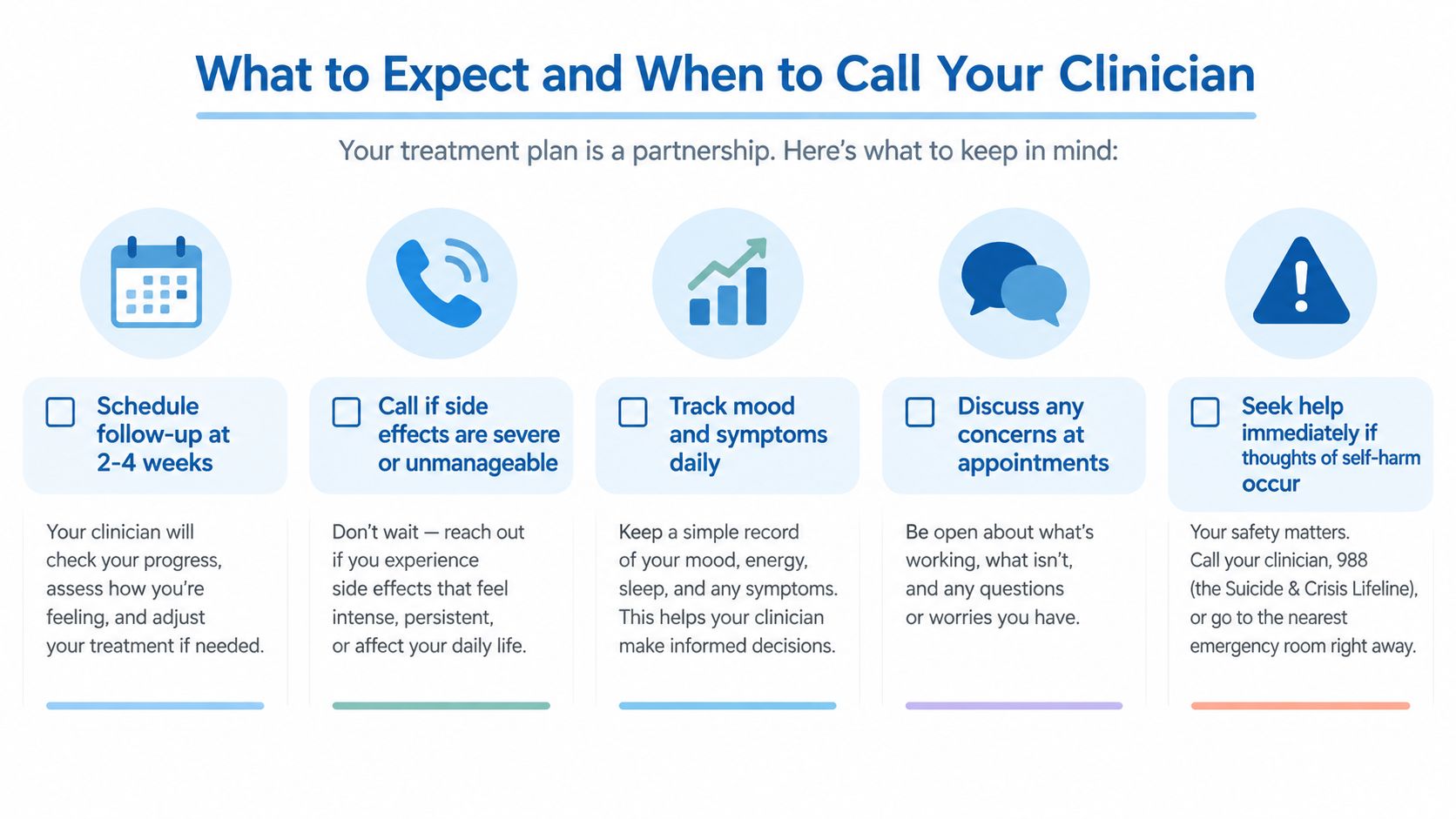
The checklist below summarizes the habits and warning signs to keep in view during the first several weeks.
A simple monitoring routine
Record a baseline: Before or just after starting, rate your mood, anxiety, sleep, appetite, energy, concentration, and functioning in a few lines.
Reassess weekly: Use the same short list each week so you can see direction, not just daily ups and downs.
Bring specifics: Note missed doses, side effects, alcohol or other substance use, major stressors, and any new medicines or supplements.
Ask direct questions: Is this dose therapeutic yet, and what should we expect by the next visit?
Whether a low starting dose explains a weak response, our guide to signs your antidepressant dose is too low can help you prepare for that conversation.
Call sooner rather than waiting for the next visit
Contact your clinician promptly if side effects feel severe or unmanageable, if anxiety or agitation is escalating, or if you can't eat, sleep, work, or care for yourself because of how you feel after starting. Don't try to fix that by stopping abruptly or changing the dose on your own.
Seek urgent help for suicidal thoughts, severe agitation, possible mania, or other serious reactions. If you're in immediate danger, call emergency services or a crisis line now. Waiting for a routine appointment isn't appropriate in that situation.
What happens at the 4-week and 6-8 week reviews
A 4-week review can identify early response and tolerability problems while there's still time to optimize treatment. A 6-8 week assessment is commonly needed to judge whether the medicine has had an adequate trial at an appropriate dose. If some improvement is present at four weeks, continuing for another two to four weeks is generally reasonable because response can continue to develop.
How Refresh Psychiatry Supports Your Treatment Journey
A useful question in the early weeks is “what changed since baseline?” At Refresh Psychiatry & Therapy, care can include a psychiatric evaluation, ongoing medication management, and coordinated therapy, so dose decisions connect to sleep, work, appetite, stress, and daily functioning. As a telemedicine-only practice for Florida residents, HIPAA-compliant virtual visits can make those early check-ins easier to attend.
The first weeks work like focusing a camera: small changes matter before the full picture sharpens. Medication is one part of care for many people. Therapy can help you build skills while the medicine takes effect, and readers outside Florida who are exploring talk therapy options may also find Interactive Counselling depression services useful as an additional resource. Bring concrete examples to each visit, such as “morning nausea started after dose increases” or “I can get out of bed now, but concentration still lags.” A clinician can sort timing, dose, side effects, and life stressors without leaving you to interpret every fluctuation alone.
Contact us or call Refresh Psychiatry at (954) 603-4081 to schedule your evaluation.
We accept Aetna, UnitedHealthcare/UMR, Cigna, Blue Cross Blue Shield, Humana, Tricare, and Oscar plans.
This blog is for informational purposes only and does not constitute medical advice. Please consult a qualified mental health professional for personalized guidance.