
💊 Switching Antidepressants Safely: A Clinician's Guide

You're still anxious, emotionally flat, or struggling to get through the day despite taking your antidepressant. Maybe it helped at first, but the side effects now feel harder to live with than the symptoms. You're considering a change, and you want to know whether switching will help or leave you feeling worse.
Switching antidepressants is a treatment decision, not just a prescription swap. The safest plan accounts for the medication you're leaving, the one you're starting, and what happens between them. Just as important, you need a way to recognize whether new symptoms reflect withdrawal, side effects, or a return of depression.
Switching Timelines and Methods at a Glance
The right switching method depends on drug half-life, withdrawal risk, and interaction risk. Half-life describes how quickly your body clears a medication. A drug that stays in your body after you stop taking it can still interact with its replacement.
For many low-interaction SSRI and SNRI combinations, clinicians consider a cross-taper, reducing the original medication while introducing the replacement at a low dose. The Specialist Pharmacy Service switching guide describes cautious cross-tapering over 2 to 4 weeks, adjusted to tolerability, alongside direct switches and taper-stop-washout strategies.
Switching methods and intervals by situation
Switch Situation | Method | Typical Interval | Key Note |
|---|---|---|---|
Most SSRI or SNRI switches with low interaction risk | Cross-taper | 2 to 4 weeks of overlap | Pace set by tolerability |
Lower relapse risk, or discontinuation symptoms before | Washout | Approximately 2 to 5 elimination half-lives, commonly 2 to 5 days | Stop the first drug fully before starting the second |
Fluoxetine to low-dose SSRI | Reduce to 20 mg, stop, then start | 4 to 7 days | Metabolite persists; prescriber sets timing |
Fluoxetine to low-dose clomipramine | Reduce, stop, then start | 14 to 21 days | Specialist supervision needed |
SSRI to MAOI | Taper, stop, then washout | At least 14 days; longer case-specific interval after fluoxetine | Specialist-only switch |
Sertraline or trazodone after an MAOI | Stop MAOI, then start | At least 14 days | Medication-specific FDA labeling |
Direct switch | Stop one drug, start the next day | Next day | Only after prescriber review of interaction risk |
The fluoxetine intervals follow Specialist Pharmacy Service guidance on SSRI switches, which specifies reducing fluoxetine to 20 mg, stopping, and waiting 4 to 7 days before a low-dose SSRI, or 14 to 21 days before low-dose clomipramine. These aren't interchangeable waiting periods.
For MAOI transitions, the FDA trazodone label requires at least 14 days between stopping an MAOI and starting trazodone, and in the reverse direction.
Prescribing reference, not a home schedule: The exact drug pair determines whether overlap is appropriate, prohibited, or unnecessary.
Why the interval isn't the whole timeline
A washout is only the gap after stopping the original medication. It doesn't include the taper beforehand or the time needed to assess the replacement afterward.
A conservative washout approach may allow approximately five half-lives, rather than using the shortest possible interval. Fluoxetine needs particular care because its active metabolite persists for weeks. Your prescriber sets the final interval using the specific medicines, doses, treatment history, and symptoms, not a table alone.
Confirm Your Reason Before You Change Anything
Start with the decision rather than the drug. Is the problem little benefit, intolerable side effects, or a safety concern? Those situations can lead to different recommendations, even when patients take the same medication.
At our practice, medication isn't automatically recommended. We conduct a thorough assessment and make the decision collaboratively; when a prescription doesn't suit someone, we may adjust the dosage, switch medications, or explore different treatment options.
Use this checklist to organize the decision before your appointment.
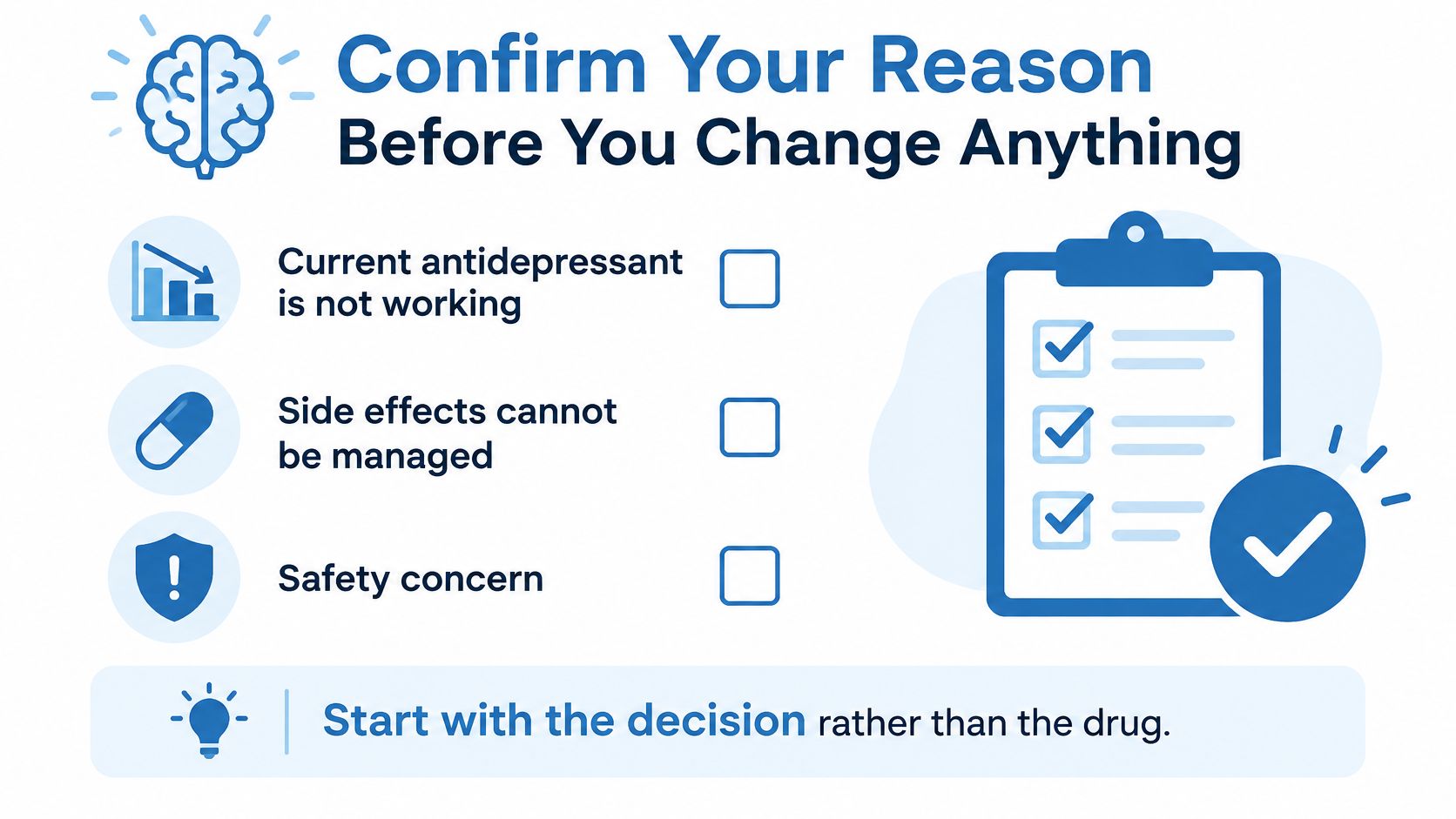
Bring a medication reconciliation checklist
Condition being treated: Depression, anxiety, or another diagnosis, plus the symptoms that interfere most with daily life.
Current treatment: Medication name, dose, start date, and dates of dose changes.
Consistency: Missed doses, refill interruptions, or changes you've already made.
Previous withdrawal: What happened when you reduced or stopped a medication before.
Mood history: Periods of unusually high energy, reduced need for sleep, impulsivity, or a bipolar-spectrum diagnosis.
Safety: Any suicidal thoughts, self-harm urges, or severe agitation.
Other substances: Prescriptions, over-the-counter products, supplements, alcohol, and recreational drugs.
Reason for switching: The exact symptom or side effect you want addressed.
If a previously useful medication seems less effective, our guide to what to do when antidepressants stop working can help you prepare a clearer history.
Set expectations without assuming failure
In a STAR*D analysis of patients switching after an ineffective initial SSRI, among 438 participants, 21% achieved remission, 9% responded without remission, and 58% experienced no meaningful benefit from the second medication. These reported categories don't describe every participant's outcome, and they aren't an individual prediction.
Remission means symptoms have resolved sufficiently to meet the study's threshold. Response means improvement without necessarily becoming well. A switch can help, but an unsuccessful switch calls for reassessment rather than the conclusion that treatment cannot work.
Medication also doesn't have to do every job. Uptown Psychology's resource on CBT techniques and relapse prevention explains practical ways to address depressive thinking and avoidance alongside medication decisions.
Write down these questions before the visit:
Why change: What specific problem are we trying to solve?
What counts as progress: What improvement should we look for over the next 4 to 6 weeks?
What happens if I worsen: Who should I contact, and what should I do before the next appointment?
Serotonin, Interaction and Genetic Risks to Check
Start with the medicines already in your cabinet. A new prescription can be appropriate on its own but unsafe alongside something you already take. Include products you use occasionally, not just your daily medications.
The FDA prescribing information for desvenlafaxine warns that SSRIs and SNRIs can cause serotonin syndrome, a potentially life-threatening reaction, and calls for monitoring particularly during treatment initiation and dose increases.
Review more than antidepressants
Bring the actual packages or clear photographs when names are hard to remember.
Other psychiatric medicines: Include prescriptions from every clinician and any leftover medication you still use.
Pain medicines: Identify prescription pain treatments and over-the-counter cough products for an interaction check.
Migraine treatments: List the exact drug, not just migraine medicine.
Supplements: Include St John's wort and products marketed for mood, sleep, or energy.
Recent changes: Mention anything you've recently stopped, because some drugs remain active afterward.
Our explanation of antidepressant drug interactions can help you organize that discussion. MAOI-related waiting periods are safety requirements, not optional gaps to shorten because you feel ready.
Genetic testing isn't a shortcut to the right prescription
Pharmacogenomic analysis examines how genetic makeup can affect medication response. It can inform recommendations for depression and anxiety, particularly when metabolism may help explain unusual dosing needs or side effects.
A review of pharmacogenomic-guided antidepressant prescribing reported better response and remission at 8- and 12-week follow-ups, particularly involving CYP2D6 and CYP2C19, with less pronounced benefit by six months. However, clinical-policy assessments have questioned whether rigorous trials establish clear, clinically meaningful utility.
Testing is most worth discussing after repeated adverse effects, multiple unsuccessful trials, unusual dose requirements, or interaction problems. Results usually tell you more about drug metabolism and exposure than whether a particular medication will definitely relieve depression.
Ask what decision the result would change before paying for testing. Consider insurance coverage, cost, and whether a result would meaningfully alter the medication or dose being considered. Testing doesn't replace diagnosis, adherence review, psychotherapy, or monitoring.
A genetic result can inform a prescription. It can't guarantee that the prescription will work.
Seek emergency assessment for confusion, fever, rapid heartbeat, muscle jerking, heavy sweating, or marked agitation, especially when several occur together after a medication change. Don't wait for a routine appointment or try to manage suspected serotonin syndrome by adjusting doses yourself.
How to Taper, Cross-Taper or Wash Out Safely
A safe transition starts with a written, medication-specific plan. You should be able to identify what you take now, what changes next, and who to contact if the transition becomes difficult.
The process below organizes those decisions without substituting for prescribing instructions.
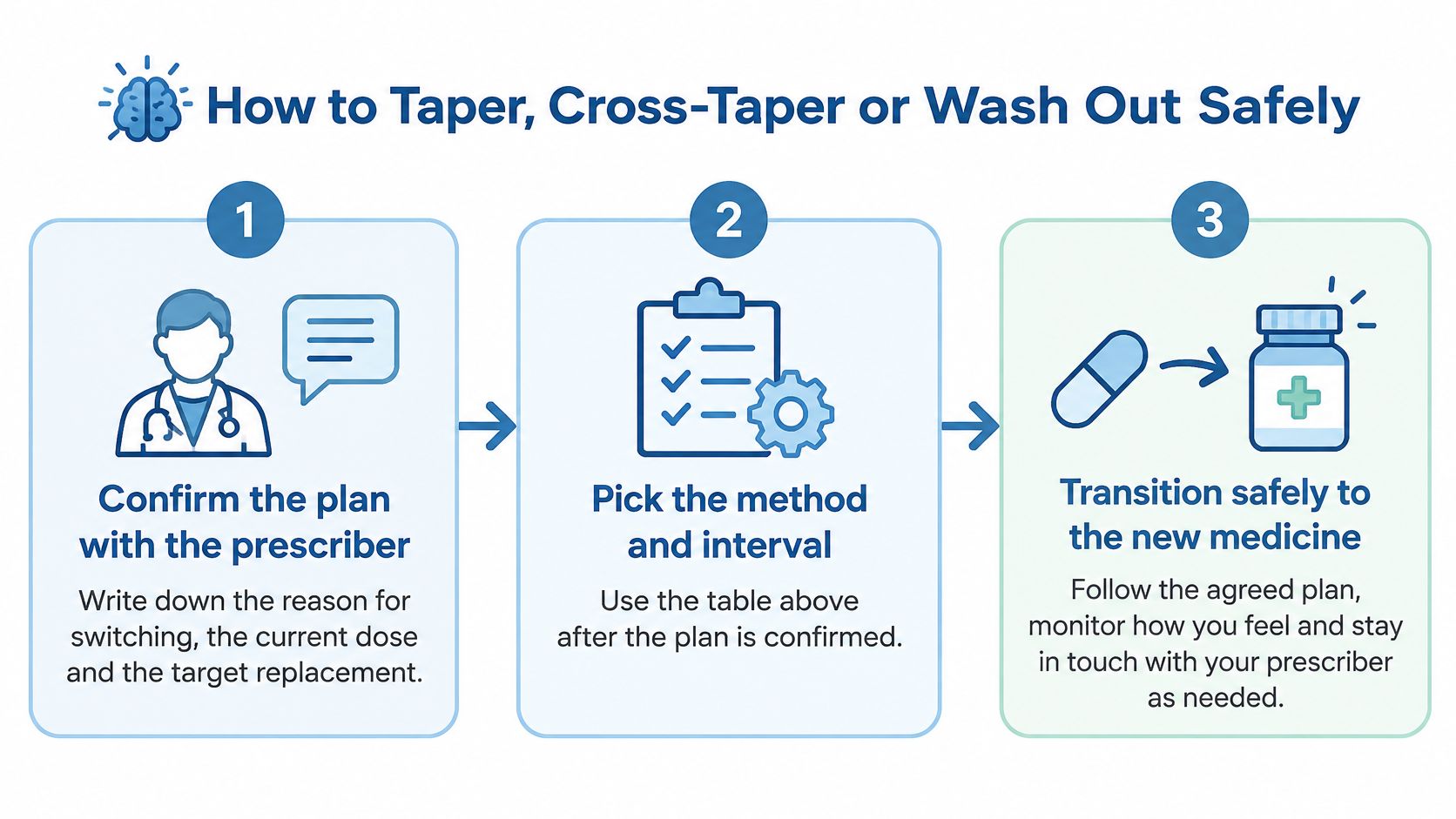
Put the transition in writing
The Australian Prescriber review of switching and stopping antidepressants describes crossover and washout methods, tapering over weeks or months, and medication-specific precautions. It specifies a washout of at least two weeks before an MAOI from most serotonergic antidepressants and five weeks after fluoxetine.
Confirm the purpose and destination. Write down the reason for switching, your current dose, and the intended replacement. Include which symptoms or side effects the clinician will use to judge whether the change helped.
Confirm the method after the interaction review. Have the prescriber name the strategy and explain whether any overlap or medication-free interval is planned. Ask for calendar dates rather than relying on instructions such as reduce gradually.
Introduce the replacement only when directed. In an appropriate cross-taper, the new medication starts at a low dose while the original medication is reduced. This avoids an unintended gap, but it's suitable only when the combination's interaction risk permits overlap.
Make reductions at the prescribed pace. Later reductions may need smaller changes or longer intervals, particularly if symptoms emerge near the end. Don't assume that tolerating an earlier reduction means every subsequent reduction will feel the same.
Confirm when the replacement increases. In a crossover plan, the clinician may increase the new medication after the original drug has stopped. Keep those instructions separate so you don't accidentally increase both medicines together.
Treat a washout as an intentional pause. Finish the prescribed taper, stop the original medication, and observe the interval for that exact drug pair. Fluoxetine requires its own instructions rather than a generic taper template.
Record symptoms with dates. Track sleep, dizziness, mood, anxiety, physical symptoms, and missed doses, then summarize them weekly. A short note linked to the dose change is more useful than a long symptom list without dates.
Use a checkpoint before each reduction. Ask the prescriber whether to hold or slow the next step if withdrawal intensifies. A stable week can be a useful discussion point, but it isn't automatic permission to reduce again.
Make the plan practical
Check that you have the correct tablet strengths and enough medication to complete the transition. Ask the pharmacist whether your formulation can be split or whether another preparation is needed; don't crush or divide a product without checking.
Our guide to stopping antidepressants cold turkey explains why an abrupt change can complicate the clinical picture. We create personalized deprescribing plans under professional guidance rather than asking patients to improvise reductions.
This video offers another way to review the transition process.
Avoid both unplanned gaps and unsupervised overlap. If the instructions are unclear or a refill problem threatens the schedule, contact the prescriber and pharmacist before the next change.
Telling Withdrawal Apart From a Return of Symptoms
Say you lower your medication and soon feel dizzy, nauseated, and unusually irritable. You might conclude that depression is returning. But when symptoms follow a dose reduction closely, withdrawal deserves consideration before anyone labels the replacement ineffective.
A systematic review of 21 clinical guidelines found that most recommended gradual tapering, but none provided concrete dose-reduction schedules, withdrawal-management instructions, or criteria for distinguishing withdrawal from relapse. That gap makes a dated history particularly important.
The distinction requires more than asking whether you feel worse.
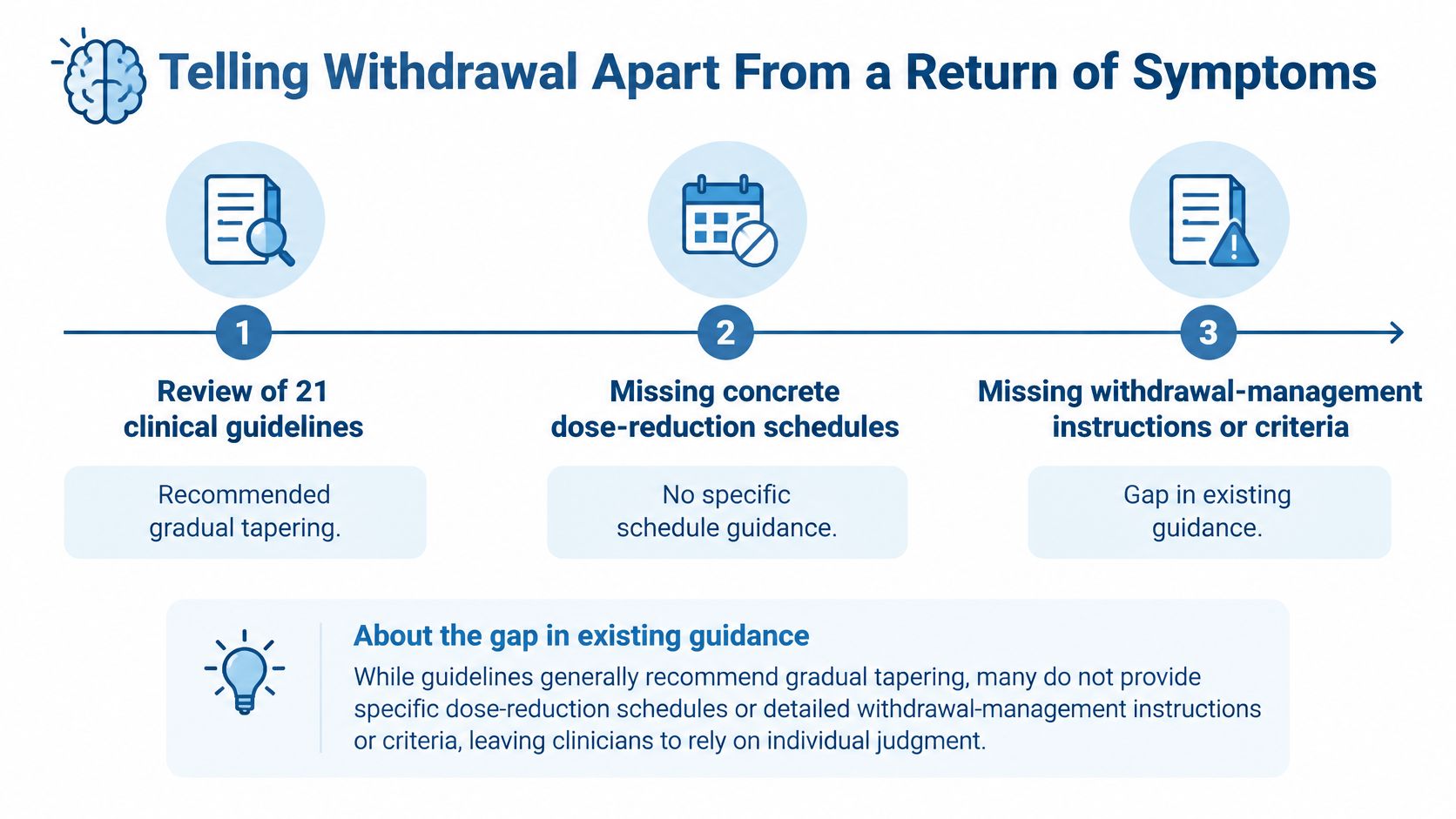
Compare timing, symptoms, and direction
Clues that point to withdrawal or relapse
Clue | Points to Withdrawal | Points to Relapse |
|---|---|---|
Timing | Starts soon after a dose reduction | Builds over weeks, often after the dose has settled |
Symptom type | Dizziness, nausea, vertigo, electric-shock sensations, sleep disturbance, irritability | Low mood, hopelessness, loss of interest, persistent worry |
Course | May peak and ease over days to a few weeks, although symptoms can last longer | Steadily worsens or does not resolve |
These are clinical clues, not diagnostic rules. Withdrawal can be delayed with a long-lasting medication, and anxiety, insomnia, irritability, and low mood can occur in either condition. Withdrawal and relapse can also coexist.
A useful comparison is with your original illness. New balance problems or electric-shock sensations after a reduction suggest a different process from the familiar pattern of losing interest, withdrawing from people, and feeling hopeless.
Our guide to how long antidepressant discontinuation syndrome lasts provides additional context, but no duration alone proves the cause.
Give your prescriber a usable timeline
Record the date of each medication change, when symptoms began, whether they fluctuate, and how they affect ordinary tasks. Include whether you can eat, sleep, work, attend school, or manage basic responsibilities.
For example, a note saying dizziness began after a reduction and now interferes with walking gives the clinician something concrete to assess. A note saying depression feels worse is important, but it needs details about mood, thoughts, physical symptoms, and functioning.
Don't force yourself to choose between withdrawal and relapse before asking for help. Describe the sequence and let the clinician assess both.
Call the prescriber before changing the dose yourself. Severe symptoms deserve prompt review rather than waiting to see whether they fit a particular timeline.
Suicidal thoughts or signs of mania are urgent regardless of cause. Markedly reduced need for sleep with escalating energy, impulsivity, or unusual behavior requires rapid assessment. The physical emergency signs described under serotonin risk also require immediate care; crisis support is listed below.
Switching Safely in Pregnancy, Adolescence and Older Age
The same medication change can require different precautions depending on pregnancy, age, health conditions, and other prescriptions. A standard calendar doesn't account for all of those differences.
Pregnancy and pregnancy planning
Say you discover you're pregnant while taking an antidepressant that has kept you well. Stopping immediately may feel protective, but abrupt discontinuation can destabilize your health, and untreated depression carries risks for both parent and baby.
Plan any switch with both your psychiatric prescriber and obstetric clinician, ideally before conception or as early as possible in pregnancy. The decision weighs the current medication's benefits and risks against the risks of changing an effective treatment.
Watch for: Worsening mood, inability to function, disrupted eating or sleep, and suicidal thoughts.
Bring: Pregnancy plans, prior pregnancy-related mood episodes, and your complete medication and supplement list.
Adolescents and young adults
Consider a teenager who becomes more restless and sleeps poorly after a medication change. Parents shouldn't assume it's ordinary stress or wait until the next scheduled visit if behavior changes sharply.
The antidepressant boxed warning addresses increased suicidal thoughts and behaviors in children, adolescents, and young adults. Younger patients need close contact during early treatment and after dose changes, with clear instructions for reaching the prescriber.
Watch for: New suicidal thoughts, agitation, impulsivity, worsening insomnia, or behavior that feels distinctly out of character.
Agree on: Who checks in, what the young person can report privately, and how caregivers will respond to urgent concerns.
Support should feel collaborative, not like surveillance. Ask direct, calm questions about safety and take the answers seriously.
Older adults
For an older adult taking several prescriptions, new dizziness could reflect medication effects, blood-pressure changes, an interaction, or another medical problem. Don't assume every new symptom is withdrawal.
Slower drug clearance and vulnerability to low sodium, sedation, dizziness, and falls can make lower starting doses and a slower transition appropriate. Clinicians may check sodium when indicated and assess balance, hydration, and blood pressure.
Watch for: Confusion, unsteadiness, falls, unusual weakness, or excessive sleepiness.
Bring: All prescription and over-the-counter products, plus the symptom log and any available blood-pressure readings.
For each of these groups, the safest approach is individual review. A caregiver can help organize information, but the prescriber needs the patient's own account whenever possible.
Book a Switch Review Before You Stop Your Current Medication
Book a review before making a dose change. Bring your medication list with doses and start dates, the reason you want to switch, previous withdrawal reactions, and your dated symptom log.
Knowing what happens at a psychiatry appointment can make that conversation easier. We assess the problem, explain the options, and develop a personalized plan rather than asking you to stop a medicine alone.
If safety is uncertain: In the United States, call or text 988 for suicidal thoughts or a mental health crisis. Seek emergency care now if you might act on those thoughts or cannot stay safe.
For payment planning: We accept self-pay and insurance, including Aetna, United Healthcare/UHC, Cigna, Blue Cross Blue Shield, Humana, Tricare, UMR, and Oscar plans. Confirm your specific plan's benefits before the visit.
This blog is for informational purposes only and does not constitute medical advice. Please consult a qualified mental health professional for personalized guidance.
Refresh Psychiatry & Therapy offers Florida telepsychiatry with coordinated medication management and therapy, including individualized support when an antidepressant change or supervised taper is appropriate. Bring your current medication list and symptom timeline so we can review the next step together. Contact us or call Refresh Psychiatry at (954) 603-4081 to schedule your evaluation.