
🧬 Is Depression Genetic? What Family History Really Means

Yes, depression is partly genetic. Twin studies estimate that genes explain roughly 30% to 50% of the differences in depression risk across a population, and that range describes a group, not a fixed share of any one person's depression.
So why does the question "Is depression genetic" get an answer that sounds more like weather forecasting than a lab result? Because the number people want does not exist. A parent with depression wants to know what will happen to their child. An adult with two aunts and a grandfather on antidepressants wants to know what is waiting for them. The research can describe how risk is distributed across thousands of people. It cannot hand any single person a percentage that applies to them. Once that distinction clicks, family history stops feeling like a verdict and starts working like a checklist, which is exactly what this article turns it into.
How Much of Depression Is Inherited
Depression clusters in families, and twin research shows why. Identical twins share nearly 100% of their DNA; fraternal twins share about 50% on average. When identical pairs are more likely to share a diagnosis than fraternal pairs, genes are part of the explanation, as the National Institute of Mental Health genetics workgroup report sets out.
The most quoted estimate comes from a large community-based twin study published in 1999, summarized in that same report. It found heritability of approximately 39% to 42% for DSM-III-R major depressive disorder, and 36% to 44% among women. Estimates for men ranged far more widely, from 1% to 24%, depending on how depression was defined. That spread is not statistical noise. It tells you the answer moves with the definition, the sample, and the sex of the people studied.
Newer samples keep landing in a similar band. A 2024 review in Frontiers in Psychiatry reports twin-study heritability of 31% to 42% for depression in children and adolescents, and a review in the International Journal of Neuropsychopharmacology places genetic predisposition at roughly 30% to 40% or more of major depression risk.
Source | Study design | Estimate | What it measures |
|---|---|---|---|
Community twin study (1999) | Identical vs fraternal twins, DSM-III-R major depression | 39–42% | Population variation in major depressive disorder |
Community twin study (1999), women | Same design, female participants | 36–44% | Variation in depression liability among women |
Frontiers in Psychiatry (2024) | Twin studies in children and adolescents | 31–42% | Depression in young people |
Review synthesis | Twin, family and epidemiological studies | About 30–40% or more | Major depression liability |
Genome-wide SNP study (2024) | Common variants, European-ancestry adults | 8.4% | Liability scale assuming 15% lifetime risk |
Common-variant synthesis | SNP-based heritability | Up to 29% | Depression-related traits |
Preprint study (2024) | Depression alone | 50% | Heritability of depression alone |
Preprint study (2024) | Combined anxiety and depression | 79% | Heritability of the combined phenotype |
DNA-level estimates run lower than twin estimates, and that gap is informative rather than contradictory. A 2024 genome-wide study posted as a preprint reported 8.4% SNP-based heritability for major depression in people of European ancestry, calculated on the liability scale with a 15% lifetime risk assumption. A 2024 synthesis of genome-wide findings puts common measured variants at up to about 29% of variation in depression-related traits.
Phenotype matters too. A 2024 preprint comparing overlapping diagnoses reported 50% heritability for depression alone versus 79% for combined anxiety and depression.
Why the divergence? Twin designs capture genetic effects that common genotyped variants miss, including rare variants and gene interactions. Change the diagnostic threshold, the age group, or the population, and the figure shifts again. The one number worth carrying around is roughly 30% to 50% of variation in liability across a population. Nothing in that range tells you what share of your own depression came from DNA.
What a Heritability Percentage Really Measures
Here is the logic twin studies rest on, stripped of jargon. If genes had nothing to do with depression, identical twins would share a diagnosis at the same rate as fraternal twins, because both pairs grow up in similar households. They don't. Identical twins share it more often, which points to biology that travels with DNA.
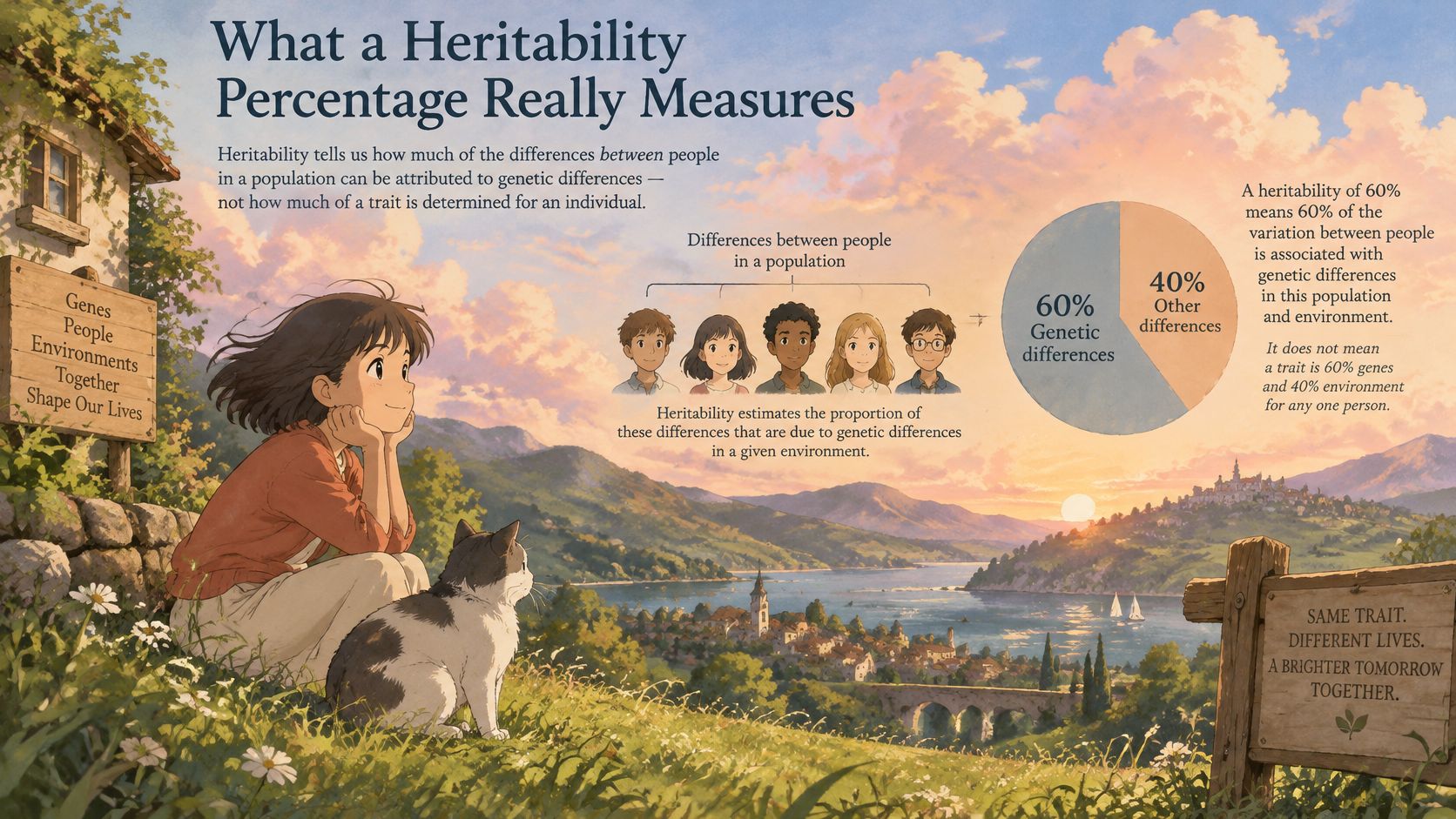
Now the part that trips up nearly everyone. Think about height in a school classroom. Genetics explains most of the difference between the tallest and shortest kids, but nutrition and childhood illness still shape how tall any one child grows. The heritability of height describes the spread in that room. It doesn't tell you how many inches of one child's height came from a chromosome.
Two people with the same genetic risk
Apply that to mood. Two adults carry the same inherited vulnerability. The first sleeps seven steady hours, has people to call on a bad night, and no chronic illness. The second works rotating shifts on four hours of broken sleep, is caregiving for a parent, and drinks most evenings to wind down. Their DNA is identical in this scenario. Their outcomes are not.
A heritability estimate near 40% describes how much of the difference between people tracks genetic differences, and the review of twin and family findings is direct about the limits: it is not a prediction that a person with a family history will develop depression, the remaining variation reflects environment and measurement, and it does not mean 40% of one person's depression was caused by genes.
Heritability also depends on the conditions of the study. Raise the stress level or change the environment across a whole population, and the estimate can shift, because it is a ratio that includes the world people live in.
The same reading applies to other conditions people ask about at the dinner table. If you've wondered whether ADHD is hereditary, the structure of the answer is identical: a real inherited contribution, no single gene, and a range that describes groups.
Practical reading: a family history signals attention, not inevitability. It earns you earlier screening, not a diagnosis in advance.
Why Depression Has No Single Gene
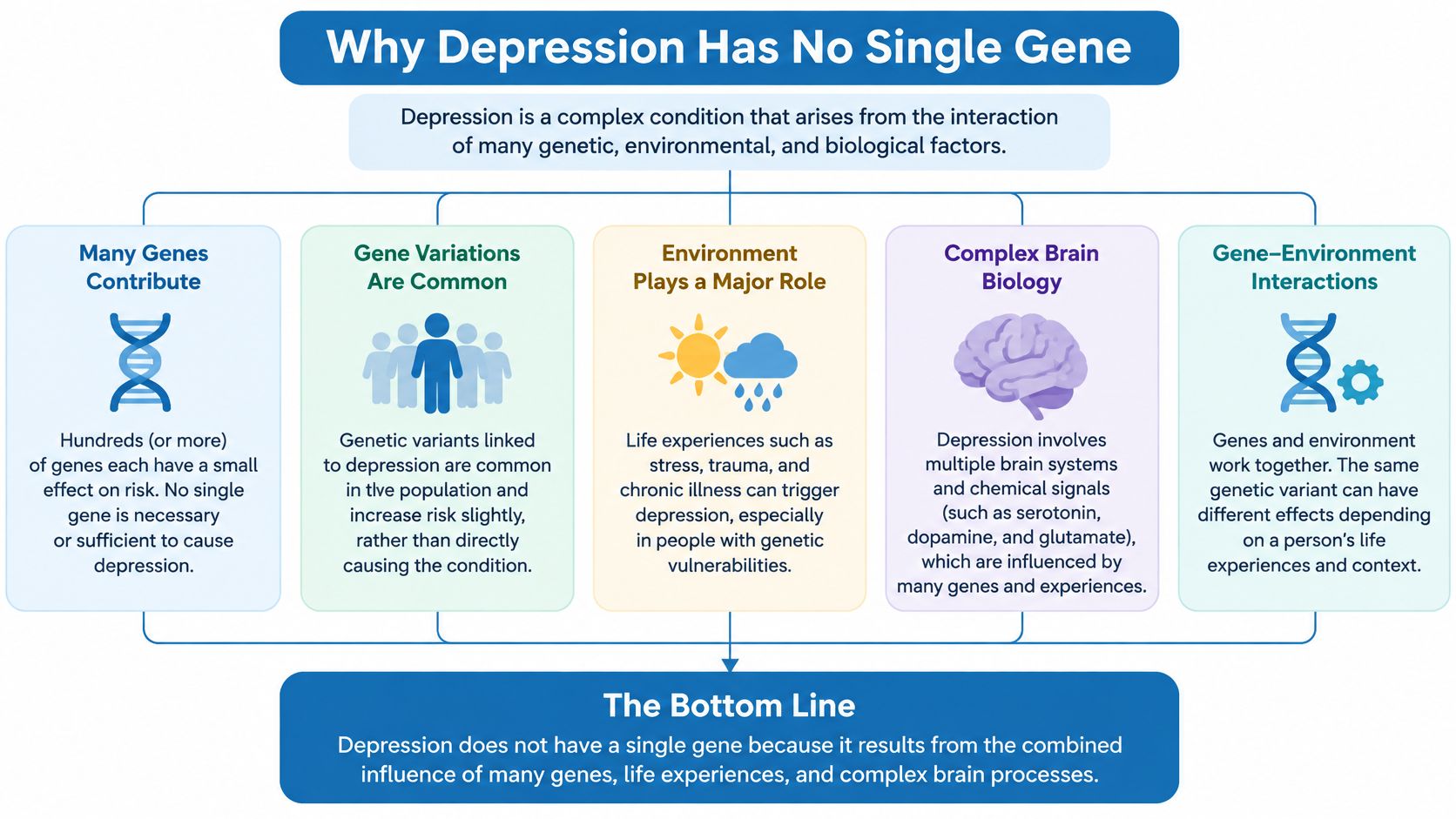
Imagine a recipe with several hundred ingredients. Each one adds a pinch, no single pinch decides the dish, and only the total changes the flavor. Depression genetics works like that. There is no "depression gene" to test for, because risk is spread across hundreds of variants that each nudge vulnerability a little.
The 2024 genome-wide association study is the best illustration of the scale. It analyzed 685,808 people with major depression or related case definitions and 4,364,225 controls from 29 countries, including participants from diverse and admixed ancestries, and identified 697 independent associations across 636 genomic loci, 293 of them never reported before, according to the genome-wide association study in Nature Genetics.
What the variants actually touch
The associations cluster around neuronal development, receptor clustering, and brain-cell function. That matters clinically, because it describes biology rather than destiny. These variants shape how brain systems are built and how they communicate, and then life experience decides how much strain those systems face.
The count keeps growing. One genome-wide analysis in Nature Medicine estimated that about 11,700 variants account for 90% of the common-variant signal for depression, and found that risk variants overlap extensively with anxiety, schizophrenia, bipolar disorder, ADHD, and educational attainment. Shared variants across diagnoses explain why the same family history can surface as anxiety in one relative and depression in another.
Where the explanation runs out
Three limits keep this from becoming a test. First, the identified variants collectively explain only part of overall risk. Second, rare variants, gene interactions, and poorly measured genetic effects fill some of the gap. Third, environment fills the rest. Someone can carry a heavy load of risk variants and never have an episode, and someone with few can become depressed after a year of loss and sleeplessness.
The honest summary is that genetics builds the instrument. It doesn't write the music.
How Genes and Stress Work Together
Picture a bucket. Genetic liability is the water already in it. Stressors are what pours in from above. A wide bucket can take a lot of pouring. A narrow one overflows sooner. The overflow is what shows up as symptoms, and it takes both a narrow bucket and enough pouring to make a mess.
The research on that interaction is more modest than headlines suggest. A review of 56 gene-environment studies found that detected interactions were heterogeneous and generally added only a small amount of explained variance beyond a simple additive model, and that reliable findings tended to come from large cohorts, often exceeding 40,000 participants.
Stress alone carries real weight. One reported analysis in that same review found depression rates rising from 10% among people reporting no stressful life events to 33% among those reporting four or more, with genetic differences appearing to modify vulnerability under high stress. Four or more major events in a life is not a rare state. It's a divorce plus a job loss plus a parent's illness plus a move.
The environments you choose and the ones you're handed
There's a subtlety worth naming. Inherited traits can influence which environments a person ends up in. A child prone to withdrawal may pick quieter social circles, which then reduces support and increases isolation. That's gene-environment correlation, and it means the line between "nature" and "nurture" is drawn with a smudged pencil.
What stays in your control is a shorter list than you'd like and longer than you'd fear: sleep regularity, alcohol, trauma treatment, chronic illness management, active substance use, social connection, and sustained financial or caregiving strain. Diet is one lever people ask about most, and the relationship between processed food and depression raises a fair question. The consistent pattern is that the levers you can move deserve as much attention as the DNA you can't.
Where to start: pick the single most changeable stressor on that list, fix it for a month, and keep a two-line daily note on mood and sleep. Patterns show up faster in writing than in memory.
What Family History Means for You or Your Child
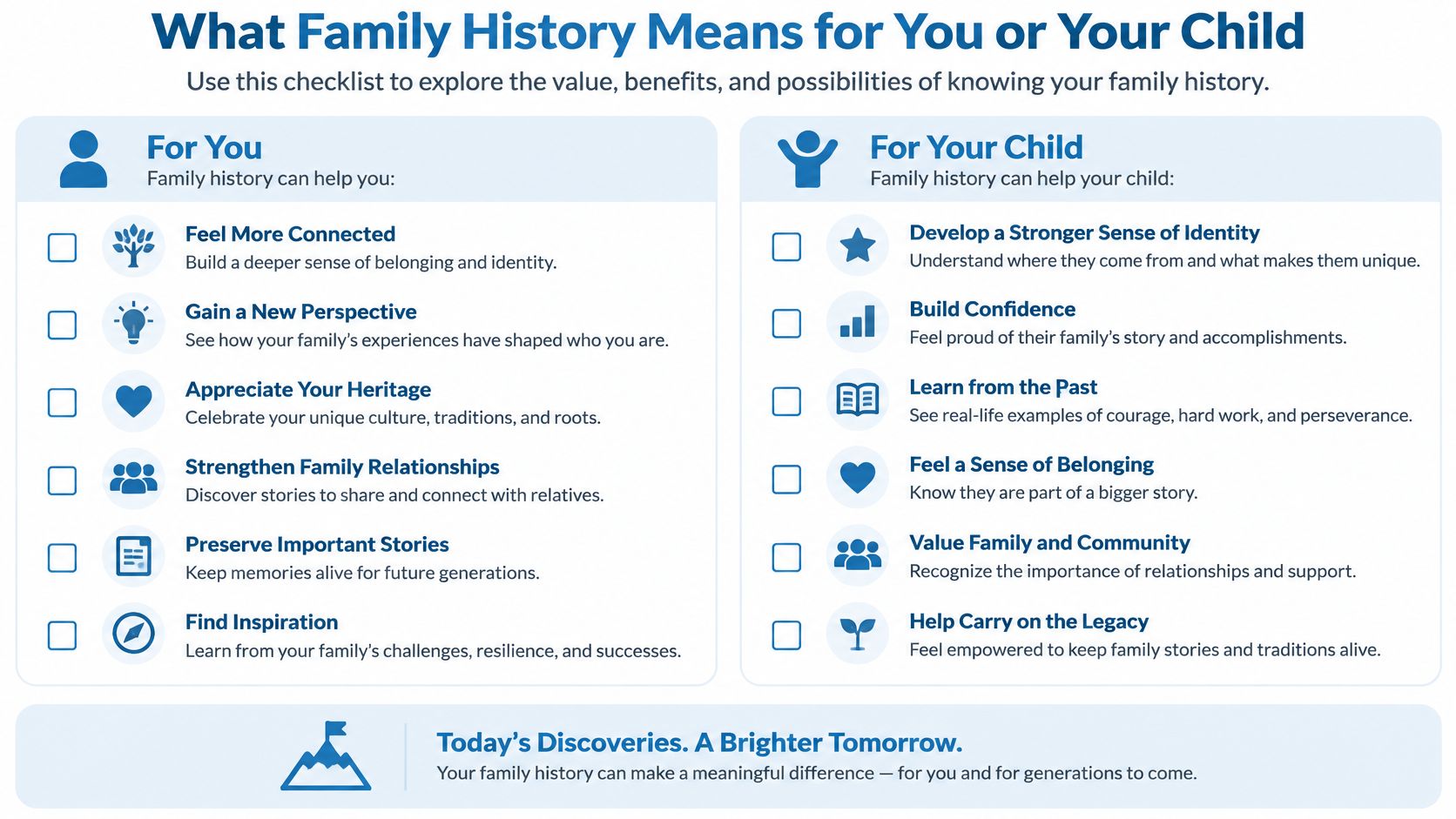
Parents ask the version of this question that hurts: will my child get this too? The answer from the family and twin literature is that a parent's depression can raise a child's vulnerability without making depression inevitable, and a 2025 review of youth depression spells out why. Youth depression is familial and modestly heritable, roughly 30% to 50% of differences in liability, and transmission runs through both genes and rearing.
The non-shared piece surprises people. Events and conditions that differ between siblings, the ones they don't experience the same way, are major contributors to symptom change. A household isn't one household to two children. One sibling gets a calm year with a healthy parent; the other gets the year of conflict and moving. Both inherit the same DNA.
The question worth asking instead
Swap "will my child develop depression" for "which warning signs and stressors should we watch, and when do we get an evaluation?" That question has answers, and it can be tracked. Children may share genetic liability, parental stress, conflict, modeling, and financial conditions all at once, which is why the young person in front of you needs watching rather than predicting.
Adolescents show a different pattern from adults. Watch for persistent irritability rather than sadness, withdrawal from friends, sleep change, grades slipping in a student who used to manage, and loss of interest in things that used to matter.
Adults in the family have an easier-to-name set: two or more weeks of low mood or lost interest, plus shifts in sleep, appetite, or energy.
What a clinician asks, and what happens next
Questions about first-degree relatives cover four areas. Depression, bipolar disorder, suicide, and substance use. Bipolar matters because it changes medication choices, and suicide history matters because it raises the urgency of safety planning.
Then bring the residue. A simple symptom log, kept for a few weeks, tracks mood, sleep hours, and one functioning note like whether work or school got done. Bring current medications and dates of past episodes. A clinician weighs family history alongside today's symptoms, sleep, trauma, and medical illness, and nothing in a family tree diagnoses anyone.
For children and teens, pediatric psychiatry works differently from adult care, and parents and caregivers are involved at every step of the treatment.
What Genetic Tests Can and Cannot Tell You
No genetic test today can tell you whether you'll develop depression. That sentence covers every product on the market, including the reports sold directly to consumers. The largest trans-ancestry research shows why the caution is practical rather than bureaucratic: polygenic scores explained up to only 5.8% of depression liability variance in Europeans, and prediction performance varies across ancestry groups, as the trans-ancestry polygenic analysis in Nature reports.
The ancestry gap is the part that gets lost in consumer marketing. Many genomic datasets remain far less representative of populations outside major European research cohorts. Earlier multi-ancestry work found fewer European-ancestry loci transferred to other ancestry groups than expected, while adding African, East Asian, South Asian, and Hispanic/Latin American participants improved discovery and fine-mapping. A score built mostly on one population performs unevenly everywhere else.
Tool | What it measures | Predicts depression? | Clinical use |
|---|---|---|---|
Direct-to-consumer genetic report | Selected variants, sometimes with a depression risk estimate | No; not a diagnostic test | Information only; not a substitute for assessment |
Polygenic risk score | Combined effect of many common variants | Limited; explains up to 5.8% of liability variance in Europeans | Research and future risk modeling |
Pharmacogenomic analysis | How genes affect medication response | No; does not predict depression | Helps guide medication choice for depression and anxiety |
Family history | Depression, bipolar disorder, suicide and substance use in first-degree relatives | No; a risk marker, not a forecast | Supports earlier monitoring and screening |
Clinical psychiatric evaluation | Current symptoms, function, sleep, trauma and medical illness | Diagnoses current depression | Basis for diagnosis and treatment decisions |
What a score cannot do
It cannot tell you which treatment will work. It cannot tell you whether your symptoms are "biological" rather than tied to trauma, stress, illness, or social conditions, because that split isn't how the biology works. Even the largest 2024 analyses leave most of the variance unexplained.
The practical risk of a consumer report runs in two directions. A low score can create false reassurance, and a high one can create alarm in a parent looking for answers about a child. Neither reaction is a service to the person being tested.
Pharmacogenomic analysis is a different tool with a real clinical role. It examines how a patient's genetic makeup affects their response to medications and is used to recommend medications for conditions such as depression and anxiety. It informs drug selection and dosing. It says nothing about whether you'll get depressed in the first place. If the distinction between testing types blurs, a psychiatrist's explanation of genetic testing walks through it.
Practical rule: use family history and a full clinical assessment to plan care, and treat direct-to-consumer predictions as background noise. Our psychiatrists are board-certified and our therapists are licensed, and genomic results still start a conversation rather than end one.
Book a Psychiatric Evaluation If Depression Runs in Your Family
Family history is context. It is not a diagnosis, and it is not a sentence. What it does justify is moving earlier, and how long a psychiatric evaluation takes is a fair question if you've been putting one off, since the answer is usually far less time than the months people spend worrying first.
A psychiatric evaluation is the first step in diagnosing and understanding a wide range of mental health conditions, and it's where a family pattern becomes a plan. Bring the family history across first-degree relatives, including depression, bipolar disorder, suicide, and substance use. Bring your current symptoms, your sleep pattern, and a list of medications and supplements.
Our clinicians are licensed in Florida, and appointments happen by secure video from anywhere in the state on any device. Medication is never automatic. A board-certified psychiatrist assesses first, then decides with you whether medication, therapy, or a combination fits, and therapy and medication management sit inside one coordinated practice.
Contact us or call Refresh Psychiatry at (954) 603-4081 to schedule your evaluation. We accept Aetna, United Healthcare/UHC, Cigna, Blue Cross Blue Shield, Humana, Tricare, UMR, and Oscar insurance plans. You can read more about what a psychiatric evaluation involves before you book.
This blog is for informational purposes only and does not constitute medical advice. Please consult a qualified mental health professional for personalized guidance.
Refresh Psychiatry & Therapy works with Florida adults, children, and adolescents who want a clear answer about what's going on, including families carrying a long history of depression who are tired of guessing. A psychiatric evaluation starts with your symptoms, your sleep, your medical history, and the family pattern you've been tracking, and it ends with a plan you helped build. Visit Refresh Psychiatry & Therapy to schedule your evaluation and stop treating family history as a forecast.