
🧠 ADHD in Men: Signs, Diagnosis and Treatment Explained

The advice most men hear first is simple and wrong: if you weren't the kid who couldn't stay in his seat, you don't have ADHD, and a job, a degree, or a family proves you've outgrown it. That story sends capable men to productivity apps and online quizzes instead of an evaluation. A checklist can name a pattern. It can't show whether symptoms started in childhood, whether they wreck more than one part of life, or whether sleep, mood, or substances are doing the damage. ADHD in men often hides inside overwork, short tempers, and nights that start too late. The useful question isn't whether you look hyperactive. It's whether the cost of keeping up has become the way you live.
How ADHD Shows Up in Men Across Life Stages
CDC surveillance estimated that 15.5 million U.S. adults, 6.0%, about one in sixteen, reported a current ADHD diagnosis in 2023, and about half received that diagnosis at age 18 or later. Men made up about 48.3% of those adults. Say a man coasts through school on intelligence, then watches the same unfinished tasks follow him from a first job into a mortgage and a toddler's bedtime. The problem didn't appear at 35. The supports that hid it did.
Life stage | Typical presentation in men | What is often missed | What an evaluator checks |
|---|---|---|---|
Childhood (boys) | Hyperactivity, impulsivity, classroom disruption | Quiet inattention and daydreaming | School records and teacher reports |
Early adulthood | Job changes, unfinished degrees, impulsive spending | Blamed on low motivation or immaturity | Work history and financial patterns |
Established career | Missed deadlines, procrastination, crisis-driven productivity | Compensation through overwork | Performance across work and home |
Partnership and parenthood | Irritability, low frustration tolerance, household conflict | Mood or anger framed as personality | Relationship and household functioning |
Midlife | Forgotten appointments, unpaid bills, disrupted sleep | Attributed to stress or aging | Developmental history and co-occurring conditions |
What each stage hides
In childhood, the boy who daydreams gets labeled unmotivated while the boy who blurts answers gets referred. In early adulthood, job-hopping and impulsive spending look like immaturity. In an established career, all-nighters before a deadline look like drive. In partnership and parenthood, a short fuse gets called personality. By midlife, missed appointments and bad sleep get blamed on stress or age.
Poor academic performance, work problems, strained relationships, missed appointments, procrastination, and a pull toward immediate rewards are common adult consequences. Screening should also cover substance use, unsafe sexual activity, job performance, and money trouble, because those risks rise in adolescents and adults with ADHD. Treatment targets should include attendance, finished projects, fewer financial errors, steadier sleep, and how the relationship is going.
A strong résumé doesn't close the case. If the results depend on exhausting effort, last-minute panic, or a partner who tracks the details, ADHD is still on the table.
Two questions sort a real concern from a bad week. Do the problems show up in at least two areas of life, such as work and home? Were there signs before adulthood, even if nobody named them? An online checklist can't answer either one. If restlessness is still the loudest adult symptom, our guide to hyperactive ADHD in adulthood walks through how that pattern changes after school.
Why Men Are Diagnosed More Often Than Women
These figures describe who gets identified, not a biological head count of who has ADHD.
Population studied | Men | Women | Male-to-female ratio |
|---|---|---|---|
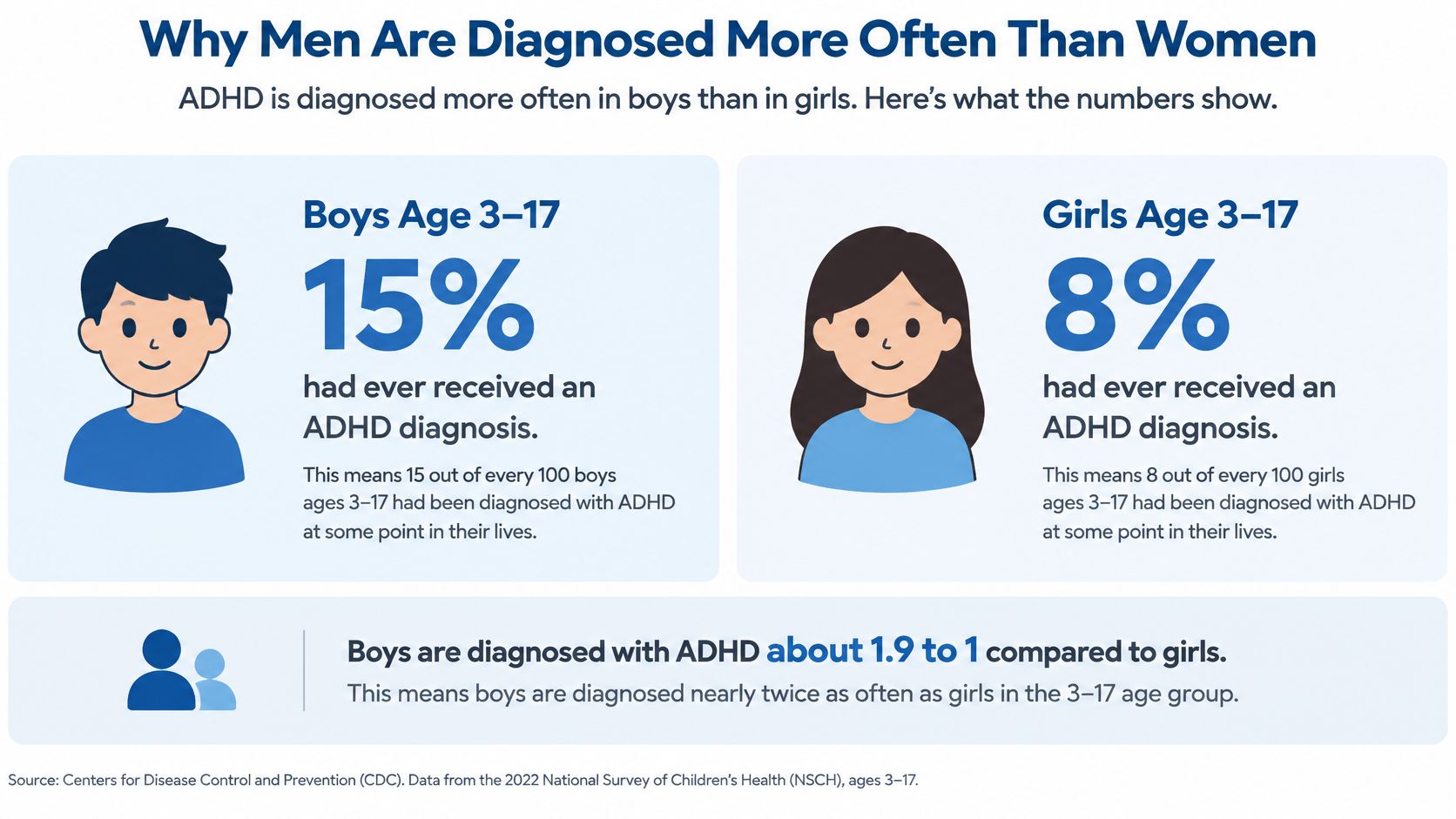
Boys vs girls aged 3-17, ever diagnosed (U.S., 2022) | 15% | 8% | about 1.9:1 |
Pediatric clinical samples, pooled | 38% | 18% | about 1.9:1 |
Adults aged 18-44, current ADHD (U.S.) | 5.4% | 3.2% | about 1.7:1 |
Adult clinical samples, pooled | 25% | 21% | about 1.2:1 |
Clinical studies, 2025 review | Not stated separately | Not stated separately | about 4:1 |
General population symptoms, 2025 review | Not stated separately | Not stated separately | about 2.4:1 |
Community studies, research reviews | Not stated separately | Not stated separately | near 3:1 |
Clinical samples across research reviews | Not stated separately | Not stated separately | roughly 3:1 to 16:1 |
What the rows actually measure
National survey data for 2022 estimated that 15% of boys aged 3–17 had ever received an ADHD diagnosis, compared with 8% of girls, a gap of 7 points and about 1.9:1. The same reviews put clinical male-to-female ratios from roughly 3:1 to 16:1, while community studies sit near 3:1. Clinics see the boys who disrupt class. Community counts catch quieter cases too.
A 2025 review put the clinical ratio near 4:1 and the general-population symptom ratio near 2.4:1. Referral patterns inflate the clinic gap. In pooled clinical samples, pediatric rates were 38% for males and 18% for females (about 1.9:1), while adult rates were 25% and 21%, about 1.2:1, and that adult difference wasn't statistically significant, according to the CDC's ADHD data summary.
Among U.S. adults ages 18–44, the National Comorbidity Survey Replication estimated current ADHD at 5.4% of men versus 3.2% of women, with 8.1% lifetime prevalence in that age band. Current and lifetime numbers answer different questions, so a man without a childhood label can still meet criteria now.
A 2024 meta-analysis of 52 studies and 18,408 participants found mostly small sex differences that depended on the method. Across the lifespan, males showed more severe hyperactivity and impulsivity when scales and interviews were combined. In adults, men scored higher on inattention on rating scales, yet interviews alone showed no significant sex difference in adult symptom severity.
Practical rule: Judge your own severity from history and impairment. Don't borrow it from a male diagnosis rate.
Boys and men get referred more often because hyperactivity, impulsivity, and disruption are easy to see at school and work. Inattentive symptoms are quiet, so recognition waits. That is a visibility problem, not proof that ADHD is a male condition. The same gap shows up in reverse for women, which is why ADHD in women needs its own look at missed inattentive symptoms.
How Adult Men Get Diagnosed With ADHD
An adult evaluation isn't a quiz score. It's a reconstruction of when symptoms started, where they still cause harm, and what else could explain them. We use evidence-based tools and thorough evaluations, and a plan may include therapy, medication management, and coping strategies. A screening form alone is not a diagnosis.
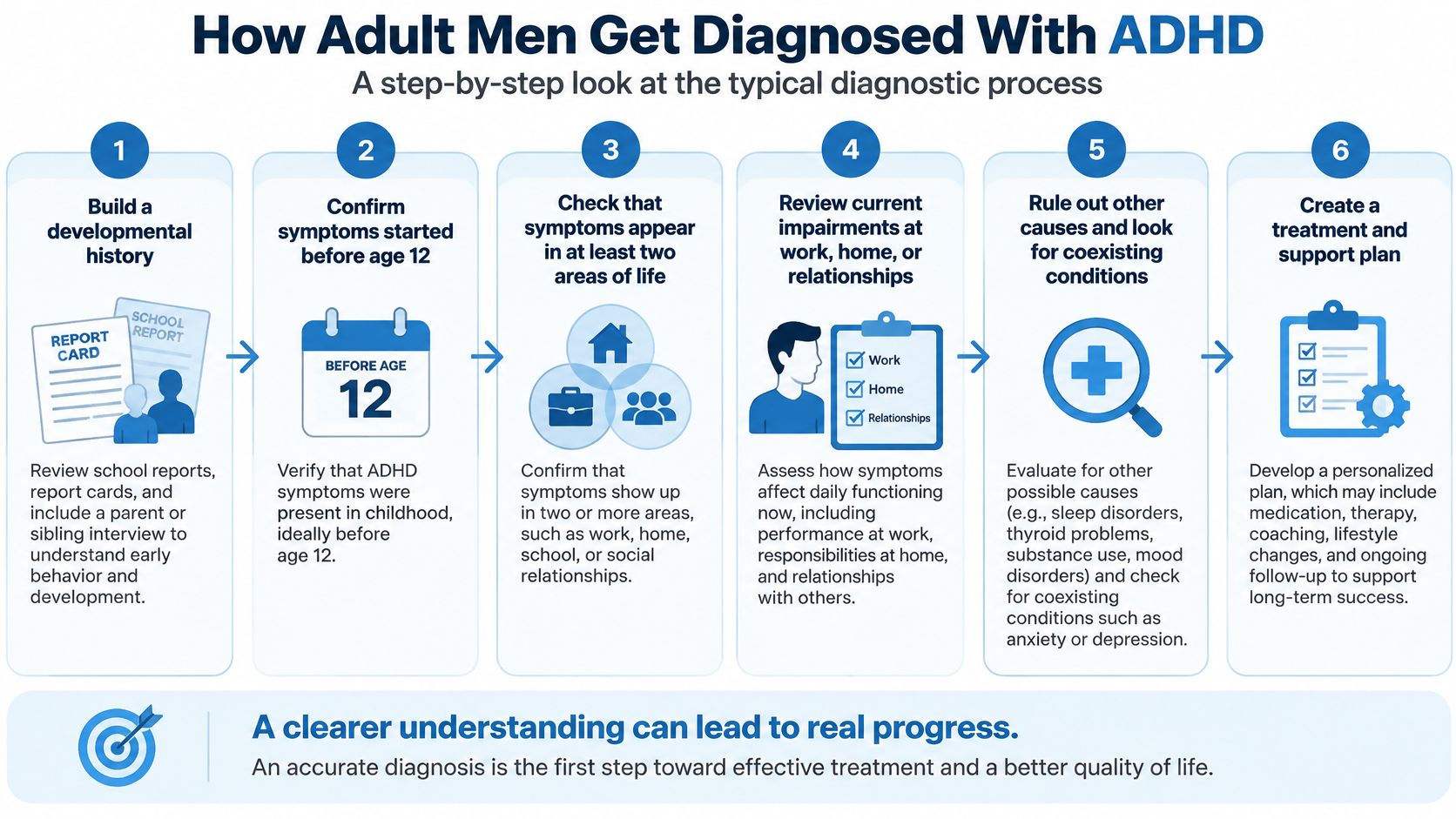
Six steps and why each one matters
Build a developmental history. Bring report cards, school reports, and, if you can, a parent or sibling who remembers elementary years. The National Institute of Mental Health states that adults must have shown symptoms before age 12. Recent chaos at work isn't enough on its own.
Check that symptoms persist. Clinicians look for a pattern lasting at least six months, not a single brutal quarter, because ordinary stress can mimic a short stretch of poor focus, as NIH guidance on ADHD frames the time course.
Map impairment, not just traits. Symptoms should disrupt at least two areas, such as work, home, relationships, or driving, and be more severe and persistent than ordinary distractibility. Write the consequences: missed deadlines, job instability, unsafe driving, financial impulsivity, unfinished projects, relationship conflict.
Screen the look-alikes. Depression, anxiety, bipolar-spectrum illness, sleep disorders, substance effects, trauma, and stress-related executive trouble can copy inattention or pile on top of it.
Pair scales with an interview. Rating scales show how you score against a standard. The interview tests whether those scores match a life story. Our overview of a test for ADHD in adults explains why the form is only one piece.
Set targets with the patient. Symptom change is one marker. Attendance, finished projects, sleep regularity, and money management tell you whether life got easier.
Men who were never assessed as boys often have no old diagnosis to lean on. The history still carries the diagnosis, rebuilt from comments like "bright but careless" and a long trail of lost assignments. Sex differences in who gets labeled narrow in adulthood, so a male stereotype shouldn't decide your case.
What to bring
Old report cards or teacher comments, even a photo of a box in your parents' closet.
A two-year consequence list covering work, money, driving, and home.
A sleep and alcohol note: typical bedtime, wake time, caffeine cutoff, and weekly drinks.
Conditions That Mimic or Accompany ADHD in Men
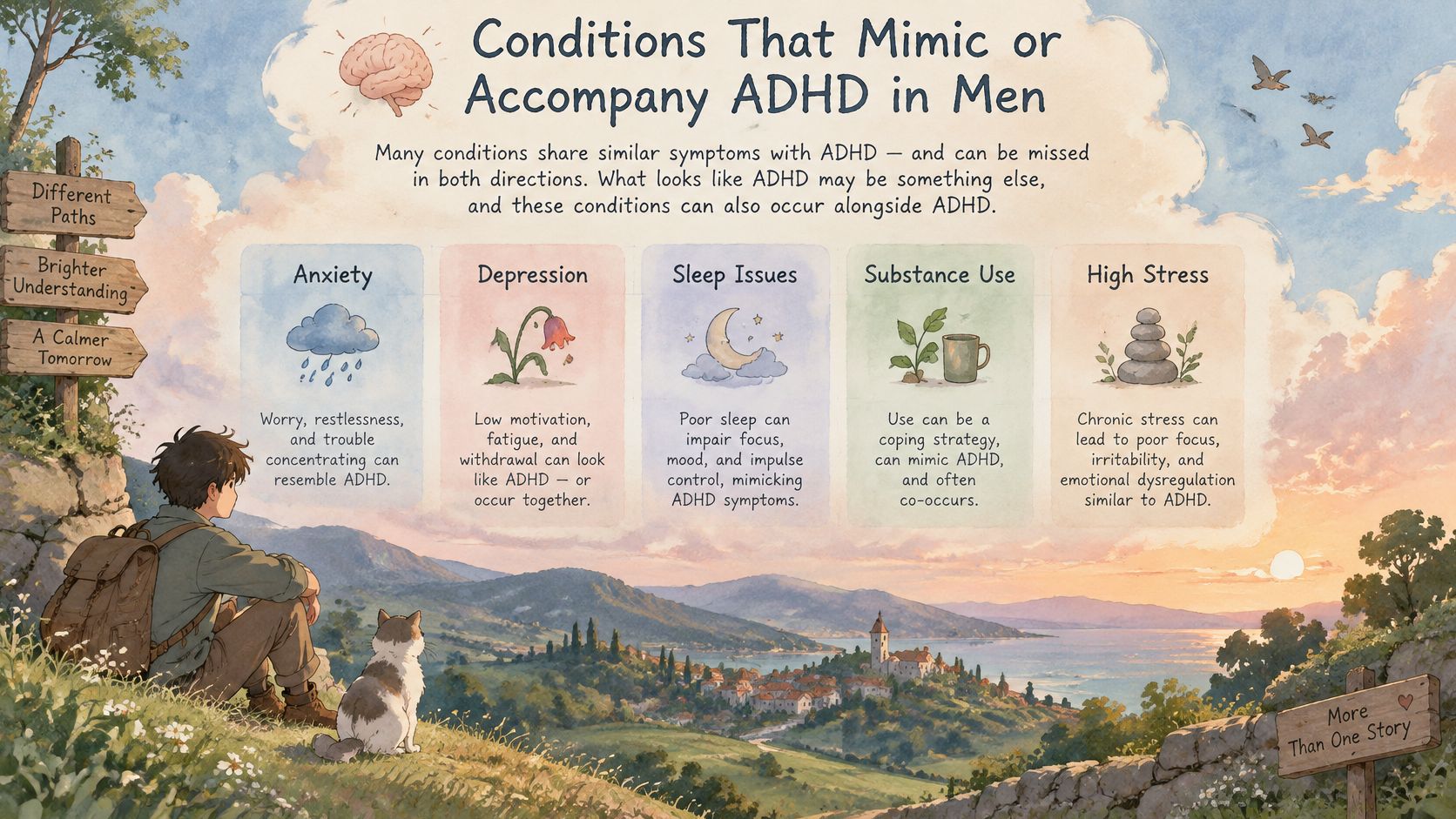
Plenty of conditions borrow the same complaints men bring to an ADHD visit: fog, a short fuse, missed mornings, and a mind that won't stay put. The miss runs both ways. ADHD gets called depression, and depression gets called ADHD.
Condition | Overlap with ADHD | How clinicians tell them apart |
|---|---|---|
Depression | Low energy, poor concentration, withdrawal | Low mood and loss of interest, with inattention that began only after a low period |
Anxiety | Restlessness and distractibility from worry | Worry is the core complaint and focus breaks around specific fears |
Bipolar disorder | Impulsivity, restlessness, racing thoughts | Distinct episodes of elevated or irritable mood lasting days |
Delayed sleep-wake phase disorder | Morning grogginess, late-night alertness, missed early commitments | Symptoms improve when sleep timing is corrected |
Sleep apnea | Daytime fatigue, poor concentration, irritability | Snoring and witnessed breathing pauses; a sleep study confirms it |
Substance use (alcohol, cannabis, stimulants) | Impaired memory and attention | Symptoms track with use and change over an abstinence period |
PTSD | Hypervigilance, irritability, poor concentration | Trauma exposure and intrusive memories |
Sleep timing is not a side note
A 2025 review reports that sleep loss occurs in roughly 80% of children and adults with ADHD, names delayed sleep-wake phase disorder as the most common comorbid sleep problem, and notes melatonin onset about 1.5 hours later in adults with ADHD than in adults without it. A man who looks lazy at 8 a.m. may have a clock that only comes online near midnight. Circadian misalignment, short sleep, snoring, restless legs, shift work, alcohol, cannabis, or a drifting routine can look like worsening focus or a medicine that "stopped working."
There is no rule that sleep must be fixed before ADHD is treated, or the reverse. The visit should cover when symptoms peak, how much bedtime and wake time swing, snoring or breathing pauses, how long a stimulant lasts, caffeine, and mood. Care may mix behavioral sleep steps, a timing change for medication, a sleep-disorder workup, and ADHD medication or therapy.
If focus is still wrecked after apnea treatment, don't assume the ADHD question was a mistake. Persistent fatigue after sleep apnea treatment is its own problem, and it can sit beside attention symptoms rather than replace them.
Worry-driven distractibility is a frequent mix-up, and ADHD and anxiety often need to be treated as a pair rather than a single label. If someone has told you that poor focus is a character flaw, ask about sleep and substance use before you decide the diagnosis is wrong, or that it is already settled.
Medication and Therapy Options Compared
Medication is a shared decision after a full assessment, not a default. It isn't always recommended. If a medicine doesn't fit or causes unwanted effects, we may change the dose, switch the medicine, or try a different approach.
Option | What it involves | Best suited for | What to monitor |
|---|---|---|---|
Stimulant medication | Methylphenidate or amphetamine formulations; a controlled substance | Adults with clear, impairing symptoms | Sleep, appetite, blood pressure, heart rate, mood |
Non-stimulant medication | Atomoxetine, viloxazine, or extended-release guanfacine or clonidine | Stimulant side effects, anxiety, or substance-use history | Nausea, fatigue, blood pressure, time to full effect |
Cognitive behavioral therapy for adult ADHD | Skills for planning, time management, and emotional regulation | Procrastination, disorganization, and self-criticism | Weekly goals completed, task tracking, mood scores |
Behavioral sleep strategies | Fixed wake time, morning light, caffeine cutoff, medication-timing review | Delayed sleep and irregular schedules | Sleep log and daytime energy |
Combined medication and therapy | Medication plus skills work in one coordinated plan | Moderate to severe impairment or co-occurring conditions | Work, finances, relationships, and symptom change |
How the options trade off
Stimulants (methylphenidate products such as Concerta, or amphetamine products such as Adderall XR and Vyvanse) often help attention and impulse control quickly. They're controlled substances, so follow-up isn't optional. Watch sleep, appetite, blood pressure, heart rate, and mood.
Non-stimulants such as atomoxetine (Strattera), viloxazine (Qelbree), or extended-release guanfacine or clonidine make sense when stimulants disturb sleep, when anxiety is prominent, or when a substance-use history makes a controlled medicine a poor first choice. They take longer to reach full effect, and nausea, fatigue, and blood pressure need a look.
Cognitive behavioral therapy built for adult ADHD doesn't replace a prescription. It trains planning, time blocks, and what to do when shame shuts a task down. Behavioral sleep strategies (a fixed wake time, morning daylight, a caffeine cutoff, and a review of when the pill is taken) keep a useful dose from colliding with a 2 a.m. bedtime.
Combined care fits moderate or severe impairment and co-occurring conditions because pills don't file the taxes and skills work doesn't correct every neurochemical gap. A skills-focused coach can sit beside clinical care. Choosing a mental health coach is worth reading if you want help with routines and aren't looking for someone to diagnose you. For a closer look at drug classes, see stimulant vs nonstimulant ADHD medications.
Access before the first fill
Shortages, cost, insurance rules, and the extra steps around controlled medication block a lot of treatment that was otherwise well chosen. Before you leave with a prescription, confirm the pharmacy can fill it, what your plan covers, and what you'll do if a refill slips. A perfect dose that you can't obtain is not a plan.
Daily Coping Strategies and Workplace Accommodations
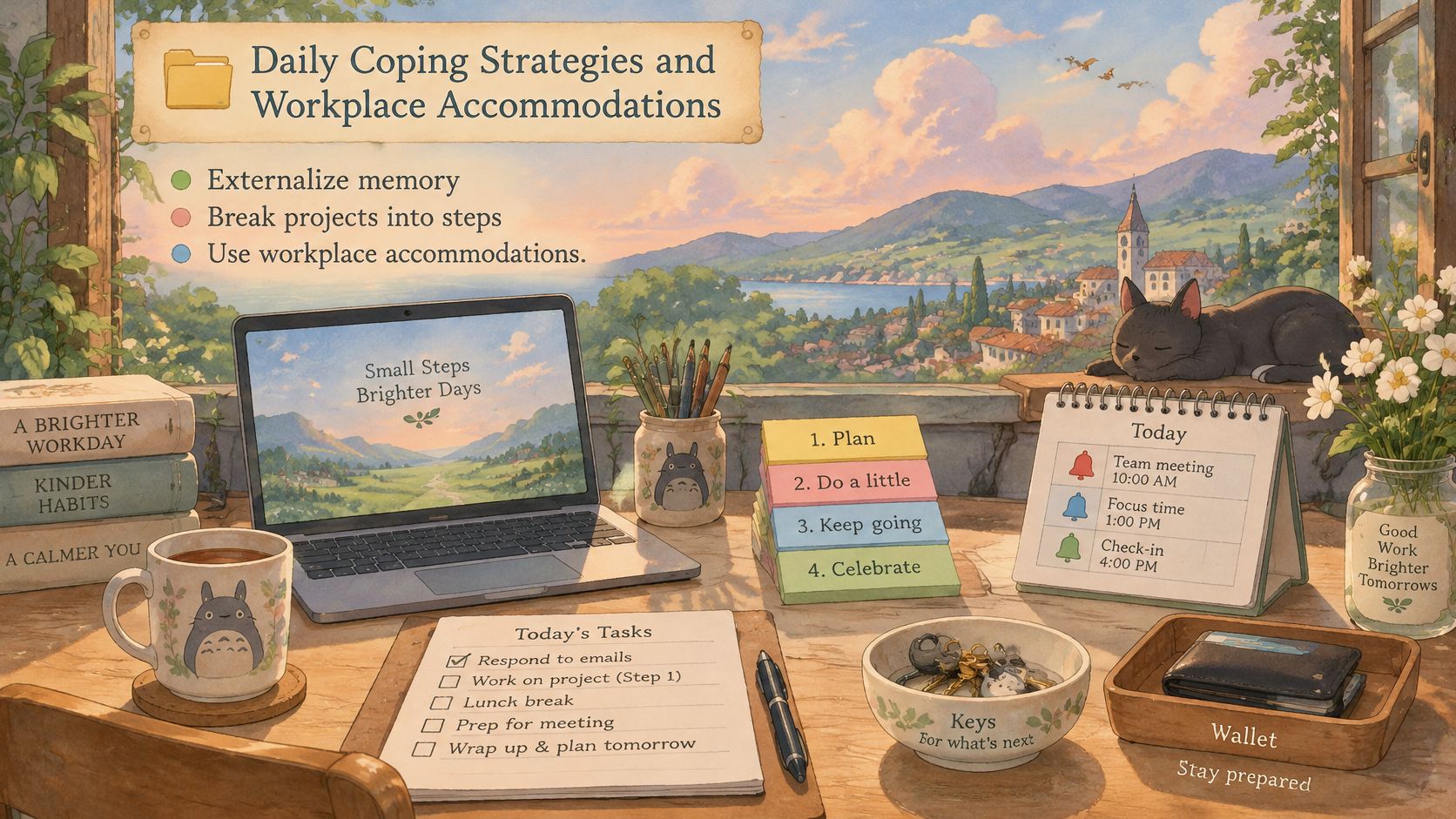
Strategies work when they move memory out of your head and cut the number of decisions between you and the next step.
Externalize memory. One task list, calendar alerts, and a single tray for keys and wallet. A second list becomes a second place to forget.
Name the first step and its deadline. "Open the spreadsheet and enter January" beats "do the budget."
Use a timer for 25 to 50 minutes. The block is short enough to start and long enough to finish a piece.
Remove friction. Pre-set meals, automatic bill pay, and a phone charging outside the bedroom so the scroll doesn't own midnight.
Anchor sleep. Same wake time daily, then morning daylight. The wake time sets the night better than a heroic early bedtime you won't keep.
Cut late alcohol and caffeine. Both steal the next morning and then get blamed on motivation.
Schedule exercise like a meeting. It supports mood and makes the next focus block easier to enter.
Asking for accommodations at work
You don't need to recite a diagnosis in a team meeting. You do need a written request that names the limit and the fix.
Written instructions for multi-step tasks, because verbal handoffs vanish by the elevator.
A weekly check-in so drift shows up in days, not at the annual review.
Deadlines split into milestones instead of one cliff date.
A quieter desk or noise-cancelling headphones when open offices shred attention.
A flexible start time when a documented sleep delay makes 8 a.m. a setup for errors.
A visible tracker the team already uses, so the accommodation is a tool, not a secret.
Send the request to HR in writing. Describe the functional limit ("I miss steps given only in conversation") rather than a label, and propose one or two changes, not a wishlist.
For four to six weeks, write down the three most disruptive situations each week and whether the change reduced them. Keep what moves the count. Drop what you only meant to try.
Book Your ADHD Evaluation in Florida Today
Schedule a thorough evaluation if signs have been present since childhood, or they appear in at least two areas of life, and you want a clear answer plus a plan rather than another checklist.
A January 2025 U.S. Department of Health and Human Services review, discussed in reporting on adult ADHD disparities, flagged insurance barriers, specialist wait times, cost, and uncertainty about where to start. Intake is built to cut that uncertainty. You know who you're seeing, what to send ahead, and which plans we accept before you guess.
Book online through Refresh Psychiatry or call the number below.
Complete the intake questionnaire on current symptoms, childhood history, family history, school or work records, and current medications.
Attend a secure video visit with a board-certified psychiatrist, typically 45 to 60 minutes, on any device from anywhere in Florida.
Leave with a treatment plan. Medication management is provided by board-certified psychiatrists, and therapy can be coordinated in the same practice when that's the right mix.
Schedule follow-up to adjust doses and review work, sleep, and home outcomes.
Licensed psychiatrists can prescribe a full range of psychiatric medications, including controlled substances when appropriate. If you need intensive monitoring, we help arrange in-person care. We accept Aetna, United Healthcare/UHC, Cigna, Blue Cross Blue Shield, Humana, Tricare, UMR, and Oscar, and self-pay is available.
Contact us or call Refresh Psychiatry at (954) 603-4081 to schedule your evaluation.
This blog is for informational purposes only and does not constitute medical advice. Please consult a qualified mental health professional for personalized guidance.
Refresh Psychiatry & Therapy provides Florida telepsychiatry for adult ADHD, including a full evaluation, medication management when it's appropriate, and therapy coordinated in one practice. If attention, sleep timing, work, or home life have been costly for years, a structured visit is a better next step than another online quiz. Visit Refresh Psychiatry & Therapy to book your evaluation.