
Anxiety and Caffeine: What You Need to Know in 2026

You reach for an afternoon latte because you're tired, distracted, and trying to finish the day. Then your chest feels fluttery, your thoughts speed up, and you start wondering whether you're stressed, reacting to caffeine, or heading toward a panic attack. The useful question isn't whether coffee is bad for anxiety. It's which dose, at what time, under what circumstances makes your symptoms worse.
When Coffee Feels Like an Anxiety Attack
A familiar situation can become frightening quickly: you drink coffee to improve concentration, notice your heartbeat, and start monitoring every sensation. The more closely you watch, the harder it becomes to focus on anything else. This is an illustrative pattern, not proof that caffeine caused a particular person's symptoms.
Caffeine-related stimulation and anxiety can look remarkably similar. Restlessness, nervousness, palpitations, difficulty sleeping, and heightened worry can occur together. Physical activation doesn't automatically mean you have an anxiety disorder, but it also shouldn't be dismissed just because you had coffee.
Separate the sensation from the explanation
When evaluating anxiety and caffeine, a clinician needs more than a beverage count. The sequence matters: what you consumed, whether symptoms followed, what your sleep was like, and whether the same distress happens without caffeine.
Useful questions include:
Timing: Did the discomfort follow a caffeinated drink, or was it already building?
Context: Were you exhausted, under unusual stress, or using an energy drink to compensate for poor sleep?
Pattern: Does the reaction repeat, or was this an isolated experience?
Impact: Could you continue your day, or did fear make you leave work, avoid driving, or cancel plans?
Optimal Native's overview of caffeine's impact on your nervous system offers additional context for thinking about stimulant-related arousal. For understanding the experience itself, this explanation of anxiety versus a panic attack can help you describe what happened more clearly.
Practical distinction: A racing heart is a symptom to assess, not a diagnosis by itself.
Don't assume unfamiliar chest symptoms are anxiety because they followed coffee. New chest pain, fainting, or severe shortness of breath warrants urgent medical assessment rather than a home caffeine experiment.
The clinical task is to distinguish a transient stimulant response, an independent anxiety condition, or both. You don't have to choose an explanation before asking for help.
What the Research Shows About Caffeine and Anxiety
Caffeine can increase anxiety symptoms, and dose matters. What the research doesn't support is a universal rule that every caffeinated drink worsens anxiety in every person.
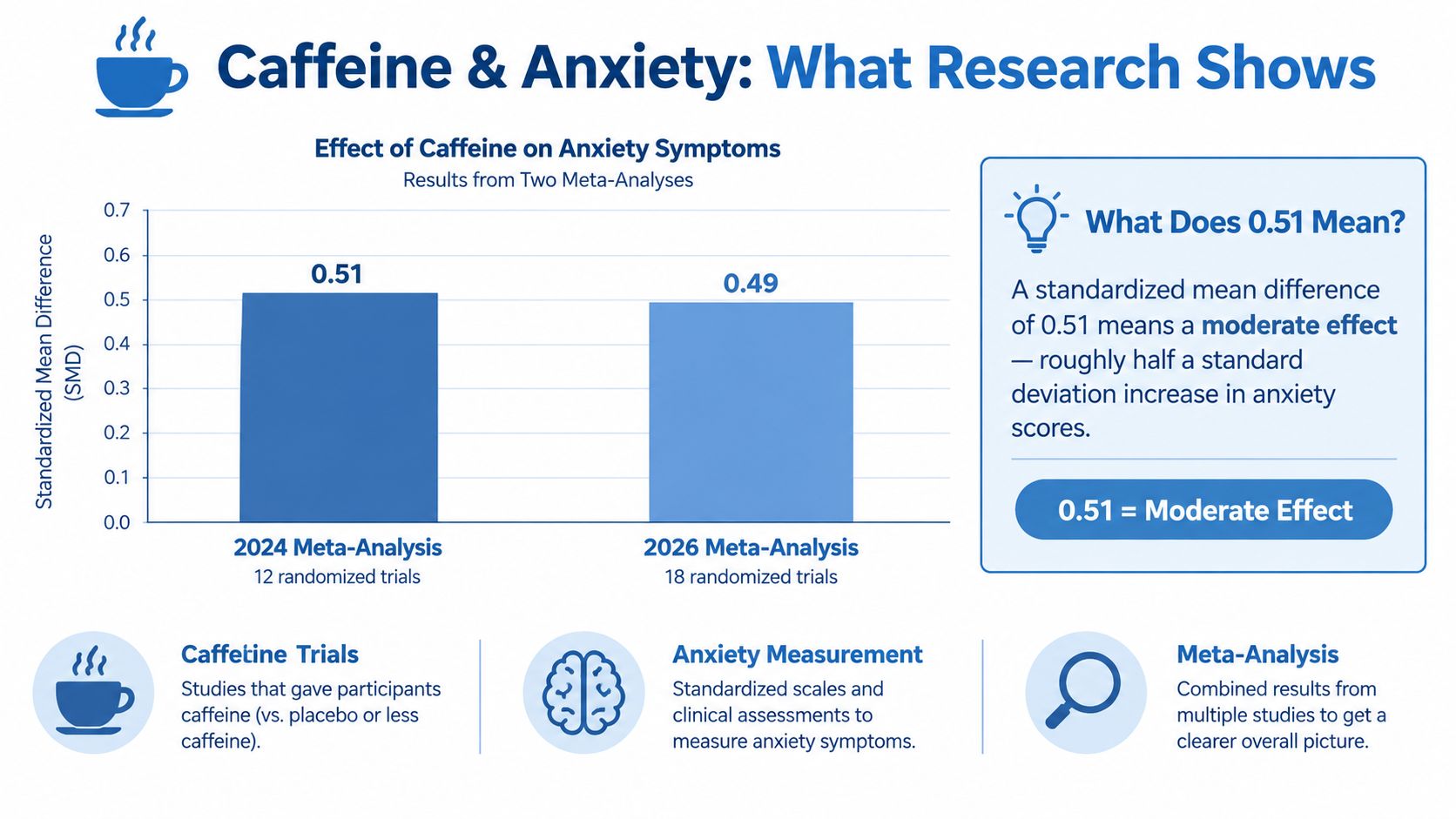
A 2026 systematic review and meta-analysis included 15 randomized controlled trials with 668 participants and found higher anxiety scores after caffeine exposure, with a standardized mean difference of 0.51, with a 95% confidence interval of 0.12 to 0.89. In plain language, the average difference was roughly half a standard deviation on the anxiety measures researchers used, not a percentage increase in anxiety.
Higher doses produced larger average effects
In that same analysis, doses above 200 mg had a larger effect, 0.97, with a 95% confidence interval of 0.55 to 1.39. Doses of 200 mg or less showed no statistically clear increase: −0.05, with a 95% confidence interval of −0.41 to 0.30.
The researchers rated the evidence very low certainty, reported substantial variation between studies, and found a prediction interval that crossed zero. Those limitations matter: the average result cannot tell you exactly how your next cup will feel.
A separate 2024 meta-analysis of caffeine and anxiety reported a standardized mean difference of 0.61 at lower doses and 2.86 at higher doses, with a particularly pronounced association above 400 mg daily. These are separate analyses with different study groupings, not points on a single dose-response curve.
The following visual accompanies this comparison. For the study counts and effect estimates, use the research results stated above rather than treating the graphic as a dosing guide.
A population benchmark isn't your personal threshold
The FDA's caffeine guidance identifies 400 mg daily, roughly two to three 12-fluid-ounce cups of coffee, as an amount not generally associated with negative effects for most adults. That isn't an anxiety-specific safety line.
A sensitive person can feel uncomfortable below that benchmark. Conversely, a statistically unclear average effect at a lower dose doesn't mean an individual reaction is imaginary. The sensible interpretation is dose-sensitive risk plus individual observation, not blanket reassurance or blanket prohibition.
Why the Same Cup Affects People Differently
Your friend finishes coffee and feels focused. You drink a similar amount and feel unsettled. That difference isn't a failure of willpower, and it doesn't necessarily mean either person is interpreting their body incorrectly.
Caffeine lifts part of the brain's brake
A useful simplified analogy is that adenosine helps apply a brake to alertness, while caffeine blocks adenosine receptors and lifts part of that brake. Caffeine can also increase catecholamine-related arousal, the body's activating signals. Alertness may feel useful until the accompanying stimulation becomes uncomfortable.
The illustration below captures that contrast, but it isn't a diagnostic test for caffeine sensitivity.

In a double-blind study of caffeine response and ADORA2A, researchers studied 102 healthy low-caffeine consumers using placebo or 50 mg, 150 mg, or 450 mg of caffeine. The highest dose increased anxiety in most participants, the lowest didn't, and anxiety responses at the middle dose were associated with variants in ADORA2A, the gene encoding the adenosine A2A receptor.
That finding supports biological variation. It doesn't justify labeling ADORA2A an “anxiety gene,” predicting someone's response from a commercial genetic result, or assuming genetics explains every bad reaction.
Familiarity changes the experience, not every consequence
Habitual exposure also matters. Regular consumers may develop partial tolerance to caffeine's anxiety-provoking effects, while occasional consumers may notice stimulation more strongly. Feeling accustomed to caffeine, however, doesn't establish that your sleep or heartbeat is unaffected.
For practical assessment, keep these distinctions clear:
Sensitivity isn't the same as metabolism: How strongly you respond and how quickly you eliminate caffeine are related questions, not interchangeable ones.
Tolerance isn't complete protection: Feeling less jittery doesn't prove that a late drink leaves sleep untouched.
Your threshold isn't your friend's threshold: Comparing cup counts across people is less useful than comparing your own symptoms under consistent conditions.
Genetic testing generally isn't necessary to begin a symptom-guided discussion. A carefully observed change in intake can provide more immediately useful information about what you tolerate.
Who Is Most Vulnerable to Caffeine's Anxiogenic Effects
People with panic symptoms deserve particular caution, but vulnerability isn't limited to a diagnosis. Age, pregnancy, sleep problems, habitual intake, and the reason someone reaches for caffeine all affect the clinical conversation.
A review of controlled caffeine-challenge studies found that caffeine aggravated anxiety or panic symptoms in all eight included studies of people with panic disorder. Challenge-study results identify a potential trigger, but they shouldn't be interpreted as proof that every ordinary serving will cause panic.
Caffeine Sensitivity by Population
Population | Typical Dose Caution | Key Consideration |
|---|---|---|
Children | Don't apply adult intake benchmarks | Review caffeinated drinks and supplements with the child's clinician |
Adolescents | Be especially cautious with energy drinks and concentrated products | Anxiety, palpitations, and sleep problems can overlap with school stress |
Pregnant people | Use pregnancy-specific guidance from the obstetric clinician | General adult advice isn't a substitute for pregnancy guidance |
People with panic disorder | Let symptoms and treatment history guide decisions | Bodily stimulation may become a feared trigger |
Habitual high-dose consumers | Avoid abrupt, unsupported changes | Withdrawal can complicate interpretation of symptoms |
People with insomnia | Consider timing as well as total intake | The main problem may appear overnight rather than immediately |
The FDA guidance discussed earlier specifically warns that excess caffeine can contribute to anxiety, palpitations, high blood pressure, and sleep problems in children and teens. Adult tolerance shouldn't be used to reassure a younger person who's having symptoms.
Panic disorder doesn't automatically require lifelong abstinence
A 2025 randomized, placebo-controlled crossover trial found that 150 mg of caffeine didn't increase subjective anxiety, interoceptive anxiety, or panic-related responses in participants with panic disorder or healthy controls. That finding doesn't erase the challenge-study evidence. It shows why dose and study conditions matter.
The right recommendation may be avoidance, a lower dose, or earlier timing. The diagnosis alone doesn't determine which choice fits.
For parents, caregivers, and adults unsure whether symptoms extend beyond caffeine exposure, an anxiety symptom checklist can help organize observations before an appointment. Use it to prepare for a conversation, not to diagnose yourself or your child.
A Practical Plan to Reduce Caffeine-Related Anxiety
A useful caffeine experiment changes something you can measure without changing everything at once. The aim isn't to prove that coffee is harmful. It's to find out whether adjusting caffeine improves your comfort, sleep, and functioning.
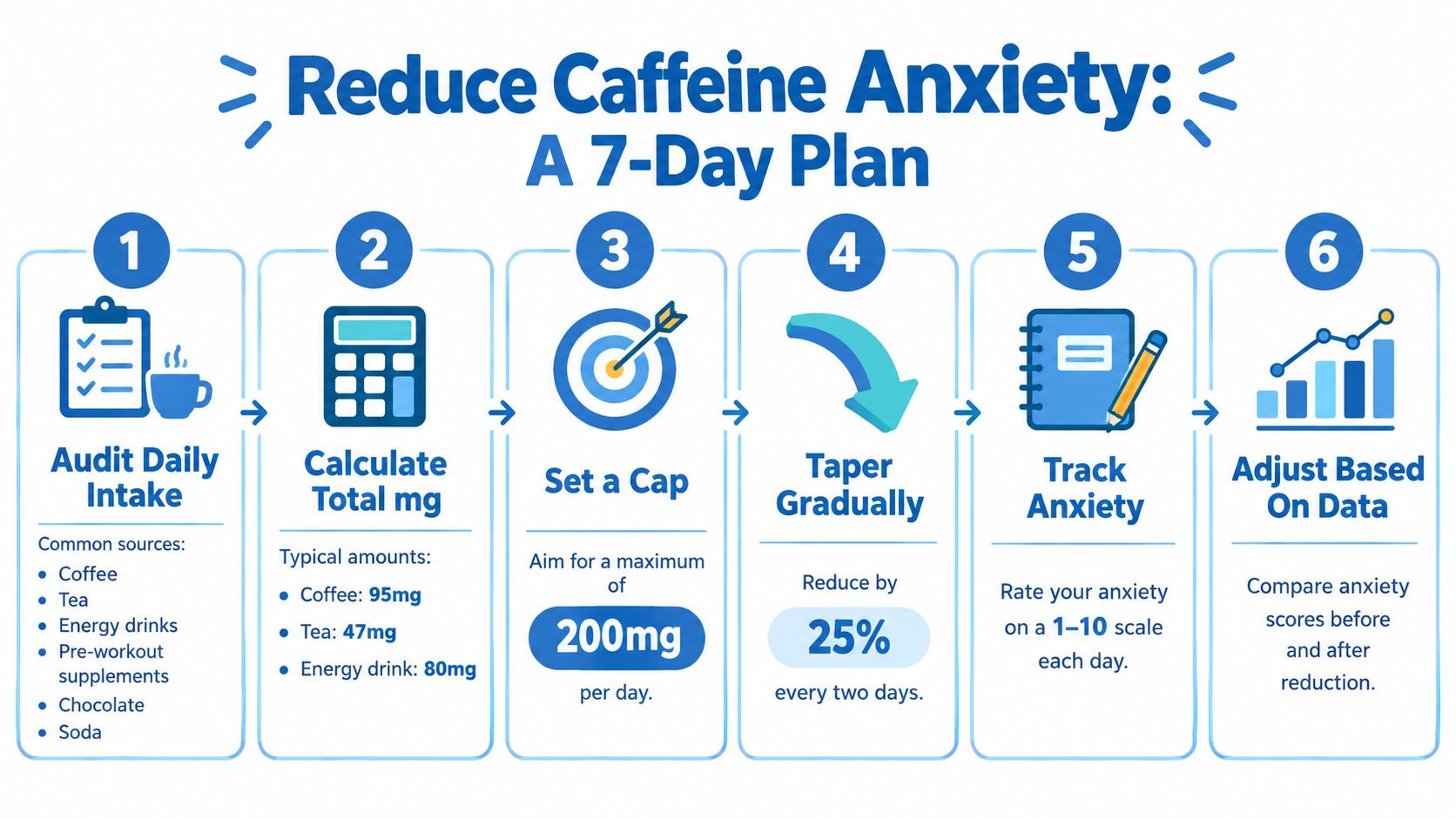
The checklist below provides a visual overview. Use product-specific caffeine information and an individualized target, rather than assuming every coffee or energy drink contains the same amount.
Measure before making a major change
Audit the full day. Include coffee, tea, energy drinks, pre-workout supplements, chocolate, and over-the-counter medications. Check serving sizes and manufacturer information when available. A familiar mug isn't a reliable unit of caffeine.
Reduce gradually. A practical starting trial is a 25%–50% reduction for one to two weeks, adjusted with your clinician if symptoms or usual intake warrant a slower approach. The clinical reduction approach accompanying the research discussed earlier is intended to limit withdrawal, not create another rigid rule.
Abrupt cessation can cause headache, fatigue, irritability, and difficulty concentrating, as described in the FDA guidance already discussed. Those symptoms can make an otherwise useful change feel like a worsening mental health condition.
Move intake earlier. Try an early-afternoon cutoff, or earlier if sleep remains poor. For shift workers, “earlier” should relate to the intended sleep period rather than the conventional workday.
Separate direct stimulation from the sleep pathway
A 2025 systematic review addressing caffeine, anxiety, and habitual consumption highlights the importance of both dose and sleep-related effects. You may feel anxious soon after caffeine, or you may feel relatively comfortable until disrupted sleep makes the following day harder.
Track the distinction with a short diary:
Exposure: Product, estimated dose, and time consumed.
Sleep: Bedtime, estimated sleep duration, and awakenings.
Symptoms: Worry, trembling, panic intensity, and any bothersome palpitations.
Function: Whether symptoms changed your work, studying, relationships, or activities.
Record heart rate only if it's useful and your clinician recommends it. Repeated checking can become another source of distress.
For readers who prefer an additional video format:
Keep the ritual without forcing the dose
Half-caff, decaf, or a caffeine-free herbal drink can preserve the break you enjoy. Check labels rather than assuming that “tea” or “decaf” means no caffeine.
Once symptoms are stable, clinician-guided reintroduction in 25–50 mg increments, as described in the individualized approach discussed earlier, may help identify a personal ceiling. Reintroduction isn't necessary if you feel better without caffeine, and you shouldn't deliberately provoke severe symptoms.
During uncomfortable moments, grounding techniques can help redirect attention. They're coping tools, not a way to cancel caffeine's effects or avoid medical assessment.
When Caffeine Habits Intersect with Therapy and Medication
Caffeine management works best as part of anxiety treatment, not as a competing explanation for every symptom. A person can have a genuine anxiety disorder and also be sensitive to caffeine. Improvement after reducing intake doesn't make their earlier distress less real.
Therapy can address fear of bodily sensations
For someone who fears a racing heart, treatment may need to address both the physical sensation and the interpretation that follows it. Cognitive behavioral therapy, including clinician-guided interoceptive work when appropriate, can help a patient examine feared bodily sensations without automatically treating them as evidence of catastrophe.
That doesn't mean prescribing coffee as an exposure exercise. Deliberately provoking symptoms without a treatment plan can make the experience harder to interpret and tolerate.
Treatment perspective: Reduce avoidable stimulation while also addressing the fear, avoidance, and worry that remain.
Sleep deserves attention alongside therapy. If someone uses caffeine to compensate for exhaustion, cutting intake without discussing the exhaustion leaves an important problem unaddressed. The clinician should ask what's disrupting sleep and whether the patient needs treatment for insomnia, anxiety, or another condition.
Bring caffeine into the medication conversation
Don't decide that caffeine is universally compatible or incompatible with a medication class. Your prescriber needs the specific drug, dose, timing, symptoms, and caffeine products you use.
Useful appointment questions include:
With an SSRI or SNRI: Could caffeine be contributing to the jitteriness I'm noticing, and how should we distinguish that from medication effects?
With a sedating medication or benzodiazepine: Am I using caffeine to compensate for sedation that should instead prompt a medication review?
With ADHD medication: Are my concentration benefits accompanied by uncomfortable physical activation or poorer sleep?
This discussion of Adderall and anxiety can help prepare for the last conversation. Don't change prescribed medication independently to accommodate a caffeine habit.
Diagnostic classification also recognizes that caffeine-related symptoms can be clinically significant. A clinical review of caffeine-related psychiatric conditions describes DSM-5 and ICD-11 recognition of caffeine-induced anxiety, caffeine-induced insomnia, caffeine intoxication, and caffeine withdrawal.
The distinction depends on the clinical pattern and meaningful distress or impairment, not the amount consumed. Persistent symptoms outside caffeine exposure require their own assessment rather than an assumption that a better beverage choice will solve everything.
When to Seek Professional Help and How to Start
You don't need to finish a caffeine experiment before seeking care. If symptoms are frightening, recurring, or interfering with daily life, an evaluation is appropriate now.
The World Health Organization's anxiety-disorder fact sheet estimates that 470 million people, approximately 5.8% of the global population, had an anxiety disorder in 2023. Anxiety disorders are common, treatable conditions, not evidence that you've failed to manage stress or drink coffee correctly.
Signs that deserve an evaluation
Recurring panic: Episodes lead you to avoid activities, places, or being alone.
Persistent worry: Anxiety remains difficult to control regardless of what you drink.
Ongoing sleep impairment: Moving or reducing caffeine hasn't restored adequate rest.
Troubling physical symptoms: Palpitations or tremor are new, persistent, or frightening.
Functional decline: Work, school, relationships, or everyday responsibilities are suffering.
Bring your caffeine diary, medication and supplement list, and a description of what you want to do more comfortably. If you've already tried cutting back, explain what improved, what didn't, and whether withdrawal complicated the process.
For Florida residents considering telepsychiatry, understanding what happens at a psychiatry appointment can make the first visit less uncertain. A thorough assessment should consider caffeine alongside sleep, medical history, medication effects, and your broader anxiety pattern.
We accept Aetna, United Healthcare/UHC, Cigna, Blue Cross Blue Shield, Humana, Tricare, UMR, and Oscar insurance plans. Confirm your specific plan's benefits and appointment coverage when scheduling.
Refresh Psychiatry & Therapy offers psychiatric evaluations, medication management, and therapy through HIPAA-compliant telepsychiatry throughout Florida to help distinguish caffeine-related symptoms from anxiety that needs broader treatment. Contact us or call Refresh Psychiatry at (954) 603-4081 to schedule your evaluation. This blog is for informational purposes only and does not constitute medical advice; please consult a qualified mental health professional for personalized guidance.