
🎒 Back to School Anxiety: A Parent's Guide to Coping

It's Sunday night in late August, the backpack is by the door, and your child suddenly has a stomachache, tears, or a long list of reasons tomorrow can't happen. If you're in Florida, you may also be juggling a new bus route, a hurricane season routine, and a classroom your child hasn't seen yet. You're not wondering whether nerves are normal. You're wondering whether this level of distress is normal, and what to do at 7 a.m. without making it worse. That distinction matters, and it's learnable.
What Is Back-to-School Anxiety
Back to school anxiety is worry that's tied to returning to school, starting a new school, or facing a new classroom, teacher, and routine. It isn't a formal diagnosis by itself. It's a situational pattern, meaning the distress spikes around a specific transition and often centers on what might happen next. A child may dread the bus, worry about finding the bathroom, or replay a fear of being called on and getting an answer wrong.
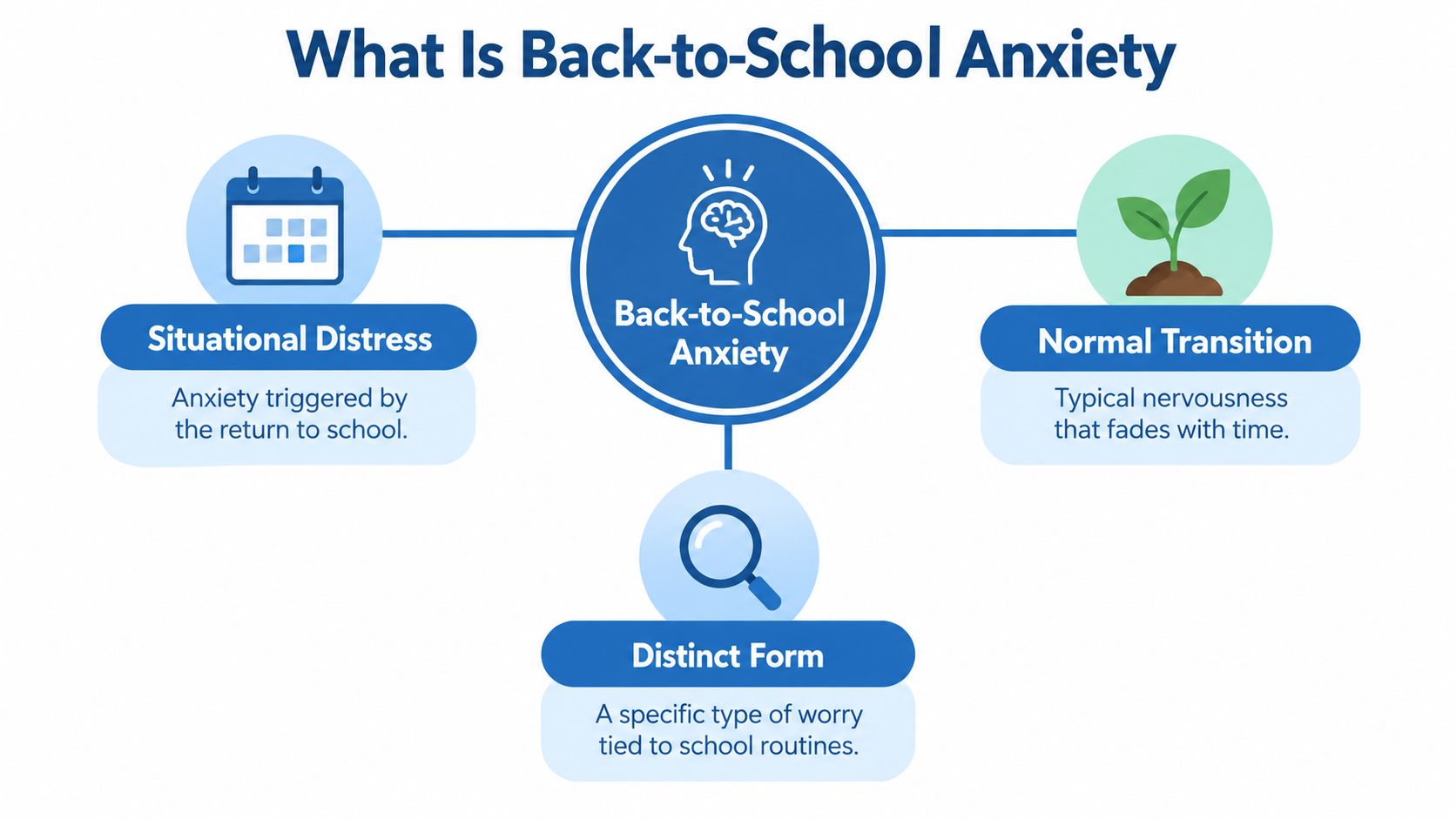
Think of it as a spectrum. On one end is ordinary adjustment. On the other end is anxiety that starts to run the family's mornings, sleep, and attendance.
Normal Nerves Versus a Pattern That Needs Attention
Normal nerves usually look like butterflies, a few questions, trouble falling asleep the night before, or a clingy goodbye that settles once the day gets going. Your child can still be comforted, still gets to school most days, and gradually talks about something that went okay. The worry is real, but it doesn't keep expanding.
A more concerning pattern looks different. Distress builds the night before, physical complaints show up mainly on school mornings, and your child pleads, negotiates, or panics about going. Concentration drops, sleep stays disrupted, and staying home brings quick relief, which makes the next morning harder. That's the point where reassurance alone stops being enough.
Practical rule: Watch function, not just feelings. If your child is still attending, sleeping reasonably well, eating, and recovering after drop-off, you're likely seeing adjustment. If daily life is shrinking around avoidance, pay closer attention.
This distinction matters because many children return to school already carrying anxiety. In the United States, a 2023 National Survey of Children's Health analysis found that 5.3 million adolescents ages 12 to 17, or 20.3% of the age group, had a current diagnosed mental or behavioral health condition, with anxiety affecting 16.1%, up 61% from 10.0% in 2016. Those figures don't prove school caused the rise. They explain why re-entry can hit harder for a child who's already vulnerable.
Parents often get confused here because a child can be excited and anxious at the same time. Your daughter may love choosing supplies and still cry about lunch seating. Your son may want to see friends and still dread math class. Both things can be true.
Much of this is anticipatory anxiety, worry about a future event that feels worse in advance than the event itself. If that pattern sounds familiar, reading about how anticipatory anxiety builds before a feared event can help you name what you're seeing at bedtime and in the morning. Naming it doesn't fix it, but it helps you respond to the worry rather than argue with your child.
Signs and Symptoms Across Age Groups
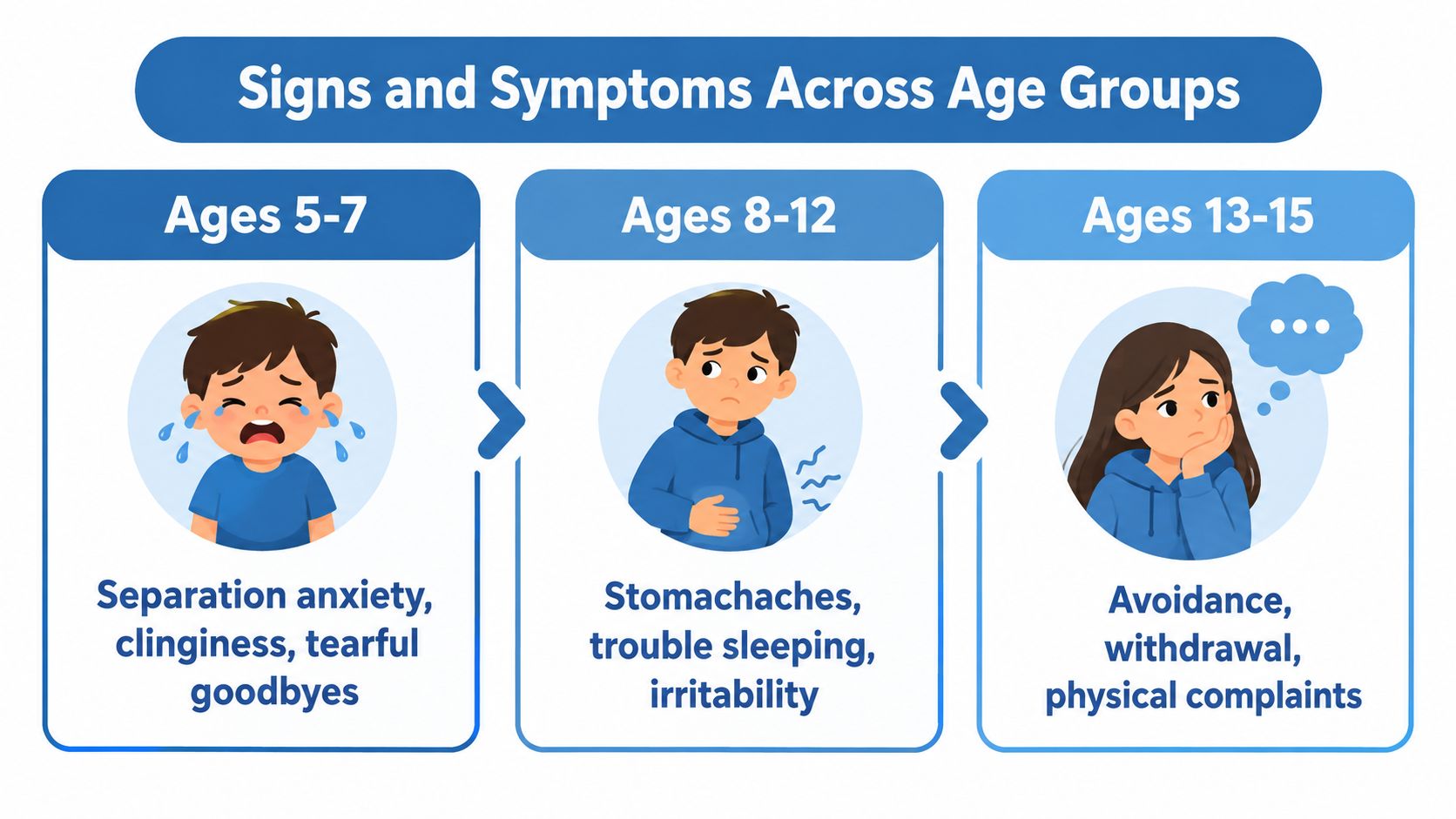
Children rarely announce anxiety in clear adult language. A five-year-old may say her tummy hurts. A fifteen-year-old may say school is pointless and stay in bed. The feeling underneath can be similar, but the behavior changes with age, language skills, and independence.
Younger Children Often Show It Through Separation and the Body
In early elementary years, look for clinginess at drop-off, tearful goodbyes, repeated questions about when you'll return, and trouble separating at bedtime. Physical complaints are common, including stomachaches, headaches, nausea, and frequent bathroom requests. These symptoms can be genuine even when there's no illness, because anxiety activates the body.
For example, a kindergartner may eat breakfast happily on Saturday, then gag or complain of stomach pain on Monday while putting on shoes. That timing doesn't mean she's faking. It means school cues may be triggering her stress response. A pediatric check is still wise when symptoms persist, but the pattern matters.
Preteens Often Show It Through Irritability and Avoidance
Older elementary and middle school children may become argumentative in the morning, stall while getting ready, or melt down over small things like a missing folder. Sleep problems, perfectionism, reassurance seeking, and declining interest in activities can also appear. Some children ask to visit the nurse often or text from school asking to come home.
A structured anxiety symptoms checklist for tracking what you are noticing can help you record timing, triggers, and severity instead of relying on memory during a stressful week. Write down when complaints start, what helps, and whether symptoms ease on weekends. Those notes become useful if you talk with a pediatrician, counselor, or psychiatrist.
Teenagers May Look Withdrawn Rather Than Worried
Adolescents often hide anxiety behind irritability, sarcasm, withdrawal, or refusal to discuss school. You may see procrastination that looks like laziness, excessive studying that never feels finished, panic before presentations, or avoidance of asking teachers for help. Grades can slip because concentration is impaired, not because your teen doesn't care.
Transitions deserve special attention. The American Academy of Child and Adolescent Psychiatry estimates that approximately 1% to 5% of school-age children experience school refusal at some point, with rates especially notable around ages 5 to 7 and again around ages 11 to 14. Those windows line up with starting formal schooling and moving into middle school demands.
Morning-only symptoms: Complaints peak before school and fade if staying home is allowed.
Repeated requests to stay home: Pleading becomes a daily negotiation rather than an occasional bad morning.
Sleep and concentration changes: Your child can't settle at night, wakes worried, or can't focus on homework.
Loss of usual functioning: Friendships, appetite, activities, or schoolwork start to decline.
One rough morning isn't a diagnosis. A repeating pattern that interferes with attendance and daily life is a signal to act.
Common Triggers Behind the Anxiety
Parents often assume classwork is the whole story. Sometimes it is. A child who fell behind in reading may dread being asked to read aloud. A teen facing advanced classes may fear that one bad quiz proves she doesn't belong. But school is also a social and sensory environment, with bells, crowded hallways, cafeteria noise, changing teachers, and constant peer comparison.
Survey findings support that broader view. In a 2026 Barnardos Ireland survey of 704 pupils, 59% of primary-school parents and 70% of secondary-school parents reported their child had at least one concern about returning to school, including friendships at 30% primary and 31% secondary, classwork struggles at 26% and 33%, routine difficulties at 18% and 25%, and bullying at 12% and 18%.
Parent-Reported Back-to-School Concerns by Age Group
Concern | Primary School | Secondary School |
|---|---|---|
Friendships | 30% | 31% |
Struggles with classwork | 26% | 33% |
Difficulties with routines | 18% | 25% |
Bullying | 12% | 18% |
Social Belonging Can Matter as Much as Grades
Friendship worry isn't vanity. Children ask themselves who they'll sit with, whether last year's friend group still includes them, and what happens if they're embarrassed in front of peers. For some children, that's ordinary shyness that warms up with time. For others, fear of judgment is intense enough to drive silence in class, skipped lunch, or refusal to attend.
If you're unsure which pattern fits, comparing social anxiety and everyday shyness in children and teens can clarify whether your child is slow to warm up or actively avoiding social evaluation. Bullying needs a different response again. If your child names a specific peer, location, bus, or online group, treat that as a safety and school issue, not an anxiety exercise.
Routines, Performance, and Hidden Skill Gaps
Summer often means later sleep, fewer transitions, and more choice. School demands early waking, sustained attention, homework planning, and public performance. A child with executive-function difficulties may feel overwhelmed by lockers, assignments, and multi-step instructions. Anxiety then grows around a real skill gap, such as organization, reading fluency, or asking for clarification.
That is why the question matters. Asking why your child doesn't want to go often produces a shrug. Asking what part feels hardest can reveal an actionable answer, such as the bus, a timed test, changing for PE, or not understanding directions. Once you know the trigger, you can choose a targeted support instead of generic reassurance.
Practical Coping Strategies for Families
Start with preparation that lowers uncertainty. Walk the route, practice drop-off, locate classrooms if the school allows it, and lay out clothes and the backpack the night before. Shift sleep and wake times gradually before school starts, and keep mornings predictable with the same sequence for waking, dressing, breakfast, and leaving.

These steps sound simple, but they remove decisions when your child's nervous system is already overloaded. A visual morning checklist helps younger children. Older students may do better with a phone alarm sequence, a packed bag by the door, and a planned check-in time after school rather than repeated texts during class.
Use Gradual Exposure Instead of All-or-Nothing Attendance
When avoidance has taken hold, prolonged reassurance and abrupt forced attendance often backfire. The middle path is gradual exposure, where your child approaches school in tolerable steps and learns that anxiety rises, peaks, and comes down without escape.
Evidence-based protocols progressively approach the feared context, first traveling to school, then entering with caregiver support, attending a limited class period, extending to half-day attendance, and eventually returning to the full schedule, using inhibitory learning through repeated, tolerable contact. Pair each step with praise for approach behavior, predictable routines, and coordination with school staff. Track both attendance and symptoms, because a child may attend more before feeling calmer.
For example, a middle schooler who panics in crowded hallways might first arrive with a counselor greeting, attend two preferred classes, then add lunch with a planned seat. The goal isn't to wait until fear disappears. The goal is to prove coping works in real conditions.
Validate Without Reinforcing Avoidance
Validation sounds like this. I see this feels awful, and we're still going to follow the plan we practiced. Avoid long debates about whether the day will be fine. Brief, calm, and consistent beats a new negotiation every morning.
At home, teach one or two regulation skills your child can use, such as slow breathing, cold water on the face, or the grounding techniques that help children refocus on the present moment. Practice when calm, not for the first time during a meltdown. After school, allow decompression before homework questions, and notice your own stress, because children read a parent's face quickly.
The short video below offers another way to hear these re-entry ideas explained step by step before you build your family's plan.
If staying home happens, keep the day boring and structured, limit screens, and return to the plan the next school day. Compassion and momentum can coexist.
Treatment Options and When to Seek Help
Seek professional assessment sooner when avoidance is persistent, panic is escalating, sleep is badly disrupted, grades or friendships are declining, or you have safety concerns. Don't wait for a perfect label before asking for help. School refusal isn't a standalone diagnosis, so a good evaluation looks for what's underneath, including anxiety disorders, depression, bullying, learning differences, ADHD-related overwhelm, trauma responses, or medical issues.
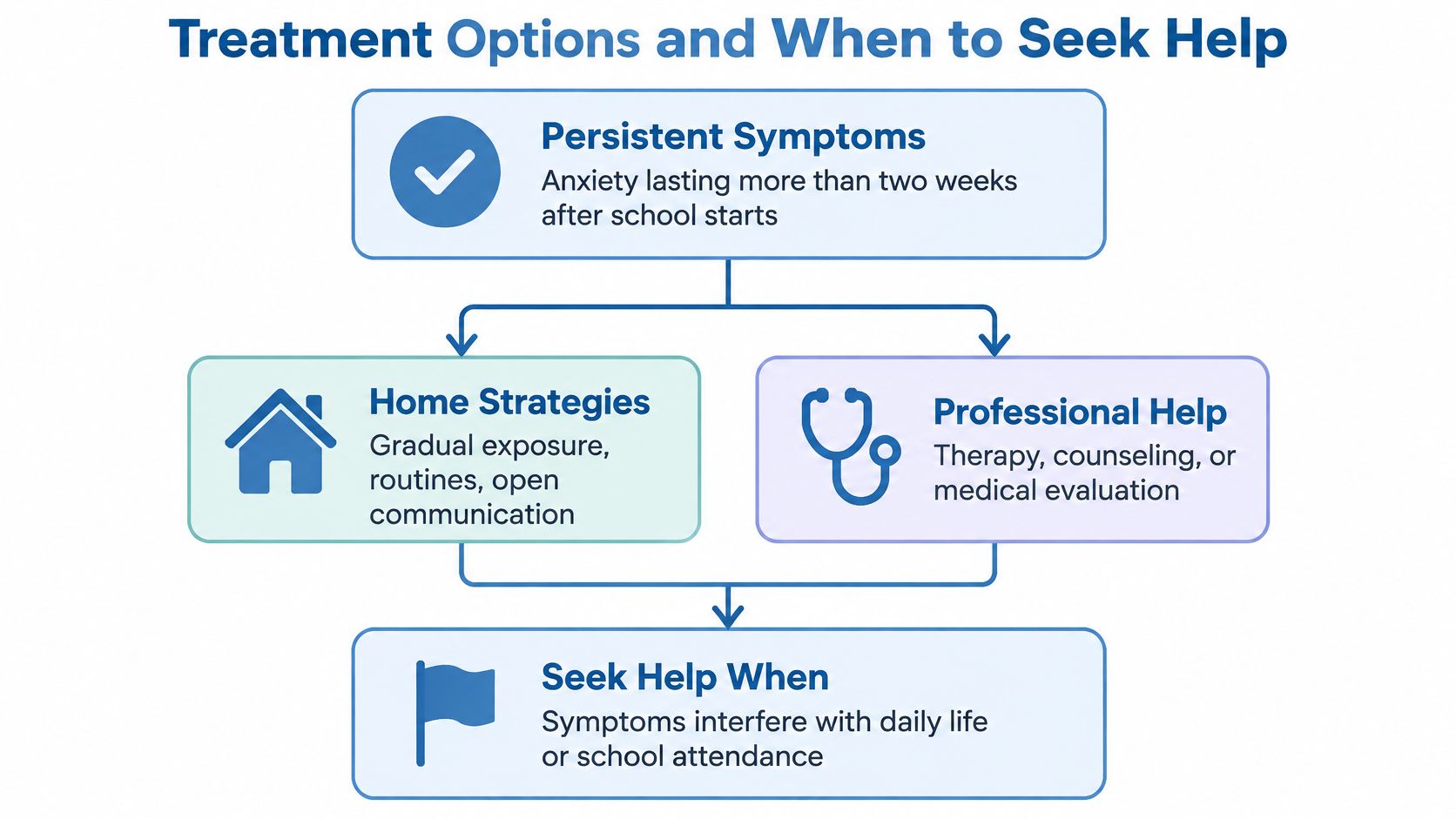
The scale of avoidance is one reason early assessment matters. A 2026 Barnardos survey found that 21% of primary students and 33% of secondary students avoided or refused school at least monthly, with anxiety identified as the main reason by 52% and 42% of parents respectively. Persistent avoidance deserves more than a generic checklist, because multiple causes can overlap.
What Treatment Usually Involves
Cognitive behavioral therapy, often called CBT, is commonly used for child and adolescent anxiety. In plain language, it helps your child notice anxious predictions, test them gradually, and build coping skills that hold up at school. Parent coaching is often part of the work, since morning responses, reassurance patterns, and school communication can either strengthen avoidance or support approach.
Other approaches may be appropriate depending on the full picture, including DBT skills for emotion regulation or trauma-focused care when a traumatic experience is driving symptoms. Medication isn't the first step for every child, but a psychiatric evaluation may discuss it when anxiety is severe, persistent, or blocking therapy and school functioning. Any medication decision should follow a careful assessment and monitoring plan.
You don't need to prove your child is struggling enough. If mornings repeatedly end in panic, missed school, or family conflict, that impairment is reason enough to ask for an evaluation.
For Florida families, access can be simpler when care is coordinated. Refresh Psychiatry & Therapy is one Florida telepsychiatry option that offers child and adolescent psychiatric evaluations, medication management, and individual therapy through HIPAA-compliant virtual visits statewide. If you're comparing providers, learning what a pediatric psychiatrist evaluates and treats can help you prepare questions about diagnosis, therapy coordination, school letters, and follow-up.
Bring your notes to the appointment. Include attendance dates, physical complaints, sleep patterns, specific triggers, teacher feedback, and what you've tried. That record helps a clinician distinguish transitional worry from a developing disorder and build a plan with you and the school.
Sample Scripts for Parents and Teachers
Words won't remove anxiety, but the right words can lower conflict and reveal the problem. Keep scripts short. A flooded child can't process a lecture, and a busy teacher needs clear, specific information.
Talking With Your Child
Try this at a calm time, not while shoes are missing. I notice mornings have been really hard. What feels most difficult about school right now. Is it the work, people, the bus, or something else.
If your child says she doesn't know, offer choices and wait. Some kids need time. Follow with, Thank you for telling me. We'll make a plan for that part, and I'll check in after school to hear how it went.
During morning resistance, avoid debating feelings. Try, I know your stomach feels awful and you're scared. We're following our plan. First get dressed, then breakfast, then I'll walk you to the counselor's door like we practiced. You're naming the feeling, holding the boundary, and pointing to the next small step.
For a teen who won't ask for help, try, I'm not asking you to raise your hand in front of everyone yet. Would emailing the teacher one question, or staying two minutes after class, feel possible this week. That turns a vague fear of looking foolish into a testable step.
Talking With the School
Email gives you a record and lets staff respond thoughtfully. Try, I'm writing because Maya has had repeated stomachaches and panic on school mornings, mostly before first period. She settles more quickly when an adult greets her at arrival. Could we meet to discuss a short-term re-entry plan and who she should go to if symptoms spike.
Ask what supports already exist, such as counselor check-ins, a safe adult, modified arrival, or a brief break pass that returns the student to class. Teachers may also benefit from classroom routines and regulation supports when they're building predictable structures that help anxious students settle. Predictability at school reinforces the work you're doing at home.
When you speak with a pediatrician or mental health professional, be concrete. Try, For the past several school mornings, he's cried, complained of nausea, and asked to stay home. Weekends look different. We need help understanding whether this is anxiety, a learning concern, bullying, or something medical, and what plan we should follow. Specific examples lead to specific help.
Frequently Asked Questions
How Long Should Transitional Anxiety Last
Many children settle as routines, teachers, and classmates become familiar. There's no single timetable that fits every child. Pay more attention to direction than to the calendar. If distress is gradually easing and attendance is holding, continue steady support. If symptoms are staying intense, spreading to weekends, or causing missed school and declining functioning, arrange an assessment rather than waiting for the problem to harden.
Is It Okay to Let My Child Stay Home Occasionally
An occasional sick day for genuine illness is different from repeated anxiety-driven absence. Staying home brings immediate relief, which teaches the brain that escape worked. That relief can make the next return harder. If your child stays home, keep routines, limit entertainment, contact the school, and restart the attendance plan promptly. When physical symptoms recur, involve the pediatrician so medical causes aren't missed.
What if Anxiety Only Appears on Sunday Nights
Sunday-night dread often means the brain is rehearsing Monday. Keep Sunday evening calm and predictable, pack bags early, and avoid long problem-solving talks at bedtime. Agree on a brief worry time earlier in the day, write concerns down, and return to the normal bedtime routine. If Sunday distress regularly becomes Monday refusal, treat it as part of the same avoidance pattern.
How Can I Tell Anxiety From ADHD-Related Overwhelm
They can overlap and look similar from the outside. Anxiety often centers on feared outcomes, embarrassment, separation, or making mistakes. ADHD-related overwhelm more often involves losing materials, struggling to start tasks, missing instructions, and falling behind, which can then create anxiety. A child can have both. A professional evaluation, teacher input, and a review of learning history help separate skill deficits from fear-driven avoidance.
What if the Problem Is One Teacher or One Class
Take the concern seriously and get specifics. Ask what happens in that class, when symptoms start, and whether peers, workload, seating, or discipline style are involved. Share observations with the teacher or counselor and ask for a meeting if the pattern continues. Changing a class is sometimes appropriate, but families usually start by clarifying the trigger and testing supports.
My Teen Uses AI for Every Question Instead of Asking the Teacher
Private digital help can feel safer because no one sees the mistake. It may clarify homework, but it can also hide confusion, perfectionism, or fear of public failure from adults who could help. Encourage a bridge back to people, such as drafting one question for the teacher, attending office hours with a friend, or asking for feedback on a small piece of work.
Contact us or call Refresh Psychiatry at (954) 603-4081 to schedule your evaluation with Refresh Psychiatry & Therapy, where Florida families can access coordinated child and adolescent psychiatric evaluation, therapy, and medication management through statewide telepsychiatry for back to school anxiety and related concerns. We accept Aetna, United Healthcare/ UHC, Cigna, Blue Cross Blue Shield, Humana, Tricare, UMR, and Oscar insurance plans. This blog is for informational purposes only and does not constitute medical advice. Please consult a qualified mental health professional for personalized guidance.