
🧠 AuDHD: What It Means When You Have Autism and ADHD

The overlap runs in both directions: about 40% of people diagnosed with autism also meet criteria for ADHD, and 13.0% of children with current ADHD also have current autism, roughly 1 in 8.
The two conditions are often assessed through different questionnaires and referral pathways. In 2024, 13.6% of U.S. children aged 5 to 17 had ever been diagnosed with ADHD and 4.5% had ever been diagnosed with autism, according to the U.S. Environmental Protection Agency's national data summary. ADHD is diagnosed roughly three times as often. Those figures describe different diagnoses across the population, not how often an individual has both.
A person who receives one diagnosis may still have traits the label does not explain. Attention problems can occur alongside sensory sensitivity, exhaustion after social contact, or difficulty maintaining routines. A dual-lens evaluation considers how autism and ADHD traits interact, helping connect daily challenges with appropriate supports.
Clinically, the task is to distinguish which difficulties relate to sensory load, attention regulation, or both. That distinction can shape treatment, accommodations, and practical strategies for daily life.
What AuDHD Means and How Common It Is
The contradiction is usually what people notice first. Focus that locks onto a subject for six hours and then collapses on a two-page form. A strong wish for friends alongside a nervous system that treats a dinner party like a physical workout. When one diagnosis explains half of that pattern and leaves the other half unnamed, people start to distrust their own account of themselves.
AuDHD is the informal community term for having both autism spectrum disorder and ADHD in the same person. It isn't a separate diagnosis, and you won't find it listed in the DSM.
How two mutually exclusive diagnoses became compatible
Earlier editions of the DSM treated autism and ADHD as conditions that could not be diagnosed together. Clinicians were pushed into picking the dominant picture and leaving the rest out of the chart, which is one reason so many adults carry a single label that fits only partly. The DSM-5, published in 2013, removed that restriction, and the term AuDHD spread through neurodiversity communities in the early 2020s as more people recognized both sets of traits in themselves. The clinical consequence is bigger than the vocabulary: assessment now has to look for the second profile instead of assuming the first one rules it out.
What the prevalence figures actually describe
Among people already diagnosed with autism, a meta-analysis summarized in Psychology Today's overview of AuDHD estimates that about 40% also meet criteria for ADHD, with some studies reporting rates as high as 70%. Read that sentence carefully. It describes autistic people, not the general population, and the spread reflects differences in sample, age, diagnostic method, and whether researchers counted symptoms or formal diagnoses.
From the other direction, a CDC analysis of the 2014 National Survey of the Diagnosis and Treatment of ADHD and Tourette Syndrome, which included 2,464 children with current ADHD, found that 13.0%, about 1 in 8, also had current autism, as published in the survey analysis. That number has limits of its own. It comes from children identified through a U.S. survey built around ADHD, and it depends on parent-reported or previously established diagnoses, so it doesn't transfer to the population at large.
Base rates shift with definitions. NICE's ADHD evidence review puts adult ADHD prevalence at roughly 3% to 4% in population surveys, and notes the figure moves depending on the criteria used and how impairment is defined. Every co-occurrence estimate inherits that wobble.
Why the two conditions travel together
The overlap isn't a labeling artifact. A 2025 nationwide Dutch three-generation study involving 15 million people estimated the heritability of both ADHD and autism at 0.5, which means roughly half the variation in liability in that population tracks with inherited factors, according to the study authors. Shared genetic architecture plus shared developmental demands is why the two so often arrive in the same nervous system.
That changes what support has to cover. Social communication, sensory regulation, executive function, attention, impulsivity, and tolerance for routine and change all belong in the same plan. A treatment that quiets the hyperactivity but leaves sensory overload untouched is half a treatment, and the person living it usually notices the gap before the clinician does.
Where Autism and ADHD Traits Overlap and Diverge
The same missed deadline or restless movement can have different causes. Surface behavior alone rarely shows whether the main driver is attention, sensory load, communication differences, or more than one of these at once. A dual-lens evaluation looks for the mechanisms behind a behavior, because the right accommodation depends on what is driving it.
Area of life | Classic autism pattern | Classic ADHD pattern | How it can look with AuDHD |
|---|---|---|---|
Focus and attention | Deep, sustained focus on preferred topics, with less attention for other tasks | Distractibility and novelty-seeking outside high-interest tasks | Intense focus on interests alongside difficulty starting routine tasks |
Social communication | Differences in reciprocal conversation and reading implicit cues | Interrupting, excessive talking, or missing cues through inattention | Wants connection but finds it draining, and may miss cues for different reasons |
Sensory experience | Heightened or reduced sensitivity, with avoidance or seeking | Stimulation-seeking or restlessness | Seeks stimulation yet becomes overloaded by noise, light, or crowds |
Routine and change | Strong preference for sameness and distress at unplanned change | Boredom with routine and impulsive switching | Needs structure to function but may struggle to build and maintain it |
Executive function | Difficulty shifting between activities or adapting plans | Working-memory slips, poor task initiation, and time blindness | Forgetting, difficult transitions, and shutdown under demand |
Emotional regulation | Intense reactions with slow recovery, including meltdowns or shutdowns | Quick frustration and impulsive reactions | Rapid escalation, slow recovery, and possible masking-related exhaustion |
Movement and stimming | Repetitive movements or vocalizations that support self-regulation | Fidgeting and restlessness | Stimming that helps regulate sensory input and arousal |
Two blurs that fool almost everyone
Trouble following speech in a noisy room can reflect sensory filtering, attention, or both. A person with AuDHD may lose the thread of a conversation because background noise is hard to filter and attention is difficult to sustain. Asking only whether they can follow instructions may not reveal which factor is getting in the way.
Novelty-seeking and a preference for sameness can coexist. Someone may feel distressed when a schedule changes unexpectedly and still become bored with the same lunch each day. Treating one response as proof that the other is not real can obscure the support the person needs.
The practical question is what a behavior is doing. Is movement helping regulate sensory input or attention? Is silence a response to overload, difficulty processing speech, or both? Understanding the function can guide support more effectively than trying to stop the behavior itself.
Practical rule: Identify the likely driver before choosing a response. Sensory, attentional, emotional, and communication needs call for different kinds of support.
Stimming can serve more than one purpose, so understanding how ADHD and stimming are connected can help families and clinicians respond with support rather than suppression.
Everyday Challenges and Real Strengths
The traits above turn into something concrete on an ordinary Tuesday afternoon.

Take an adult who is remarkable on a project she cares about. She rebuilds a client's reporting model over a weekend and presents it without notes. The same week she misses three deadlines, forgets lunch twice, and leaves a meeting without the one detail she went in for. By six in the evening the overhead lights, the keyboard clicks and ten simultaneous conversations have used up whatever was left. She isn't diligent at nine and lazy at three. The environment changed, and so did her capacity.
Now take a college student who scripts small talk before every class, holds eye contact she finds physically uncomfortable, and suppresses every stim for six hours. She looks composed in the way a held breath is composed. At home the mask comes off as a meltdown over a changed dinner plan, or four hours of scrolling because it's the only input quiet enough to tolerate. Social connection is genuine and expensive, which is why practical resources on autism and dating that explain pacing, directness and recovery time help far more than advice to be more outgoing.
The mechanism behind the inconsistency is usually executive dysfunction rather than effort. Planning, initiating and switching between tasks cost more, and the cost compounds as the day goes on.
Those two scenarios sit side by side with a video walkthrough of how the combined profile shows up in daily life.
The recurring difficulties are specific and predictable. Masking debt accumulates every hour spent performing neurotypical norms. AuDHD burnout arrives after months of compensating and looks like skill loss, not laziness. Transition paralysis makes switching tasks feel like pushing a car uphill. Sensory overload hits hardest in open-plan offices, supermarkets and family gatherings. Time blindness turns a ten-minute task into an afternoon. Anxiety and depression commonly ride along, and the self-blame loop of being "capable but inconsistent" does its own damage.
The strengths list is just as real and gets far less airtime. Hyperfocus produces mastery that peers can't match. Pattern recognition catches errors other people miss. Creative problem-solving shows up because two operating systems generate unusual combinations. Directness reads as honesty. Justice sensitivity makes people fierce advocates. Adaptability is hard-won and genuine, built from years of adjusting to environments that weren't designed for them.
Most of the daily difficulty lives in the fit between neurology and environment, not in character. That framing matters, because it points treatment toward environments, skills and supports instead of toward fixing the person.
How Clinicians Evaluate AuDHD
Autism and ADHD can hide behind each other. A clinician may recognize one set of traits and stop searching, especially when the person has learned to compensate or when one condition seems to explain the visible difficulties.
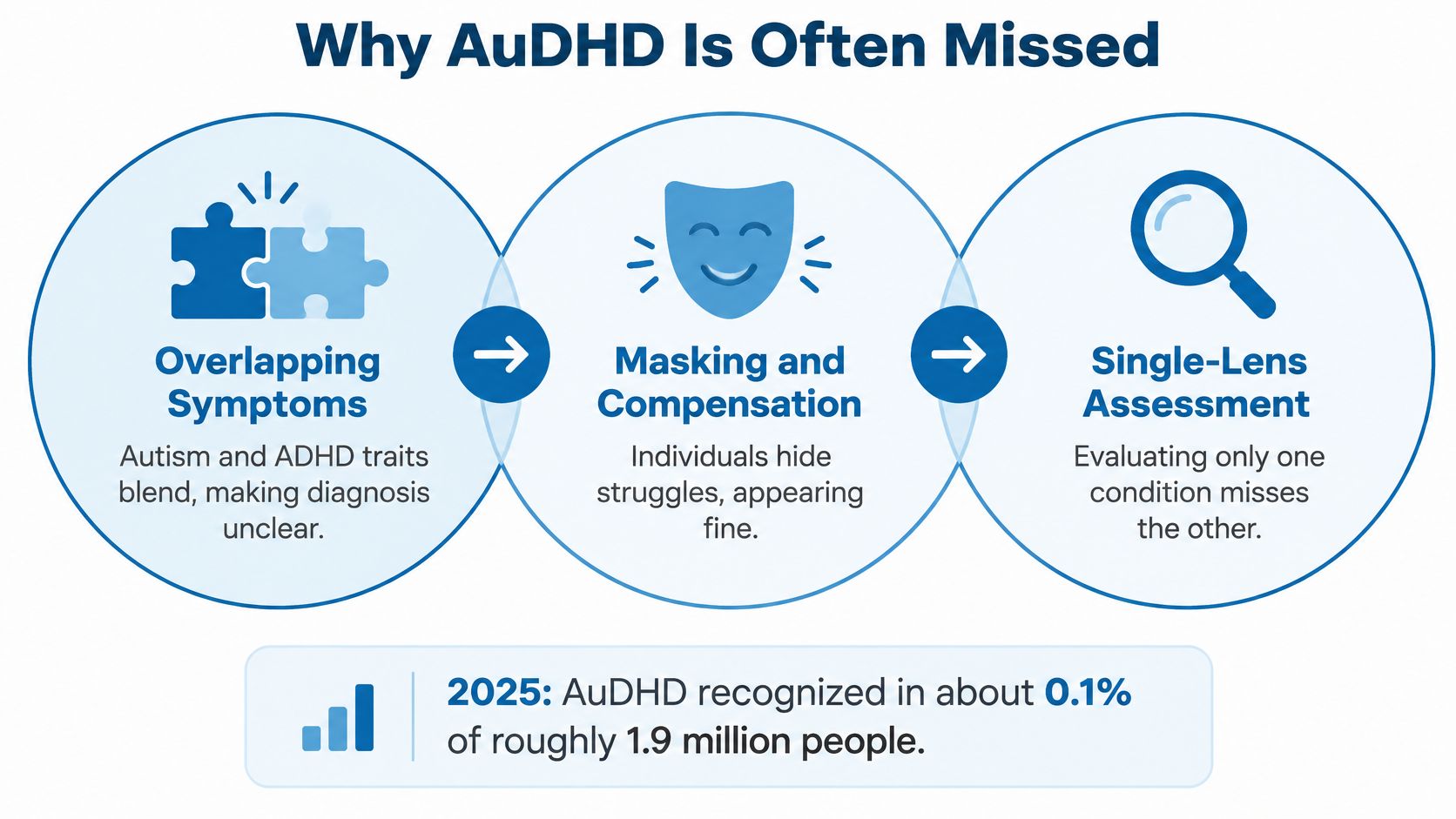
A 2025 analysis of roughly 1.9 million U.S. adult insurance members identified AuDHD in 0.1% of that population, according to the published analysis of U.S. insurance members. Claims data capture recorded diagnoses, so they cannot show how many people have traits that have not been assessed or diagnosed.
Online screeners can help identify whether a full assessment may be useful, but they cannot diagnose autism or ADHD. A borderline or conflicting result also does not settle the question. Traits can be masked, compensated for, or appear to conflict, making developmental history and day-to-day functioning important parts of the evaluation.
A screener can point toward an assessment. It cannot provide a diagnosis.
The six steps a thorough evaluation follows
NICE's ADHD recommendations say an adult assessment should establish whether inattention or hyperactivity-impulsivity began in childhood, persisted over time, causes moderate or severe impairment, and is not better explained by another psychiatric diagnosis. For a possible dual diagnosis, the clinician needs to examine each profile rather than treating evidence for one as an explanation for everything.
Developmental history. Ask about childhood onset, early school records, report cards, and when difficulties first appeared.
Collateral information. With the person's agreement, information from parents, partners, teachers, or employers can add context to self-report.
A semi-structured interview mapped to DSM-5 criteria. Assess autism and ADHD features rather than focusing on only one.
Standardized rating scales. Use scales for ADHD and autism features as supporting evidence, not as the verdict.
Screening for coexisting conditions. Anxiety, depression, sleep problems, learning disorders, trauma, and substance-use risk can affect the clinical picture.
Functional mapping across settings. Ask for concrete examples from home, work or school, and relationships, such as missed deadlines, shutdowns, or sensory avoidance.
A second specialist opinion may be useful when important questions remain unresolved, particularly if the person's history and current presentation are difficult to reconcile.
What a dual diagnosis changes
A dual-lens evaluation can clarify why a single diagnosis has not fully explained someone's experience. It gives clinicians a fuller basis for understanding functional needs and discussing treatment, accommodations, and daily supports. Adults reconsidering an earlier ADHD-only assessment may find this overview of undiagnosed autism in adults helpful when preparing to discuss their history with a clinician.
Treatments and Supports With Evidence Behind Them
A dual diagnosis changes treatment choices because each diagnosis affects how the other presents. For co-occurring mental-health conditions in autistic adults, NICE autism guidance recommends psychosocial interventions informed by guidance for the relevant condition, adapted to the person's needs and delivered by clinicians who understand autism. NICE's ADHD guideline says people with ADHD and coexisting autism should be offered the same medication choices as other people with ADHD.
ADHD medications include stimulants such as methylphenidate and amphetamine-based formulations, and non-stimulants such as atomoxetine, viloxazine and guanfacine. The choice and dose need to account for both profiles. Track attention and impulsivity alongside irritability, appetite, sleep and sensory sensitivity. If focus improves but sleep worsens, the treatment plan needs review.
What adapted therapy looks like
Standard CBT may need adjustments to its pace, written materials, breaks and homework demands. Therapy can also account for alexithymia, the difficulty some autistic people have identifying and describing internal states. DBT skills offer concrete procedures for distress tolerance and emotion regulation. Occupational therapy can address sensory regulation and daily living skills, while executive-function coaching can support planning, task initiation and time management.
Support | What it targets | Why it helps in AuDHD |
|---|---|---|
Stimulant medication | Inattention, hyperactivity, impulsivity | Treats ADHD symptoms; co-occurring autism alone does not rule it out |
Non-stimulant medication | Attention and emotional regulation | An option when stimulants are poorly tolerated or affect anxiety or sleep |
Adapted CBT | Anxiety, depression, self-criticism | Adjusts pace and format for processing style and sensory needs |
DBT skills training | Emotion regulation, distress tolerance | Teaches concrete skills for managing intense reactions |
Occupational therapy | Sensory regulation, daily living skills | Develops sensory strategies and practical daily-living supports |
Executive function coaching | Planning, task initiation, time management | Provides structure and accountability for tasks |
Family and school supports | Routines, communication, accommodations | Helps align expectations across home, school and work |
Treat the person's needs, not just the diagnosis. Improving attention may leave sensory difficulties unchanged, and sensory supports alone may not address task initiation. A dual-lens plan makes room for both.
Coping Strategies and Accommodations That Actually Help
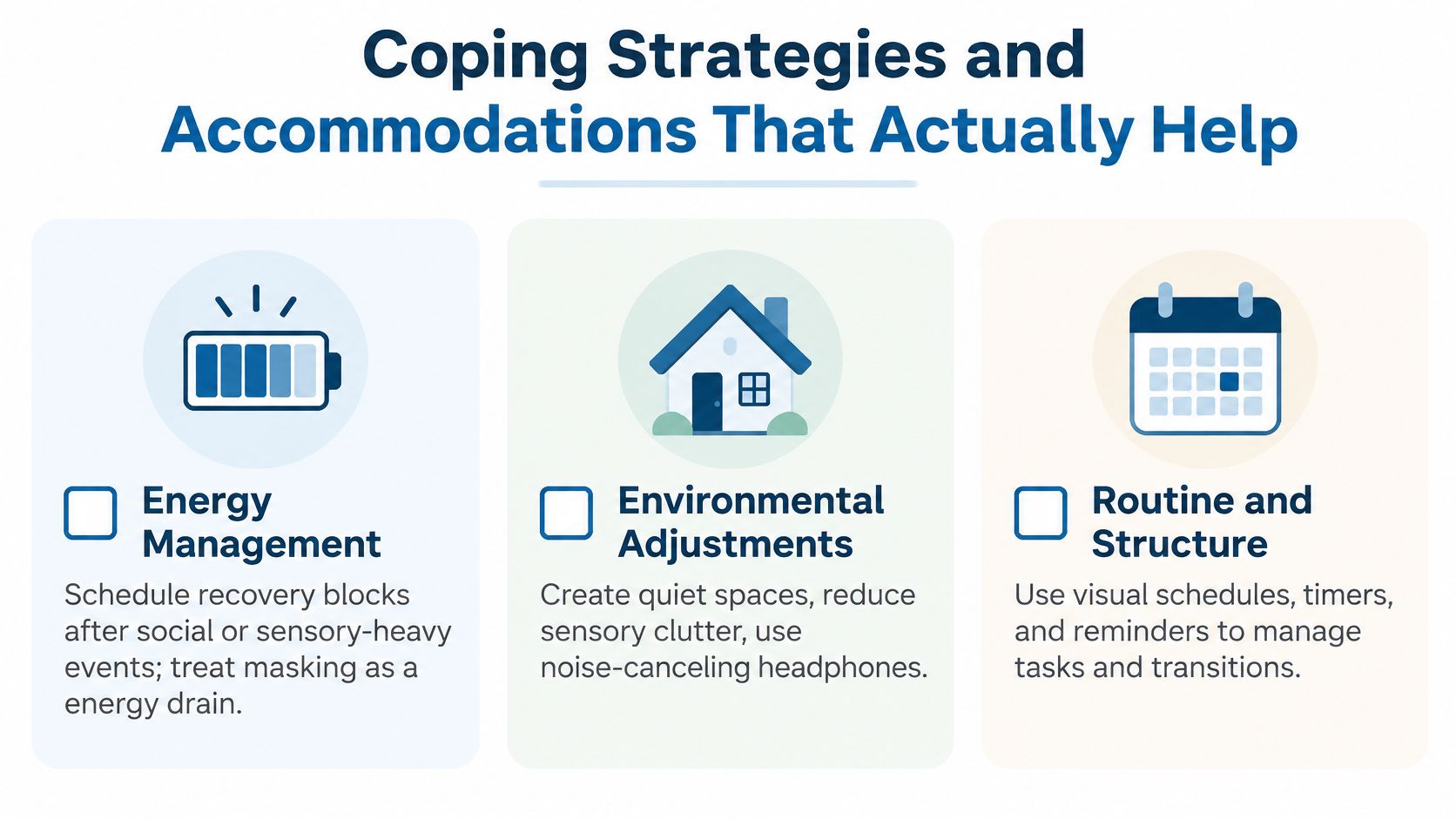
The strategies that hold up are unglamorous, specific and physical. They change the environment and the scaffolding around the person instead of asking the nervous system to try harder.
Start with recovery, not productivity
Schedule the crash instead of dreading it. Block 20 to 30 minutes after any social or sensory-heavy event, on the calendar, the way you'd block a meeting.
Treat masking as a cost. Count the hours you spend performing neurotypical norms in a week. If the number is high, the recovery time needs to be higher.
Build a stim-friendly space at home and, if you can, at work. Headphones, sunglasses, a chair that allows movement, and permission to leave a room early.
Then add external structure
One calendar with alarms, not three lists in three places. Every commitment goes in the moment it's made.
Body doubling for low-interest tasks. Working alongside another person, in person or on a video call, solves the initiation problem better than any app, which is the logic behind this explanation of body doubling for ADHD.
Twenty-five minute blocks with a visible timer, so time becomes something you can see rather than something you estimate.
Write it down before the meeting ends. A three-line summary replaces the working memory you don't reliably have.
Ask for accommodations that match both profiles
At work or school, request a quiet workspace or remote days, flexible deadlines, written instructions, movement breaks and extended test time. A dual diagnosis often makes both executive-function and sensory supports available at once, because the request finally matches the assessment instead of half of it.
Pick two or three strategies, run them for two weeks, and keep only what measurably reduces crash days. A strategy that works but that you can't sustain isn't a strategy you have.
How to Get AuDHD Care in Florida
A dual-lens evaluation can clarify why one diagnosis explains some difficulties while leaving others unresolved. Consider seeking an assessment that looks at both autism and ADHD if traits interfere with daily life, burnout keeps returning, or treatment has helped attention but not other concerns.
To find a clinician, ask whether the assessment considers both profiles rather than evaluating them one at a time. This guide to finding an ADHD specialist can help you prepare for that conversation.
Refresh Psychiatry & Therapy offers ADHD assessments using evidence-based tools and evaluations to diagnose ADHD. Treatment plans may include therapy, medication management, and coping strategies. The practice provides private, HIPAA-compliant telepsychiatry visits on any device. Patients must download a video chat app for their appointment.
Schedule an evaluation through the Refresh Psychiatry & Therapy website. The practice offers in-network care with Aetna, UnitedHealthcare/UMR, Cigna, Blue Cross Blue Shield, Humana, Tricare, and Oscar Health, as well as self-pay.
This blog is for informational purposes only and does not constitute medical advice. Consult a qualified mental health professional for personalized guidance.
Refresh Psychiatry & Therapy provides psychiatric evaluations, medication management, and therapy for adults, adolescents, and children across Florida. For concerns that may involve both autism and ADHD, ask about an evaluation that considers how each profile affects daily life. Visit Refresh Psychiatry & Therapy to schedule an evaluation.