
Stopping Antidepressants Cold Turkey: Key Risks

You can feel the moment when this topic comes up. The refill is gone, the next appointment got pushed back, or you've been feeling better and started thinking, maybe I don't need this anymore. Sometimes the decision happens in a flash, a missed dose turns into two, and then the question becomes less about theory and more about what to do after stopping antidepressants cold turkey has already started.
That choice can look simple from the outside, but clinically it isn't. Cold-turkey stopping means an abrupt cessation with no taper, no prescriber oversight, and no plan for what symptoms to expect or how to respond if they appear. It's different from a planned discontinuation, and the difference matters because the first few days can tell you a lot about whether you're seeing withdrawal, relapse, or both.
What Stopping Antidepressants Cold Turkey Really Means
A patient calls because the pharmacy won't refill the prescription before the weekend. Another says she feels fine and doesn't want to keep taking pills that make her feel flat. A third missed appointments during a chaotic month, then realized she'd been off the medication long enough that restarting felt awkward. Those stories are common, and they usually land in the same place, abrupt stopping without a plan.
Why this happens in real life
People stop for practical reasons as often as emotional ones. Cost, side effects, shame about being on medication, fear of dependency, feeling “back to normal,” and missed follow-up visits all push someone toward an abrupt stop. None of those reasons make a person careless, they make the situation human.
What matters next is not whether the choice was ideal. What matters is whether the next step reduces the chance of a rough first week. If you're already in that spot, an honest medication review is safer than trying to white-knuckle the transition alone. What to do if you feel medications are making things worse
Choosing to stop is not the same as choosing how to stop
The risk isn't only the decision to discontinue. It's the method. A planned stop gives the nervous system time to adjust, while an abrupt stop asks a brain that has adapted to the drug to recalibrate all at once.
Practical rule: the more stable the medication has felt, the easier it is to underestimate how abruptly the body may react when it's removed.
That's why this topic shouldn't be treated like a moral verdict. People stop cold turkey for understandable reasons, but the safer question is always the same, what happens now, and how do we lower the odds of a cascade?
Antidepressant Discontinuation Syndrome Explained
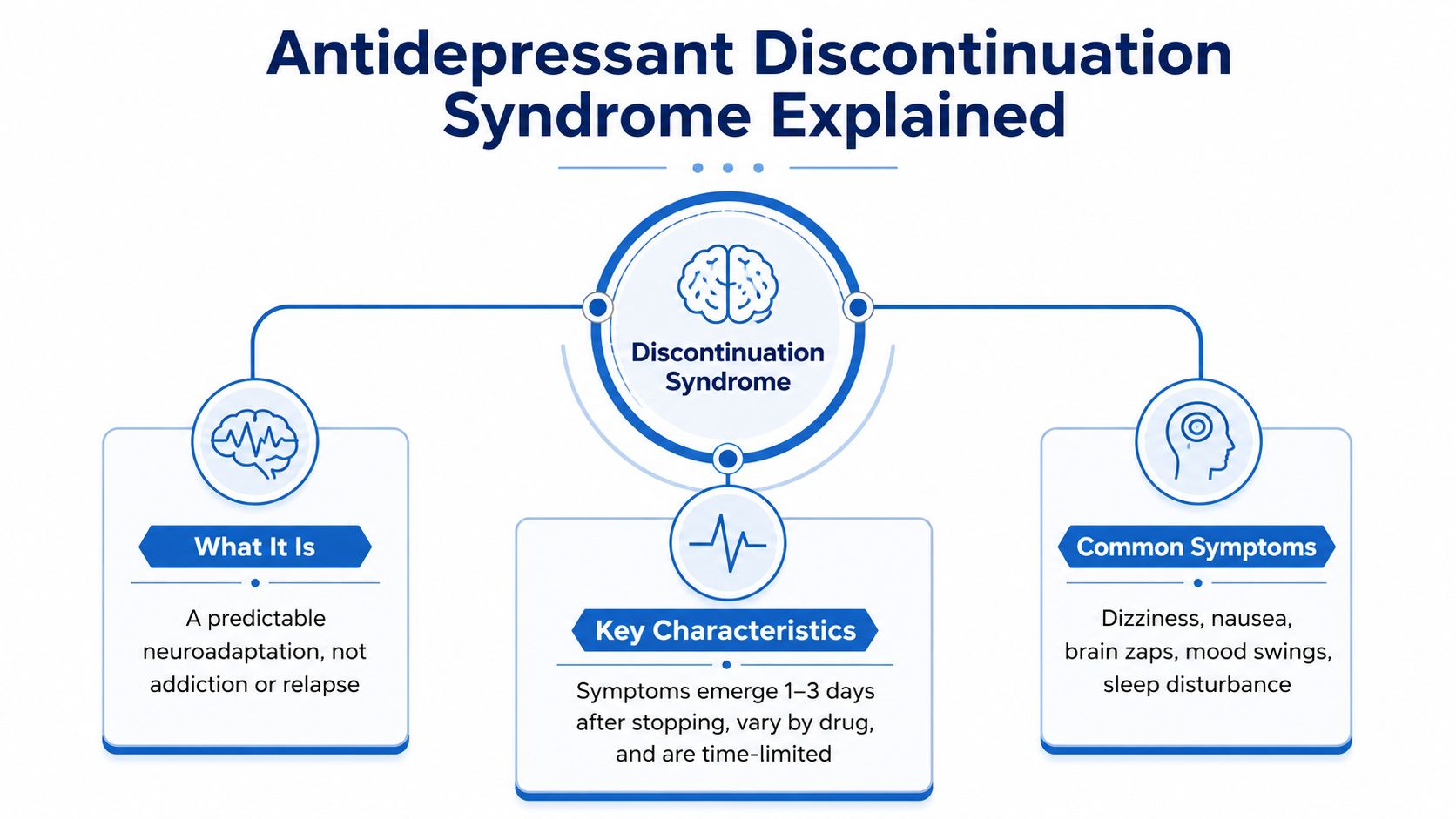
Antidepressant discontinuation syndrome is the nervous system's reaction to a sudden drop in a medication it has adapted to. It is not addiction, and it is not proof that someone is weak or “dependent” in a moral sense. The body has adjusted to a steady signal, then that signal disappears quickly, and the result is a physiologic correction period.
The usual onset is 2 to 4 days after stopping, though some sources note it may begin within a day or two, and symptoms usually last 1 to 2 weeks (Mayo Clinic, American Journal of Psychiatry review via PMC). The earlier the stop and the shorter the half-life, the more likely the symptoms show up fast. In the first week, that timing can feel alarming because it often arrives before people have time to connect the dots.
The symptom pattern clinicians watch for
The symptom clusters are familiar. Sensory symptoms include brain zaps, dizziness, and paresthesia. Gastrointestinal symptoms include nausea and diarrhea. Sleep symptoms include insomnia and vivid dreams. Mood symptoms include irritability, anxiety, and low mood (American Journal of Psychiatry review via PMC).
Here's the part many patients find confusing. Those symptoms can look like the original illness, especially when anxiety or depression was the reason for treatment in the first place. That overlap is exactly why timing matters so much after a dose change.
Withdrawal tends to announce itself with body symptoms first, relapse usually returns as a fuller psychiatric picture that keeps building.
Persistent cases do happen. Most resolve in the usual window, but some people describe a longer tail, which is one reason a rushed restart or a rushed assumption can both go wrong.
For patients who want a medication-specific example, the symptom pattern after escitalopram is often discussed in more detail in this Lexapro withdrawal overview.
Withdrawal Profiles by Drug Class
Not every antidepressant behaves the same way when it's stopped. That's the part consumer articles often flatten, and it's a mistake. The drug class, and often the half-life, changes the risk profile enough that two people who both “stopped antidepressants” may have very different first weeks.
The main classes and how they differ
SSRIs include sertraline, escitalopram, fluoxetine, and paroxetine. SNRIs include venlafaxine and duloxetine. TCAs include amitriptyline and nortriptyline. MAOIs include phenelzine and tranylcypromine. In practice, paroxetine and venlafaxine are the names that tend to come up when withdrawal is roughest, while fluoxetine is usually easier because it stays in the body longer.
Drug Class | Half-Life | Withdrawal Risk | Hallmark Symptoms |
|---|---|---|---|
SSRIs | Varies by agent, fluoxetine is long-acting | Often moderate, but can be significant | Brain zaps, dizziness, flu-like feelings, anxiety |
SNRIs | Often shorter for venlafaxine | Often higher, especially with venlafaxine | Dizziness, nausea, agitation, electric-shock sensations |
TCAs | Variable | Can be significant | Cholinergic rebound, sleep disturbance, GI upset |
MAOIs | Variable, but the clinical issue is broader than half-life | Medically serious because of interaction risk | Withdrawal plus dietary and interaction concerns |
This isn't just a pharmacology exercise. It changes what patients feel in the first week, and it changes how cautious a taper needs to be. A person on long-acting fluoxetine may have a different experience than someone on venlafaxine who misses just a couple of doses.
Class-specific practical takeaways
SSRIs can be deceptively tricky because they're so common. Most patients hear “these are well tolerated,” then assume stopping them will be just as simple. That's not always true, especially with shorter-acting agents.
SNRIs deserve special respect. Venlafaxine in particular has a reputation for abrupt symptom return because even short gaps can be felt quickly. TCAs can cause uncomfortable rebound effects, and MAOIs need the most careful medical oversight because the stakes include more than withdrawal alone.
For a side-by-side discussion of the SSRI and SNRI categories, see SSRI vs SNRI. The point is simple, the pill bottle matters.
Who Is Most at Risk and Why
Risk rises when the nervous system has had more time to adapt. That means months to years of use usually carry more stopping risk than a short trial, and higher doses can make the transition harder. A patient who has already had a difficult withdrawal episode is also much more likely to fear, and sometimes repeat, that experience.
The people who need more caution
The highest-risk scenarios are easy to recognize in clinic. Someone on a short half-life agent like paroxetine or venlafaxine, someone with a history of severe depression or anxiety, someone taking more than one centrally acting substance, and someone with prior withdrawal symptoms all deserve a slower, more deliberate plan. Concurrent benzodiazepine or alcohol use adds another layer of instability.
Life circumstances matter too. Pregnancy, recent suicidal ideation, sudden loss of insurance, and unstable housing all make abrupt stopping more dangerous because the patient has less margin for error. In those situations, the medication issue and the life issue are tied together.
Two brief clinical contrasts
A 34-year-old on sertraline for two years may not feel much on day one, then notice dizziness, irritability, and sleep disruption several days later. A college student on venlafaxine for six months may feel symptoms much faster and may interpret them as panic, illness, or a return of anxiety before realizing they're medication related.
The rule I use is blunt, the more the drug has shaped daily functioning, the less forgiving a sudden stop tends to be.
That doesn't mean every higher-risk patient will struggle. It means the margin for guessing is smaller. A taper plan should reflect the person, not just the prescription.
Safer Alternatives to Stopping Cold Turkey
A safer approach is clinician-supervised tapering, a method your brain can tolerate better than an abrupt stop. In practice, that often means clinician-supervised tapering, and sometimes it means reducing more slowly than patients expect. For long-term users, the timeline may be measured in months, not a couple of weeks, especially when symptoms show up during earlier dose cuts.
What tapering can look like
Some tapers are linear, where each step removes the same amount. Others are hyperbolic, where the later reductions get smaller because the brain often feels those last cuts more sharply. That difference matters because a patient who handles the first few reductions may still struggle near the end.
Precision tools help. Liquid formulations and compounding pharmacies can make small dose cuts more accurate when tablets cannot be split reliably. In more complex cases, a clinician may consider a cross-taper, where one medication is adjusted while another, often longer-acting, medication is introduced or used as a bridge.
The practical goal is not to force the schedule. It is to keep the patient functional enough to keep going. That may mean pausing the taper, repeating a dose step, or reversing a recent cut if symptoms flare.
For patients comparing medication options before a switch, SSRI alternatives can help frame the conversation, but the switch still needs a stopping strategy.
A few clinical guardrails
Consult first: A supervised plan lowers the chance that symptoms get misread or ignored.
Go smaller when needed: If the last step is the hardest one, the answer is often a smaller reduction, not a faster one.
Use the right tools: Liquid dosing or compounding can solve problems that pill splitting cannot.
Escalate the plan, not the panic: If withdrawal shows up, slow down before the situation becomes chaotic.
Withdrawal or Relapse How to Tell in the First Four Weeks
The first month after stopping an antidepressant is where the question shows up in practice. A patient may be dealing with withdrawal, a return of the original illness, or a mix of both. The pattern usually becomes clearer when timing, symptom type, and how the symptoms change over several days are considered together. Abrupt stopping raises both possibilities, so a wrong early assumption can delay the right next step.
A practical decision rule
Withdrawal usually begins within days of the stop or dose reduction. It often brings physical sensations such as dizziness, nausea, electric-shock feelings, flu-like discomfort, and sleep disruption. Relapse more often looks like the original syndrome coming back, with persistent sadness, hopelessness, loss of interest, excessive worry, or the same functional decline that was present before treatment.
The course also matters. Withdrawal often eases day to day, especially if the dose is reinstated or the taper is slowed. Relapse usually persists or deepens. If symptoms are still broadening after the first couple of weeks, that calls for a clinical reassessment, not a guess based on a single bad day.
Same-day contact is warranted if suicidal thoughts, mania-like symptoms, severe agitation, or new psychotic features appear.
A small reinstatement of the prior dose can sometimes clarify the picture, because withdrawal often improves quickly when the medication is restored. That does not mean the person “needs it forever.” It usually means the stop was too abrupt for that nervous system, or that the taper needs to be slower and more deliberate.
Some antidepressants create more diagnostic confusion than others. SSRIs and SNRIs are more likely to produce discontinuation symptoms that begin soon after a dose change, while TCAs and MAOIs can bring a different clinical picture depending on the drug, the dose, and how long it was taken. The practical point is the same across classes. The clinician has to decide whether the problem is a transient medication effect or a return of the underlying disorder, then respond to the course rather than the label alone.
Why the stakes are real
The relapse risk is not theoretical. Harvard Health warns that depression can return if patients stop too soon, and Cleveland Clinic notes that relapse is more common after antidepressants are discontinued than when treatment continues (Harvard Health, Cleveland Clinic). That does not mean nobody should discontinue. It means the stop should be supervised and timed carefully, with enough follow-up to separate withdrawal from relapse.
A comparison chart showing the differences between discontinuation symptoms and a relapse of a medical condition can also help when the presentation is muddy. A comparison chart showing the differences between discontinuation symptoms and a relapse of a medical condition.

How Refresh Psychiatry Can Help With Deprescribing
Stopping safely is a clinical service, not a guess. At Refresh Psychiatry & Therapy, deprescribing is handled through psychiatric evaluation, individualized taper planning, and follow-up that can adjust as symptoms change. The practice also offers integrated medication management and therapy, including CBT, DBT-informed care, and trauma-focused approaches, with statewide telepsychiatry across Florida.
What supervised deprescribing looks like
A good deprescribing visit starts with the medication history, not just the current dose. That includes how long the drug has been used, what happened during past dose changes, and whether the patient has any risk factors that make a slower taper smarter. When useful, pharmacogenomic analysis can also be part of the discussion.
The practical cadence matters too. Follow-up every 2 to 4 weeks after each dose reduction gives enough time to catch early withdrawal, adjust the taper, or pause it before things slide. That's very different from telling someone to “call if needed” and hoping for the best.
Refresh Psychiatry & Therapy is in-network with Aetna, United Healthcare/UHC, Cigna, Blue Cross Blue Shield, Humana, Tricare, UMR, and Oscar insurance plans. For people who want a medication-change plan that's grounded in real follow-up rather than a one-time handoff, deprescribing psychiatrist is a relevant starting point.

If you're considering stopping an antidepressant, don't do it alone, and don't wait until the symptoms are already loud. Refresh Psychiatry & Therapy can help you build a supervised taper plan, monitor the first weeks after each dose change, and decide when to slow down or pause. Contact us or call Refresh Psychiatry at (954) 603-4081 to schedule your evaluation.
This blog is for informational purposes only and does not constitute medical advice. Please consult a qualified mental health professional for personalized guidance.