
Hurricane Anxiety: How to Stay Calm and Safe

The forecast has shifted again. Your water supply is half-stocked, your spouse won't turn off the coverage, and you're scrolling through spaghetti models while wondering whether the next storm could undo everything you've rebuilt. Seventy-two hours before possible landfall, you're already exhausted, and the wind hasn't started.
Hurricane anxiety deserves more than reassurance or a breathing exercise. You need a workable safety plan, a way to recognize when stress needs clinical attention, and access to care that won't disappear when travel becomes difficult.
What Hurricane Anxiety Actually Feels Like
In a Florida household preparing for a storm, anxiety rarely announces itself neatly. One person keeps checking the shutters. Another snaps over a grocery list. Someone lies awake calculating evacuation costs, imagining roof damage, or remembering the last time water entered the house.
Hurricane anxiety describes storm-related fear and distress, not a diagnosis by itself. It can include anticipatory anxiety before landfall, acute fear during dangerous conditions, and prolonged vigilance after the immediate threat has passed. Federal guidance recognizes that disaster-related mental-health effects can be brief or long-lasting and can affect people with or without a prior mental-health condition, as described in the CDC's overview of climate-related mental-health effects.
The Difference Between Preparation and Alarm
Useful worry helps you make a decision. You identify a shelter, arrange transportation, or check whether a prescription needs renewing. Unproductive worry keeps you repeating the same task without gaining information or becoming safer.
For a business owner worried about building damage, Aastro Roofing Company's commercial guide offers a concrete resource for organizing roof-inspection questions. That's a different activity from repeatedly imagining a roof failure without arranging an appropriate professional assessment.
Practical rule: Ask whether your next action changes your safety plan or only briefly relieves uncertainty.
The consequences of severe exposure can be substantial. Following Hurricane Katrina, researchers estimated 30-day anxiety-mood disorder prevalence at 49.1% among New Orleans-area residents versus 26.4% elsewhere in the sample, with PTSD estimates of 30.3% versus 12.5%, respectively, in the Katrina mental-health study.
Those findings don't mean ordinary storm fear is a disorder. Clinically, the important distinction is whether your response remains flexible enough to let you prepare, rest, communicate, and function. Fear before a real threat can be appropriate. Fear that continues controlling your life after useful action is complete deserves closer attention.
How Common Hurricane Anxiety Really Is
Hurricane-related anxiety isn't a character flaw, and its frequency can't be reduced to a single universal rate. Exposure, housing security, prior experiences, assessment timing, and the condition being measured all affect how findings should be interpreted.
After Hurricane Irma, 17% of surveyed Florida Keys residents reported worsening anxiety, and 17% said their household needed a mental-health-care provider during the period assessed; among households reporting that need, 37.9% didn't receive services, according to the CDC's Florida Keys assessment. Recognizing distress and obtaining treatment are separate problems.
Hurricane-Related Mental Health Outcomes by Event
Study | Population | Anxiety or Mood Prevalence | PTSD Prevalence | Time Frame |
|---|---|---|---|---|
Hurricane Katrina study cited above | New Orleans-area residents and residents elsewhere in the sample | Anxiety-mood disorders were more prevalent in the New Orleans group | Higher in the New Orleans group | Post-storm assessment of recent symptoms |
Hurricane Irma assessment cited above | Florida Keys residents | Worsening anxiety was reported, rather than a diagnostic prevalence estimate | Not specified in the cited findings | Recovery period following the storm |
These aren't interchangeable measurements. Worsening anxiety isn't the same as a diagnosed anxiety disorder, and an anxiety-mood category isn't an anxiety-only estimate.
A systematic review of disaster-related mental-health conditions found anxiety-related conditions across all 22 included studies, with reported prevalence ranging from 2.2% to 84%. That wide spread reflects different disasters, populations, measures, and assessment times, not a dependable prediction for an individual Floridian.
Use your circumstances to guide the intensity of your follow-up, not to assign yourself a diagnosis:
Personal factor | Question to ask yourself |
|---|---|
Prior storm exposure | Does this forecast bring back distressing memories? |
Displacement history | Am I worried about losing housing again? |
Current stress load | Are finances, caregiving, or work already stretching my capacity? |
Social support | Who can help with decisions and practical tasks? |
Psychiatric history | Are familiar symptoms returning or becoming harder to manage? |
The useful conclusion isn't that everyone exposed will become ill. It's that support should match the person's circumstances, including practical barriers that make getting help difficult.
When Worry Crosses Into a Clinical Concern
Start with safety, not a questionnaire. Someone facing flooding, an unsafe building, missing essential medication, or an urgent medical problem needs practical intervention before a detailed anxiety assessment.
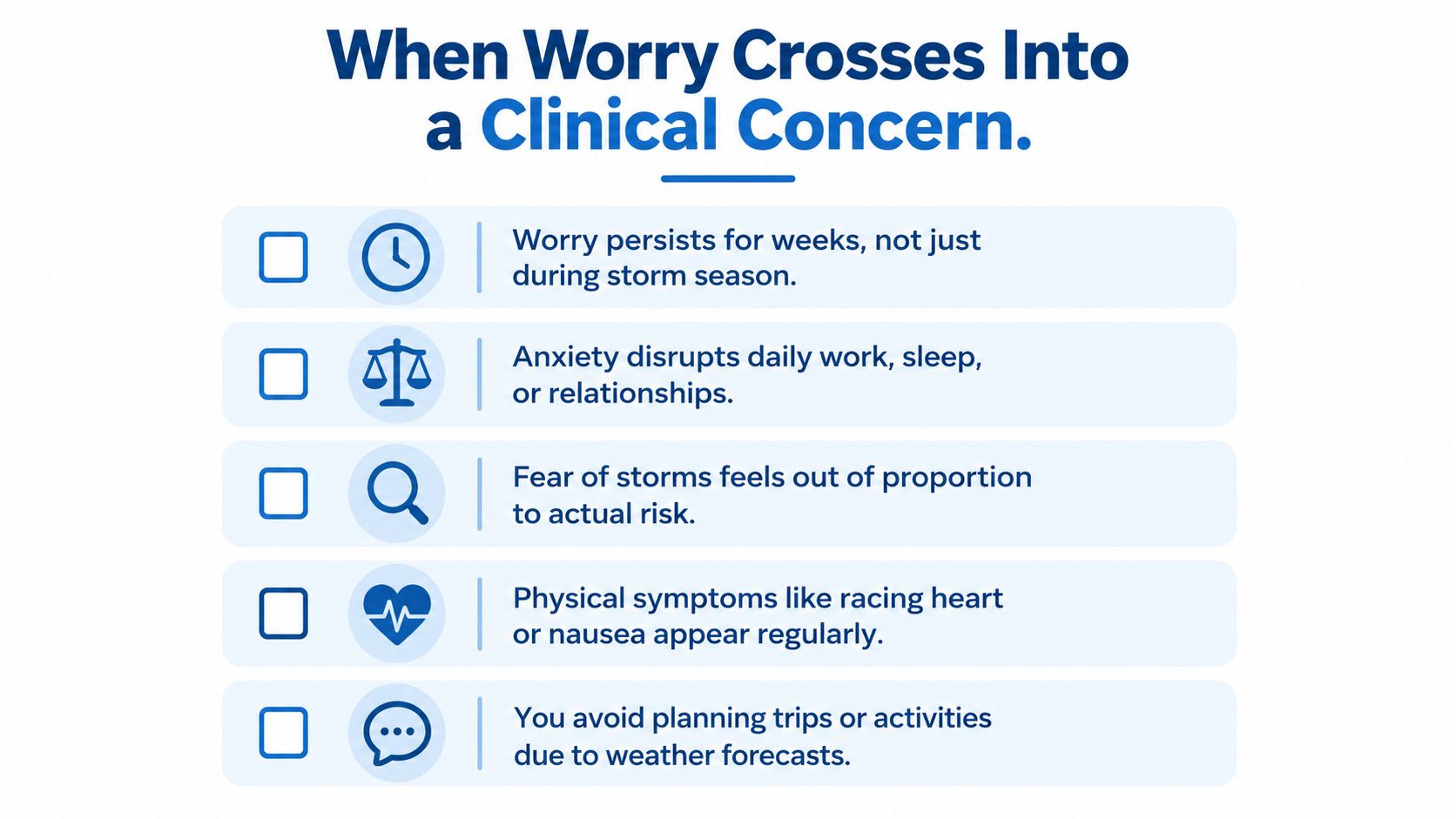
Once immediate needs are addressed, assess duration, functional impairment, sleep, panic, avoidance, substance use, suicidal thoughts, and psychiatric history. An anxiety symptom checklist can help organize what to discuss, but it can't establish a diagnosis.
The following checklist highlights patterns worth bringing to a clinician.
Use Screening to Guide a Conversation
A practical assessment can proceed through these steps:
Establish a baseline. Describe what has changed from your usual sleep, concentration, relationships, and daily responsibilities.
Screen for generalized anxiety. A clinician may use the GAD-7 alongside an interview, rather than treating its score as a diagnosis.
Assess trauma symptoms when relevant. After threat, injury, displacement, or loss, ask about a PTSD-specific instrument such as the PCL-5.
Look beyond anxiety. Depression, substance use, and other psychiatric symptoms need attention too.
Make a follow-up plan. Decide when symptoms and functioning will be reassessed, including what would trigger an earlier appointment.
Repeated assessment matters. In a cohort of 438 low-income mothers, psychological distress rose from 23.95% before the hurricane to 35.16% at one year; PTSD prevalence was 43.84% at one year, 31.96% at 3–4 years, and 16.67% at 10–12 years, as reported in the longitudinal hurricane mental-health evidence.
Those figures describe that cohort, not your personal prognosis. They do explain why an apparently reassuring early check-in shouldn't be the only assessment.
Don't wait for an arbitrary anniversary if you can't function, symptoms are worsening, or you feel unsafe.
Seek a prompt appointment for persistent insomnia, escalating panic, worsening depression, or avoidance that prevents necessary activities. Suicidal intent, inability to remain safe, or severe psychiatric deterioration requires urgent local emergency evaluation, not a routine telehealth booking.
Skills That Calm You Down Before, During, and After the Storm
Preparedness and psychological skills belong together. Breathing won't solve an evacuation problem, and a full supply kit won't necessarily settle trauma symptoms.
A randomized trial in disaster-affected Haitian communities combined preparedness with psychosocial support delivered by local lay workers over three days; participants had fewer anxiety, depression, and PTSD symptoms than controls, with anxiety findings reported at p < 0.001, in the preparedness-plus-mental-health intervention trial. The study supports an integrated approach, not a claim that any single breathing technique treats hurricane anxiety.
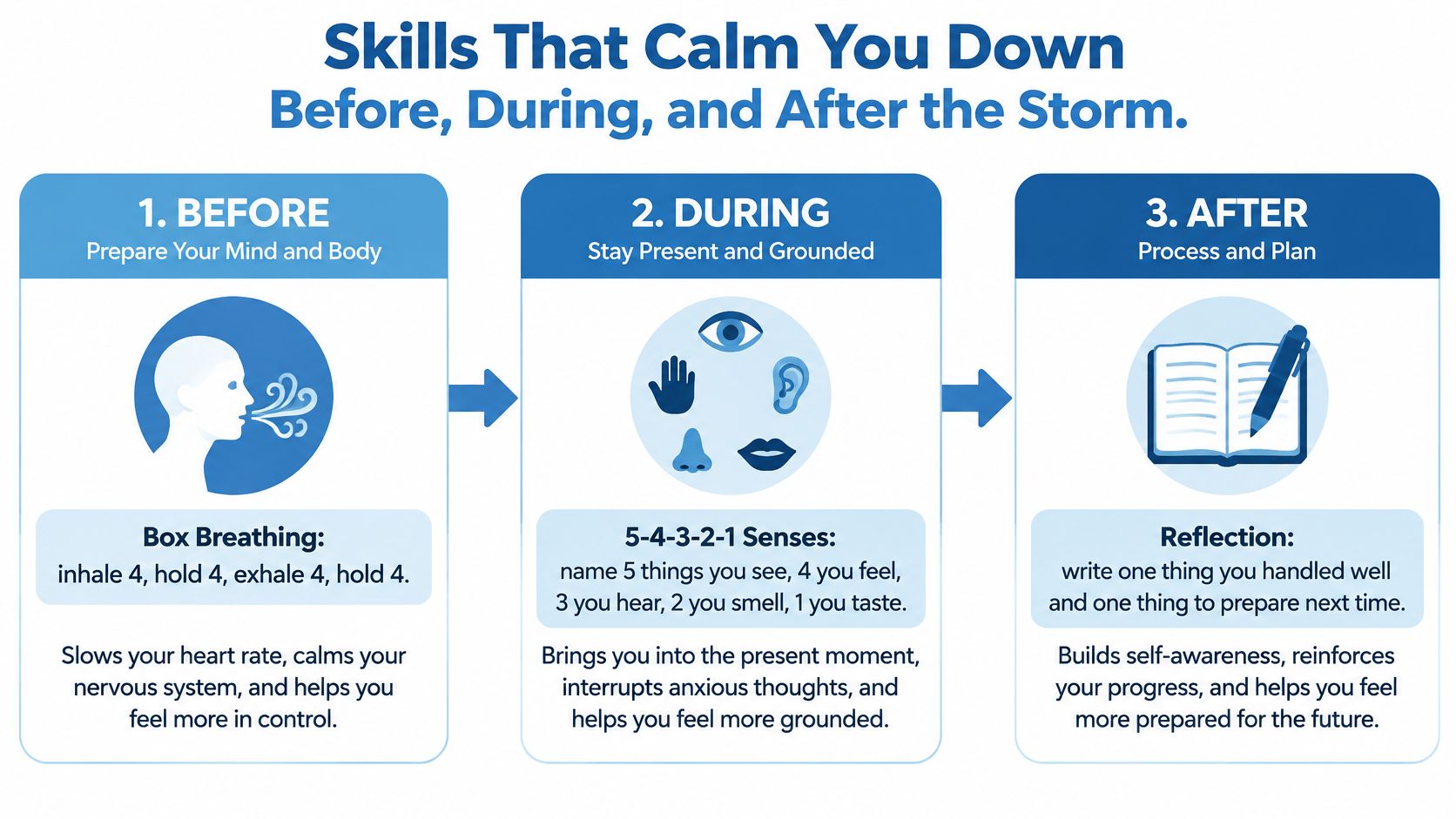
This visual provides a reminder of skills to practice when conditions are safe.
Match the Skill to the Problem
Paced breathing for a surge. A parent in a shuttered home can breathe gently and slowly while keeping attention on the room. Don't force oversized breaths or uncomfortable breath holds.
Grounding for hyperarousal. Try the 5-4-3-2-1 exercise: identify five things you see, four you feel, three you hear, two you smell, and one you taste. These grounding techniques are attention exercises, not a substitute for responding to danger.
Sleep protection during recovery. A healthcare worker between long shifts may need help with childcare, a quieter resting space, and a clear handoff of responsibilities more than another relaxation app.
Graded re-engagement after safety returns. A retiree shaken by a neighbor's roof damage might restart with a familiar indoor activity, then resume safe outings gradually. Don't confuse therapeutic re-engagement with entering hazardous areas.
For readers who already draw comfort from faith, Scroll With God's biblical meditation techniques for beginners can provide an optional reflection practice. Spiritual support can accompany clinical care without replacing it.
Use video material as an optional practice aid, not as an instruction to ignore evacuation or safety needs.
The practical test is whether a skill helps you return to a necessary task or restorative activity. Feeling perfectly calm isn't required.
When Self-Help Is Not Enough and Professional Care Makes the Difference
Self-management isn't sufficient when you're repeatedly missing work, unable to sleep, or organizing your life around avoiding storm reminders. You don't need to prove that you've exhausted every coping strategy before requesting an evaluation.
Environmental exposure also deserves consideration. Compared with adults in the lowest hurricane-risk quartile, those in the highest had an anxiety prevalence ratio of 1.24, with intermediate ratios of 1.07 and 1.14, and a PTSD prevalence ratio of 2.29, with a 95% confidence interval of 1.74–3.01, in a large epidemiologic hurricane-risk study. These are associations, not proof that exposure alone causes an individual's symptoms.
Choose Care Around the Main Impairment
Therapy is a reasonable starting point when worry, checking, or avoidance persists. Ask whether the treatment will include CBT skills, DBT-informed distress tolerance, or another approach matched to your difficulties, with specific goals beyond talking about the storm.
Psychiatric evaluation becomes especially useful when symptoms substantially interfere with sleep, work, or safety, persist beyond two weeks, or occur alongside a complicated psychiatric history. That timeframe is a practical appointment trigger, not a diagnostic rule or a reason to delay help for severe symptoms; this guide to when to see a psychiatrist can help prepare your questions.
Main concern | What to ask about |
|---|---|
Trauma reminders, nightmares, or avoidance | Whether trauma-focused treatment such as prolonged exposure, EMDR, or cognitive processing therapy fits |
Persistent insomnia | Whether CBT for insomnia should be part of the plan |
Broad worry and repeated reassurance-seeking | A structured formulation and targeted therapy goals |
Medication disruption | A prescriber-led continuity and refill plan |
CBT for insomnia targets sleep; it isn't interchangeable with trauma-focused treatment. Supportive counseling may provide valuable connection, but ask how treatment will address the symptoms preventing recovery.
Don't start, stop, or adjust benzodiazepines, sleep aids, SSRIs, or stimulants without your prescriber. Telepsychiatry can support continuity when roads are inaccessible, provided you have a safe location and a workable connection. Tell the clinician where you're physically located after evacuation so they can confirm whether care can proceed.
Helping Children and Teens Weather the Storm Inside the Storm
A young child may complain of stomach pain rather than say they're frightened. A teenager may insist everything is fine while staying awake, withdrawing from friends, or falling behind academically. These examples are illustrative, not evidence that every such change comes from hurricane anxiety.
SAMHSA's hurricane and tropical-storm guidance identifies concerns including fear of another storm, increased dependence on caregivers, eating or sleeping changes, headaches, and stomachaches. Youth disaster research summarized in the supplied evidence found anxiety in 42% of reported outcomes, but that combines varied disasters, populations, and study designs and isn't a universal hurricane rate.
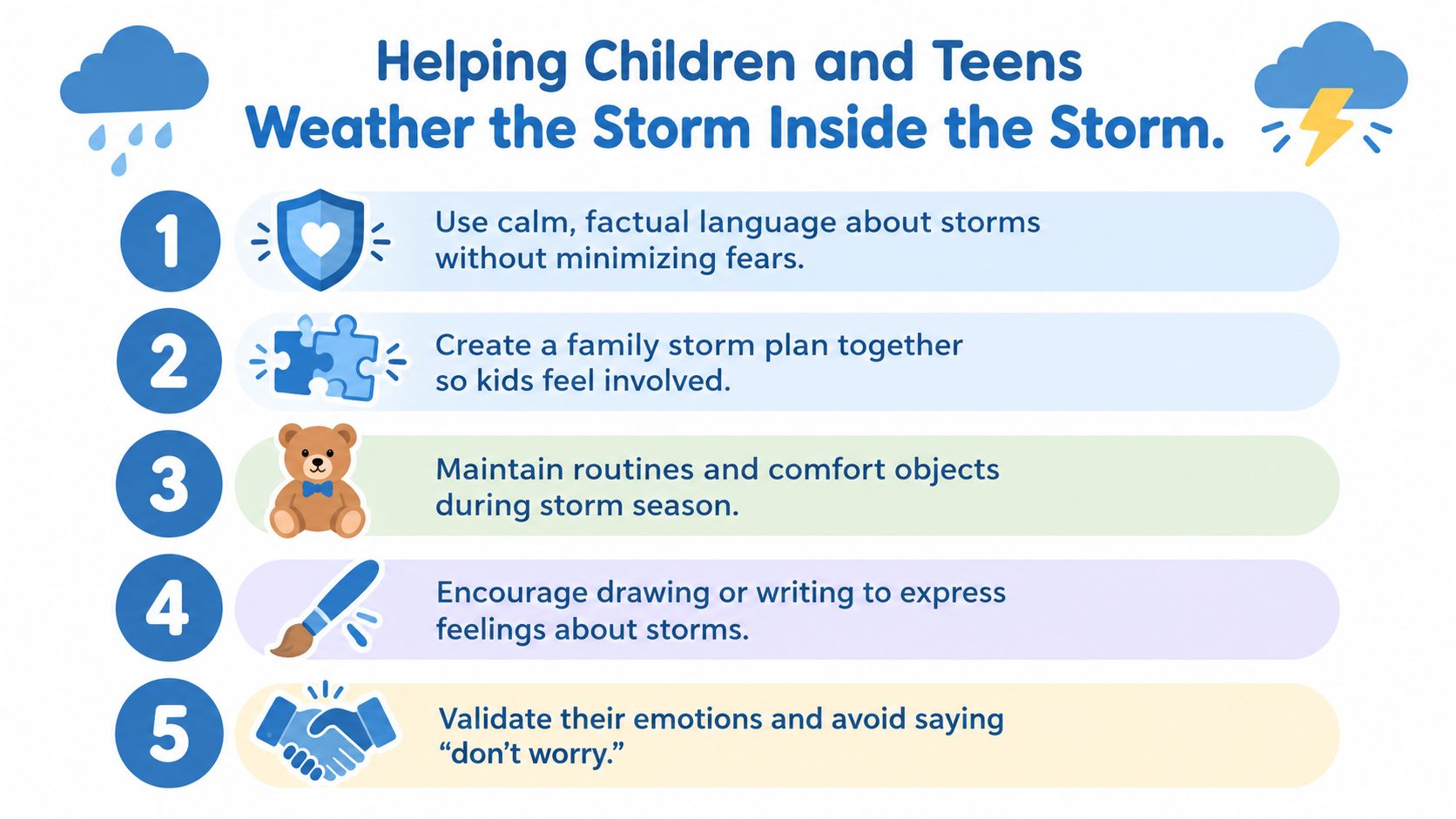
Use these reminders to keep your response calm and concrete.
Watch Functioning Over Time
The following is a suggested family monitoring schedule, not a diagnostic timetable:
At 24 hours, notice acute distress, clinginess, regression, and immediate needs for comfort and safety.
At one week, review sleep, school participation, and repeated reassurance-seeking. Coordinate with teachers rather than assuming refusal is misbehavior.
At one month, assess ongoing irritability, academic decline, withdrawal, or new substance use in adolescents. Seek help sooner when impairment is significant.
Tell the Truth at Their Level
For ages 4–7, try: “The wind may be loud. We're following our safety plan, and I'll tell you what we're doing next.”
For ages 8–12, explain: “The forecast can change. Your job is to pack your comfort items; adults will handle the safety decisions.”
For ages 13–18, invite participation without assigning adult responsibility: “Let's agree on reliable updates and what would change our plan. You don't have to monitor everything.”
These are suggested scripts, not quotations from research. Avoid promising that nothing bad can happen or repeatedly replaying alarming footage.
A child who seemed calm at landfall still deserves later check-ins. If returning to class becomes difficult, use school-anxiety guidance alongside communication with the school and pediatrician. A child psychiatrist, trauma-focused therapist, or family therapist can assess persistent problems, including through Florida telepsychiatry when appropriate; suicidal thoughts or serious safety concerns require urgent evaluation.
Your Three-Phase Hurricane Anxiety Action Plan
Keep this plan with your hurricane supplies. It's a suggested workflow, not a substitute for local emergency instructions or individualized medical guidance.
Seventy-Two Hours Before Possible Landfall
Confirm logistics. Review evacuation arrangements, transportation, shelter options, medications, and who needs assistance. Don't wait for this window if officials advise earlier action.
Close practical gaps. Use JA Edwards of America Roofing's checklist for hurricane roof safety to organize questions before hazardous conditions arrive. Leave roof access and repairs to qualified professionals.
Assign communication roles. Decide who follows official updates and how family members will share changes. Use planned information windows while keeping emergency alerts available.
Record your baseline. Note current sleep, functioning, and any symptoms you want to discuss with your clinician.
During the Storm and Immediate Aftermath
Follow safety directions first. Use the breathing and grounding practices already described only when doing so won't distract from urgent action.
Delegate tasks where possible, keep essential medication accessible, and identify a backup contact method for your care team. If connectivity fails, don't assume a virtual appointment can meet an urgent medical or psychiatric need.
Through the Thirty-Day Recovery Window
Revisit your symptom notes and the family monitoring plan. If symptoms persist beyond two to four weeks, arrange follow-up; seek help earlier for deterioration, substantial impairment, or safety concerns.
A quiet visual can serve as a pause between recovery tasks, without implying that you should already feel recovered.

For Florida telepsychiatry, verify your physical location, device access, privacy, and follow-up arrangements before the appointment. We accept Aetna, United Healthcare/ UHC, Cigna, Blue Cross Blue Shield, Humana, Tricare, UMR, and Oscar insurance plans. Confirm your specific network benefits, deductible, copay, and any authorization requirements rather than assuming plan acceptance guarantees payment.
This blog is for informational purposes only and does not constitute medical advice. Please consult a qualified mental health professional for personalized guidance.
Refresh Psychiatry & Therapy offers psychiatric evaluations, medication management, and therapy through a telemedicine-only practice serving adults, children, and adolescents across Florida. If hurricane anxiety is disrupting your sleep, responsibilities, or recovery, visit the practice online to discuss coordinated care. Contact us or call Refresh Psychiatry at (954) 603-4081 to schedule your evaluation.